Lookback Archive / Stock Stories
Lookback: TITAN's 2025 winter slide,how jewellery demand wobbled and the stock corrected 12%
Lookback: TITAN's 2025 Winter Slide, and the Twelve Percent the Tape Quietly Took Back
Between late January and late March 2025, the Tata jewellery franchise lost roughly an eighth of its market cap as gold ran hot, weddings underwhelmed, and the chart broke every support the optimists had pencilled in.
Caption: TITAN weekly timeframe around 2025-03-12.
Caption: TITAN daily timeframe around 2025-03-12.
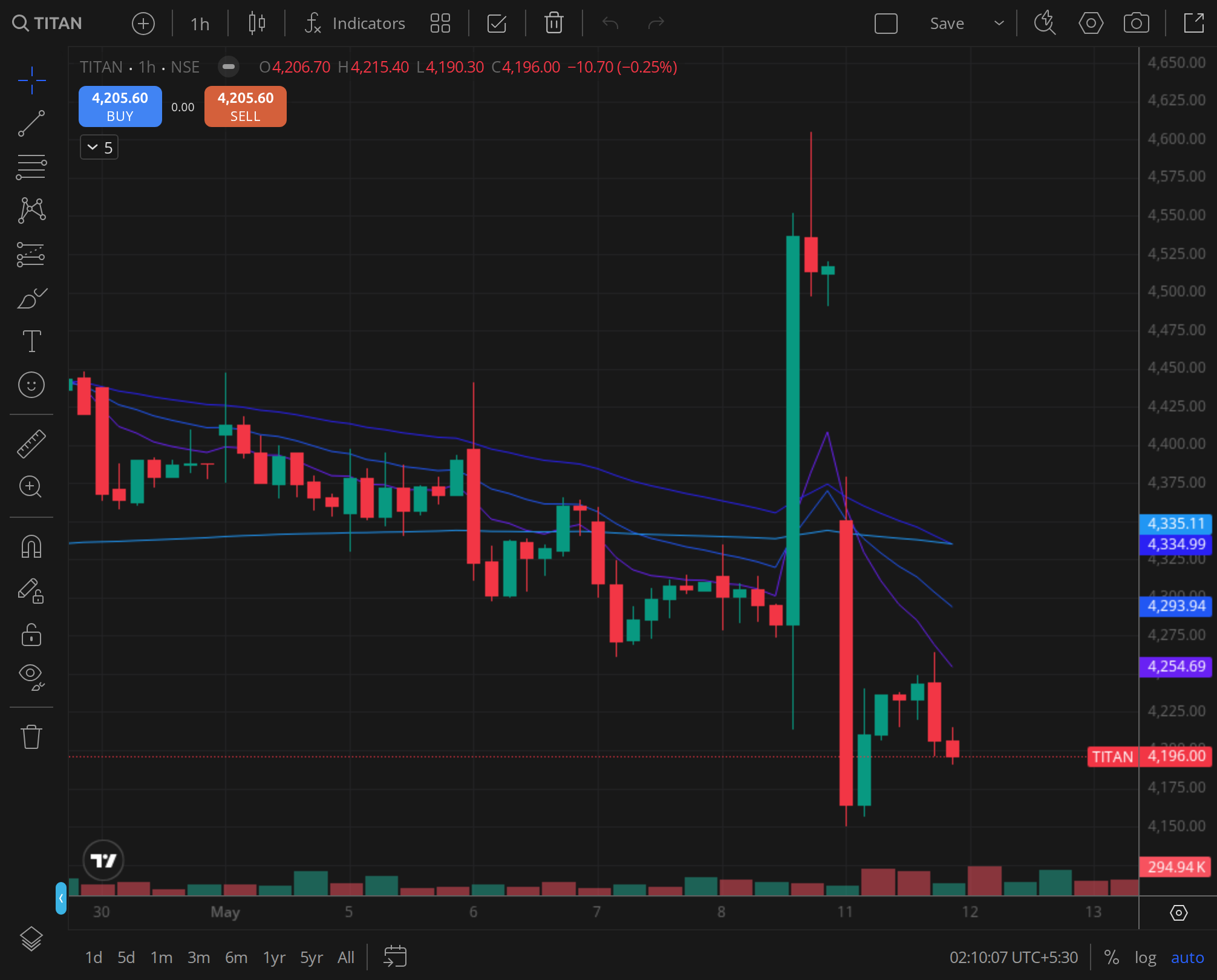
Caption: TITAN 30min timeframe around 2025-03-12.
The first warning came not from the tape but from the metal. Gold, priced in rupees, had been climbing through the second half of January 2025, and by the time TITAN entered the Republic Day week at the upper end of its three-month range, the math on jewellery margins had already started to bend. Anyone who covered the consumer-discretionary basket on the NSE knew the script. When the underlying commodity that the company sells by the gram appreciates faster than the consumer's willingness to pay, the studded-ratio drops, the making-charge cushion compresses, and the same-store growth print that the buy-side spreadsheets depend on starts looking like a story the management has to apologise for, not advertise.
By the focus date of this Lookback, March 12, 2025, TITAN had given up over twelve percent from its late-January high. The 50-DMA, which had acted as a polite floor for most of the previous calendar year, had been broken decisively on rising volume. The 200-DMA, the line the long-only crowd actually watches, had been tested twice in early March and lost on the second visit. For a stock that institutions had treated as a defensive compounder for the better part of five years, the price action between January 26 and March 27 was not a wobble. It was a re-rating, quiet but complete, and the two weeks after March 12 offered nothing that resembled relief.
The technical map: a clean break of a long uptrend
On the weekly frame, TITAN had been respecting an ascending channel since the post-COVID reset. The lower rail of that channel, drawn off the March 2023 and October 2023 lows, had absorbed every meaningful pullback for almost two years. The week ending March 7, 2025, was the first weekly close convincingly below that rail in the lookback window. The week ending March 14 confirmed it with a lower low. There was no hammer, no rejection wick, no rescue candle. A long-duration trend that had asked very little of its holders had finally asked a question, and the answer, mechanically, was lower.
On the daily, the moving-average stack inverted in stages. The 20-DMA crossed under the 50-DMA in the second week of February 2025. The 50-DMA started rolling over by month-end. By March 12, price was trading below all three of the 20, 50, and 200-DMA, and the 200-DMA itself had flattened, a condition that quantitative trend filters typically treat as an exit signal rather than a buying opportunity. Volume behaviour told the same story. The down days through February and early March were heavier than the up days, a textbook distribution signature without the textbook needing to be opened.
The intraday tape on the focus day itself, mapped on the 30-minute chart, was instructive in its lack of drama. There was no panic opening gap, no climactic capitulation candle. The session opened soft, drifted lower through the morning, attempted a tepid mid-day bounce that failed under the previous day's VWAP, and faded into the close. Volume was concentrated in the first and last hour, a pattern that suggested institutional rebalancing rather than retail puke. The week leading into March 12 had a similar character. The session structure was orderly, the selling persistent, and the buyers conspicuously absent at every level that a chart-reader would have marked as a likely defence.
The fundamental backdrop: gold, weddings, and the studded-ratio problem
The fundamental layer underneath this slide was not a mystery. The Q3 FY25 update that TITAN had filed in early January had already flagged what the management called a moderation in growth versus the previous year's high base. Jewellery revenue had grown, but the composition had shifted toward plain gold, which carried thinner margins than the studded and solitaire pieces that the analyst community spent most of its time modelling. The buyback of stock through gold-exchange schemes had risen as a share of the mix, another structurally negative input for margin. None of this was secret. Most of it had been disclosed by the company itself.
What the market spent January and February reassessing was the second derivative. If the wedding season, traditionally a strong tailwind from January through March in the southern and western markets, was tepid, then the operating leverage that the buy-side had built into FY26 estimates was going to fall short. The trade channel was reporting weaker footfalls. Gold price volatility, on its own, was depressing consumer purchase decisions, a phenomenon that the jewellery industry had documented across multiple cycles. Customers tended to postpone, not abandon, but a postponement that lands in the next fiscal year is a downgrade for the analyst whose model ends in March.
Peer behaviour reinforced the read. Kalyan Jewellers, which had been the high-beta proxy for the same trade for most of 2024, had corrected more sharply than TITAN through February. Senco Gold had been even weaker. The relative performance of TITAN versus its smaller peers was less damaged, which fit the long-running narrative that the Tata jewellery brand carried a quality premium, but the absolute direction across the sub-sector was uniformly lower. Sector breadth had turned, and a single-stock thesis was always going to struggle against that current.
Sentiment: derivatives showed the buy-side leaning out, not in
The F&O picture in the week of March 12, 2025, was a useful tell. Open interest in TITAN futures had been building on declines through the second half of February, which on its own was ambiguous. The clarification came from price. Rising OI with falling price is the signature of short build-up, not long accumulation. The option chain reinforced this. Put open interest at the 3,200 and 3,100 strikes had grown faster than call OI at the 3,400 and 3,500 strikes, indicating that the market was paying up for downside protection rather than for upside lottery tickets. Implied volatility had ticked up from the early-January floor without spiking, again consistent with a controlled distribution rather than a panic.
Brokerage flow through the window was uncharacteristically mixed for a stock that had spent most of the previous twenty-four months on consensus buy lists. There were no outright downgrades to sell from any of the larger domestic or foreign houses in the window, but several research desks trimmed target prices and qualified their language. The phrase that recurred in client notes was near-term margin pressure, which was the polite framing of what the price had been signalling for six weeks. FII derivative positioning in the broader auto-and-consumer basket had also lightened through February and early March, which was the structural backdrop against which a single name like TITAN was being sold.
Historical analog: the muscle memory of 2018 and late 2019
For anyone who had traded TITAN through more than one cycle, the setup carried echoes. The late-2018 correction, driven by a different set of inputs but with the same gold-price-and-discretionary-softness combination, had produced a similar weekly breakdown that resolved with a sideways base of roughly three to four months before the next leg up. The late-2019 wobble, before the pandemic rewrote every chart, had been shallower but structurally similar. In both prior cases, the stock had not bottomed on the breakdown candle. It had bottomed weeks later, after a period of dull, range-bound action that wore down the dip-buyers. The 2025 setup, viewed through that lens, did not look like a buyable correction at March 12. It looked like the front end of a base that had not yet been built.
The qualitative read on the brand and the franchise had not changed. TITAN remained the dominant organised jewellery play in a market where the unorganised sector continued to lose share, and the long-duration thesis about formalisation and premiumisation was intact. The cyclical question, however, was whether the next two quarters of operating performance would justify the multiple at which the stock had been trading in January. The market's answer, paid for in twelve percent of market cap, was that they would not.
Was the move justified, and what came next
Looking back from May 2026, the March 2025 correction reads as a textbook revaluation rather than a panic. The stock did not break on a single bad print. It broke on the slow accumulation of evidence that the FY26 setup was going to be harder than the FY25 exit price implied. The five-day forward read from March 12 was, predictably, more of the same. By March 19, the stock had made fresh lows. By March 27, it was still below the 200-DMA with no reclaim attempt that mattered. The base that the price-action analogs had hinted at took its time to form, and the patient money that waited for it was rewarded more than the brave money that tried to catch March 12.
VERDICT
Stance: BEARISH (as of March 12, 2025, with the benefit of hindsight) Horizon: 5d / 1mo Rationale: A weekly trend break confirmed by daily MA inversion, distribution-style volume, short-build OI signature, and a fundamental setup of gold-price stress plus weak wedding footfalls. The next two weeks delivered lower lows, validating the technical and sentiment read.
Aditya Sharma