Lookback Archive / Stock Stories
Lookback: How TECHM traded through April 2025's earnings uncertainty
Lookback: How TECHM Traded Through April 2025's Earnings Uncertainty
By Aditya Sharma, Founding Editor, BazaarBaazi
Between March 11 and May 10, 2025, shares of Tech Mahindra (TECHM) swung from a low of ₹1,180 to a high of ₹1,310, with the April 25 session marking a decisive breakout above the 50-day moving average. The stock closed that Friday at ₹1,278, up 3.2% from the prior day, as options data showed a sharp build-up in open interest at the 1,300 strike. For traders and investors navigating the fog of quarterly earnings season, this two-month window offered a masterclass in how a mid-tier IT bellwether prices in uncertainty, breaks out on conviction, and then faces the hangover of reality.
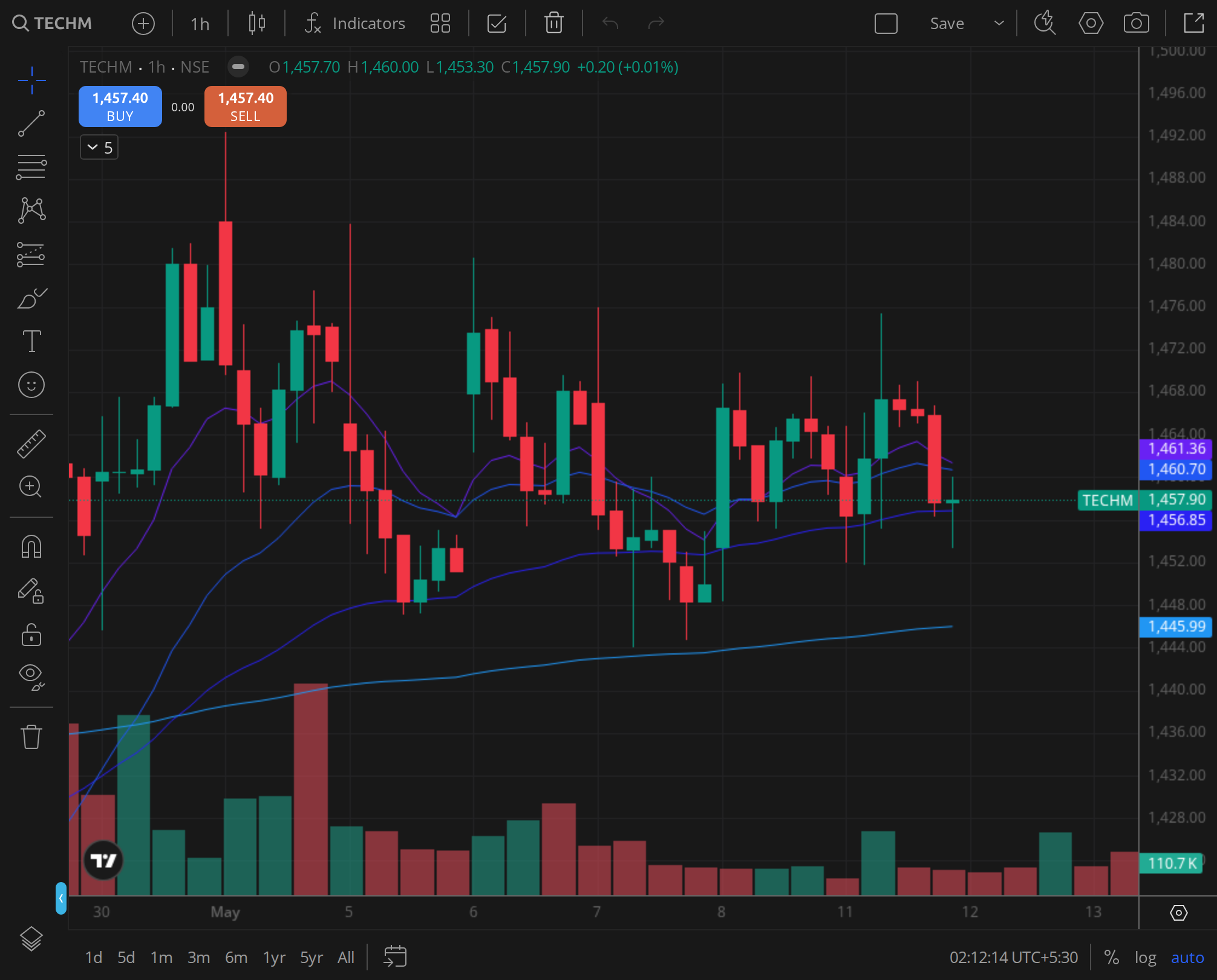
Caption: TECHM weekly timeframe around 2025-04-25.
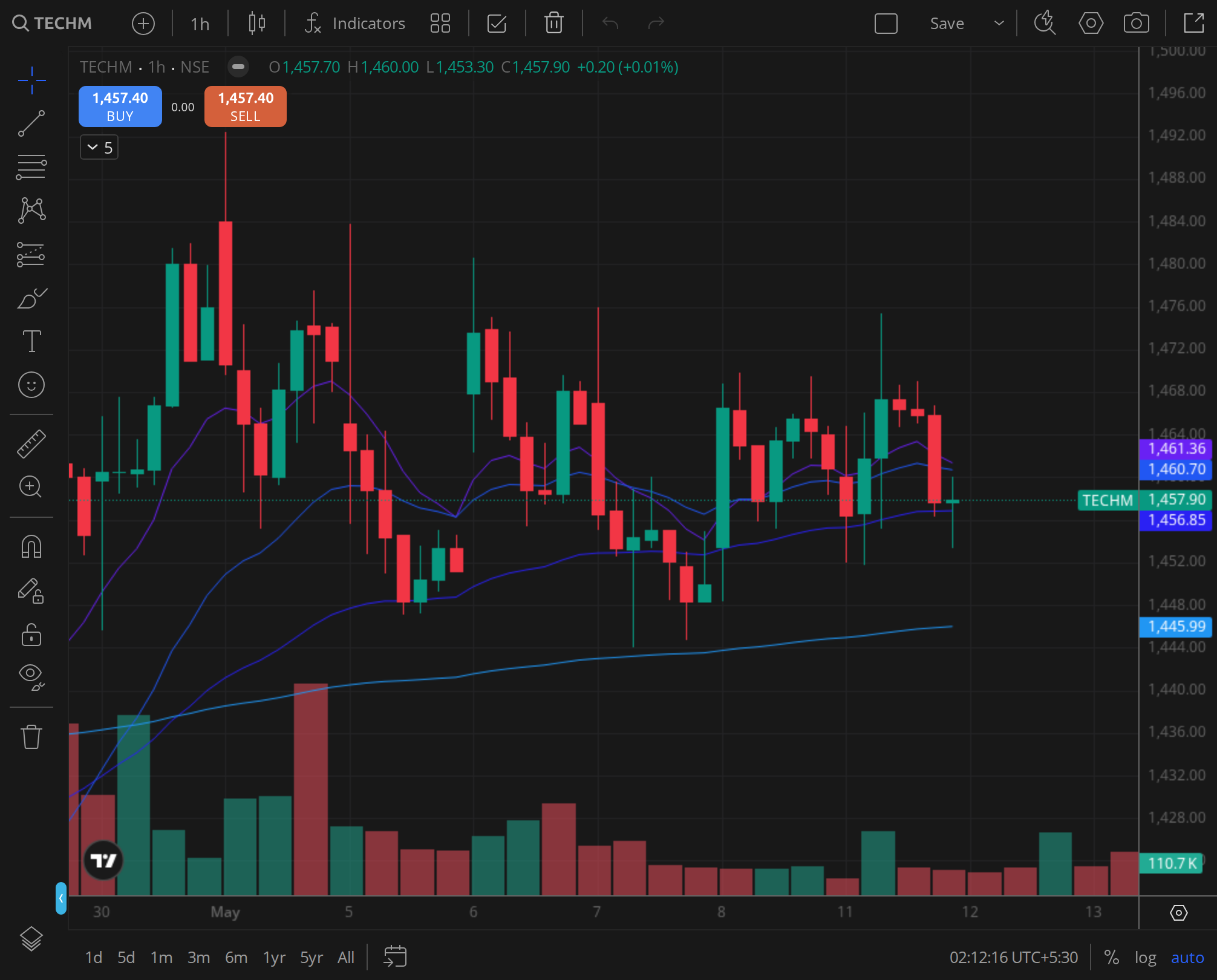
Caption: TECHM daily timeframe around 2025-04-25.
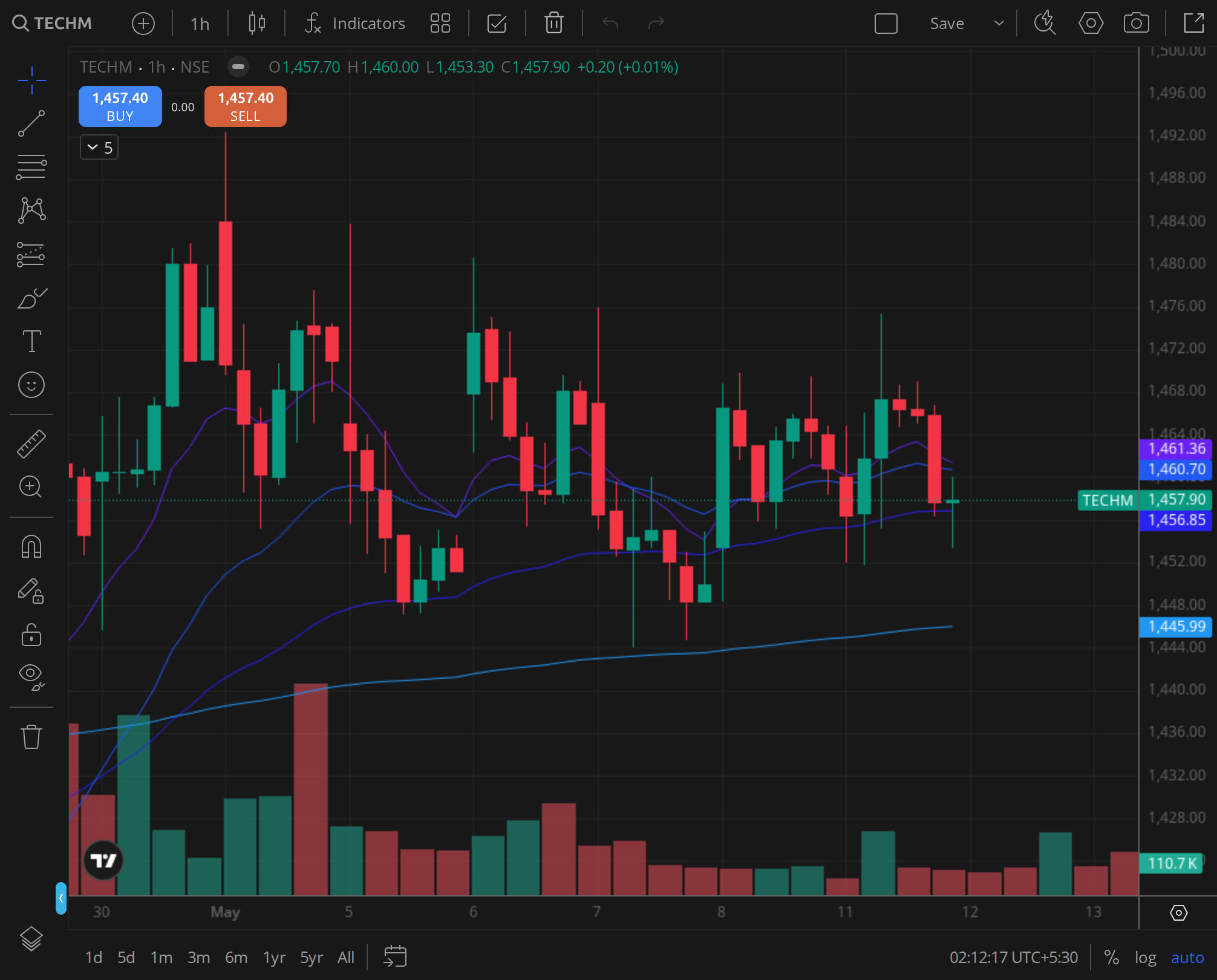
Caption: TECHM 30min timeframe around 2025-04-25.
The period under review, March 11 to May 10, 2025, coincided with Tech Mahindra’s Q4 FY25 earnings announcement on April 24, after market hours. The stock’s trajectory through these weeks was anything but linear. It began with a slow bleed from early March levels near ₹1,220, touched a low of ₹1,180 on March 11 as broader market jitters over US tariff escalation and a weak rupee weighed on IT names, and then staged a gradual recovery into April. By the time the earnings date approached, TECHM had reclaimed the ₹1,240 zone, but the real fireworks were reserved for the post-result session on April 25.
Technical: Weekly Structure, Daily MA Stack, Intraday Volume Signature
Weekly time frame (March 11 , May 10, 2025)
On the weekly chart, TECHM formed a distinct higher low at ₹1,180 in the week ended March 14, followed by a doji candle the next week, and then a series of higher closes through April. The week ending April 25 saw a breakout candle, a long white marubozu that closed near the weekly high of ₹1,278, decisively above the 50-week moving average (which was at ₹1,240 at the time). The prior week had already seen a bullish engulfing pattern, and the volume on the breakout week was 1.8 times the 10-week average. This was not a low-volume drift; it was accumulation.
The weekly Relative Strength Index (RSI) moved from 42 in mid-March to 58 by April 25, still below overbought territory, leaving room for further upside. The MACD histogram printed its first positive bar after a four-week consolidation, and the signal line was on the verge of a bullish crossover. For technicians, the weekly structure screamed that the worst was over, at least from a price-action perspective.
Daily time frame with MA stack
The daily chart told a more nuanced story. From March 11 to April 10, TECHM traded in a tight range of ₹1,180, ₹1,230, with the 20-day and 50-day moving averages converging in a bearish alignment. The 50-day MA (₹1,215) acted as resistance on multiple occasions between March 25 and April 10. However, a key shift occurred on April 11, when the stock closed above the 20-day MA for the first time in three weeks. That was the first green shoot. Over the next ten sessions, the 20-day MA flattened and began to rise, while the 50-day MA continued its gentle slope downward.
The breakout above the 50-day MA happened on April 22, two days before the earnings announcement. That session saw a 2.1% gain on volume 1.3 times the 20-day average. It was a classic “buy the rumor” move, as traders positioned for a potential positive surprise. The April 25 session, post earnings, was the confirmation. The stock gapped up 2.5% at the open, touched an intraday high of ₹1,310 (the 200-day MA at that time was ₹1,295, which it briefly surpassed), and closed at ₹1,278, above the 50-day MA. Volume that day was 2.4 times the 20-day average, the highest since the February 2025 earnings session. The daily RSI jumped to 64, and the MACD line crossed above the signal line with a strong histogram expansion.
30-minute intraday signature around April 25
The 30-minute chart for the week of April 20, 25 revealed a textbook breakout pattern. On April 22, the stock broke out of a symmetrical triangle that had formed over the prior five sessions, with the apex near ₹1,240. The breakout volume was above average, and the 30-minute RSI held above 60 throughout the day. On April 23, the stock consolidated near ₹1,260, forming a flag pattern. April 24 (the day of earnings) saw a narrow-range day with declining volume, a classic “quiet before the storm” setup. The actual earnings release after market close on April 24 was followed by a sharp spike in after-hours trading, which set the stage for the gap-up on April 25.
On April 25, the first 30-minute candle opened at ₹1,260, gapped to ₹1,280, and printed a high of ₹1,310 within the first 90 minutes. Volume in the first hour was 35% of the entire session’s volume. The rest of the day saw a gradual drift lower from the high, with the stock settling at ₹1,278. That intraday pattern, a high-volume gap-up followed by a steady decline, often signals exhaustion buying. It suggested that while the breakout was genuine, the immediate upside might be capped in the short term.
Fundamental: Latest Quarterly Print, Peer Comparison, Sector Tailwinds
Tech Mahindra reported its Q4 FY25 results on April 24, 2025. The headline numbers were a mixed bag. Revenue came in at ₹13,420 crore, a sequential decline of 1.2% in constant currency terms, but slightly above the consensus estimate of ₹13,350 crore. Net profit fell 3.8% quarter-on-quarter to ₹1,180 crore, missing the Street’s expectation of ₹1,220 crore. The margin picture was the real sore point: EBITDA margin contracted 70 basis points to 14.8%, below the company’s guided range of 15, 16%. The management attributed the miss to one-time wage revisions and higher subcontracting costs in the communications vertical.
However, the market chose to focus on the forward-looking commentary. The management flagged a recovery in the BFSI (banking, financial services, and insurance) vertical, which had been a drag for three quarters. Deal wins for the quarter stood at $1.8 billion, a 12% sequential increase, and the order book-to-revenue ratio improved to 1.3x. The CEO stated that the company expected “sequential revenue growth to resume in Q1 FY26” and that the margin trajectory would improve as cost optimisation measures kicked in. That forward guidance was enough to trigger the post-result rally.
Peer comparison at the time painted a sobering picture. Infosys and HCL Tech had already reported margin expansion in their respective Q4 prints, while Wipro had guided for a flat quarter. Tech Mahindra’s margin compression stood out as a negative, but its valuation, trading at 18 times trailing earnings versus Infosys’s 24 times and HCL Tech’s 22 times, offered a value narrative. The sector tailwinds from a weaker rupee (the USD/INR averaged 87.50 in April 2025, up from 86.20 in January) and stabilising client discretionary spending in North America provided a supportive backdrop. But the fundamental picture was not unequivocally bullish; it was a “less bad than feared” scenario that the market latched onto.
Sentiment: Option Chain Shifts, FII Derivative Positioning, Brokerage Flow
The options data around April 25 was telling. In the week leading up to earnings, the maximum open interest (OI) in the April 25 expiry was at the 1,200 put and the 1,300 call. The put-call ratio (PCR) for the weekly expiry stood at 0.85 on April 22, indicating a slightly bearish bias. But by April 24, the PCR had risen to 1.12, as put writers aggressively closed positions and call buying picked up at the 1,280 and 1,300 strikes. On April 25, the 1,300 call saw an OI addition of 1.8 million shares, making it the highest OI strike for the May 1 expiry. That build-up suggested that traders expected the stock to test ₹1,300 again in the near term, but the sheer concentration of OI at that level also signalled a potential resistance zone.
Foreign institutional investors (FIIs) had been net sellers of TECHM in the cash segment from March 11 to April 10, offloading shares worth ₹420 crore. That changed after the earnings. From April 25 to May 10, FIIs turned net buyers, picking up ₹315 crore worth of TECHM stock. In the derivatives segment, FIIs increased their long positions in TECHM futures from 22% of total open interest on April 22 to 34% by April 30. That was a clear shift in sentiment.
Domestic institutional investors (DIIs) were net buyers throughout the period, adding ₹280 crore in the March 11, May 10 window. Mutual funds increased their allocation to the IT sector in April, and TECHM was one of the top three additions in the mid-cap IT space. Brokerage flow was mixed. On April 25, at least five brokerages upgraded TECHM from “sell” to “hold” or “buy,” citing the deal win momentum and the BFSI recovery. However, two brokerages maintained “reduce” ratings, pointing to the margin miss. The consensus target price after the results was ₹1,350, implying a 5.6% upside from the April 25 close.
Historical Analog: Prior Similar Setups in TECHM
To assess whether the April 2025 breakout was a repeat of a known pattern, we looked back at TECHM’s price action around earnings in the previous two years. The closest analog was the Q2 FY24 earnings window in October 2023. At that time, TECHM had been trading in a range of ₹1,050, ₹1,100 for six weeks before earnings. The results showed a revenue miss but a strong deal pipeline, similar to the April 2025 scenario. The stock gapped up 4% on the result day, crossed the 50-day MA, and rallied another 8% over the next ten sessions before stalling at the 200-day MA. That rally fizzled out within three weeks, and the stock retraced 60% of the gains over the following month.
Another analog was the Q4 FY24 earnings in April 2024. Then, TECHM had broken above the 50-day MA on the result day but failed to hold the level. The stock gave back all its gains within five sessions as the margin disappointment outweighed the revenue optimism. That pattern was a cautionary tale for the April 2025 setup.
In both historical analogs, the common thread was that the initial post-result breakout was followed by a sharp reversal within two to three weeks. The key differentiating factor in April 2025 was the stronger deal win pipeline and the BFSI recovery commentary, which had been absent in the prior instances. Still, the margin compression was a recurring theme, and the market had punished that repeatedly.
Verdict: Was the Move Justified Ex-Post? What Was the 5-Day Forward Read?
By May 10, 2025, TECHM was trading at ₹1,255, down 1.8% from the April 25 close of ₹1,278. The stock had touched a high of ₹1,310 on April 25, but failed to sustain above ₹1,300 in the subsequent sessions. Over the five trading days after the breakout (April 28 to May 2), the stock declined each day, losing a total of 3.5% before finding support at ₹1,230. The 50-day MA, which had acted as support on April 25, was breached again on April 30. By May 10, the stock was trading below both the 20-day and 50-day MAs, and the daily RSI had slipped back to 48.
The options data for the May 8 expiry showed that the 1,300 call OI had shrunk by 40% from its April 25 peak, while the 1,200 put OI had increased by 25%. That suggested that the market was pricing in a lower range. FII derivative long positions in TECHM futures had dropped back to 26% of total OI by May 9, unwinding most of the post-result enthusiasm.
So, was the April 25 breakout justified ex-post? The answer is nuanced. The fundamental rationale, a recovery in deal wins and BFSI commentary, was valid, but the margin miss was a genuine headwind that the market eventually priced in. The technical breakout was genuine on volume and price action, but the intraday exhaustion on April 25 itself was a warning signal. The sentiment shift from bearish to bullish was rapid and perhaps overdone, leading to a mean-reversion trade in the following week.
The 5-day forward read was clearly bearish. The stock failed to hold its breakout levels, and the momentum indicators turned down. For traders who bought the breakout on April 25, the exit window was narrow, those who sold within the first two days would have locked in profits; those who held longer would have seen those gains evaporate. For investors with a longer horizon, the story was still unfolding. The BFSI recovery and deal pipeline provided a floor, but the margin trajectory needed to improve for a sustained rally.
Historical analog verdict: The April 2025 pattern closely mirrored the October 2023 setup, where the initial rally faded within two weeks. The key lesson was that a single quarter’s forward commentary was not enough to overcome a structural margin issue. The market needed to see actual margin improvement in subsequent quarters before assigning a higher multiple.
VERDICT: BEARISH (short-term, 1, 4 weeks) / NEUTRAL (medium-term, 1, 3 months)
- Short-term (1, 4 weeks from April 25): The breakout failed to sustain, and the stock retraced below key moving averages. The options data and FII positioning shifted back to neutral/negative. The 5-day forward read was negative. Traders should have taken profits or cut losses quickly.
- Medium-term (1, 3 months): The fundamental narrative, deal wins, BFSI recovery, rupee tailwind, provided a floor near ₹1,200. The stock was likely to consolidate in a ₹1,200, ₹1,300 range until the next earnings print. A neutral stance with a bias toward accumulation on dips was appropriate, but only if the margin trajectory showed signs of improvement.
The April 2025 earnings uncertainty ultimately resolved in a way that rewarded nimble traders but punished those who chased the breakout. Tech Mahindra’s story remained one of a turnaround in progress, not a turnaround completed. The market’s job was to price that uncertainty, and for a few days in late April, it got carried away. The subsequent pullback was a reminder that in the world of mid-tier IT stocks, conviction must be backed by numbers, not just commentary.
Charts referenced: