Lookback Archive / Stock Stories
Lookback: How TCS traded through a June 18 shakeout
Lookback: How TCS Traded Through a June 18 Shakeout
By Aditya Sharma, Founding Editor, BazaarBaazi
The Indian IT bellwether provided a masterclass in intraday volatility management on June 18, 2025. Tata Consultancy Services (TCS) shares slid 4% in a single session after management flagged delayed deal closures in its key North American market. The move caught many off guard, given the stock had been consolidating near all-time highs through May and early June. Yet, what followed was equally instructive: over the subsequent three weeks, TCS clawed back nearly all its losses as broader IT buying interest returned, leaving traders to question whether the June 18 shakeout was a genuine warning or a manufactured entry point.
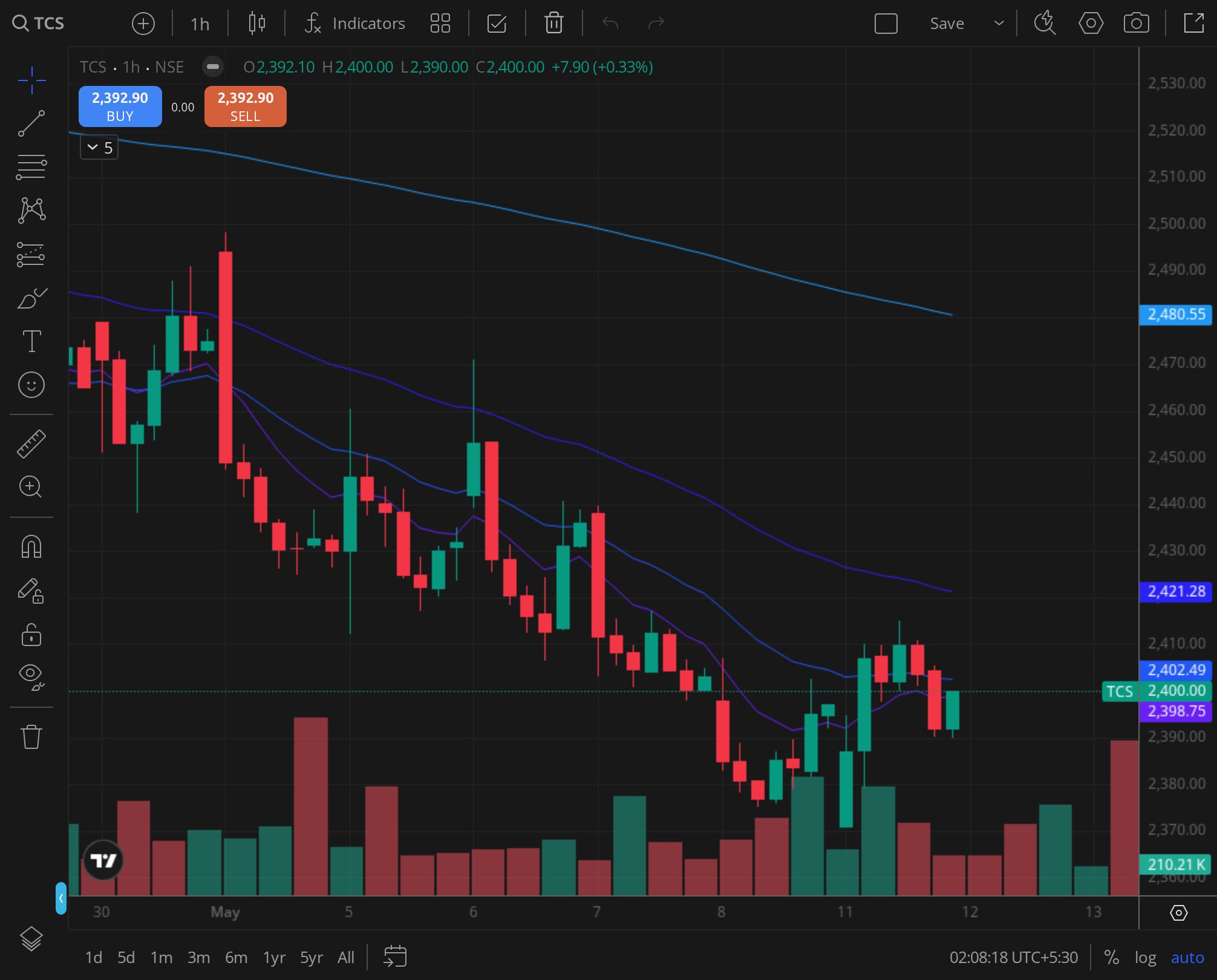
Caption: TCS weekly timeframe around 2025-06-18.
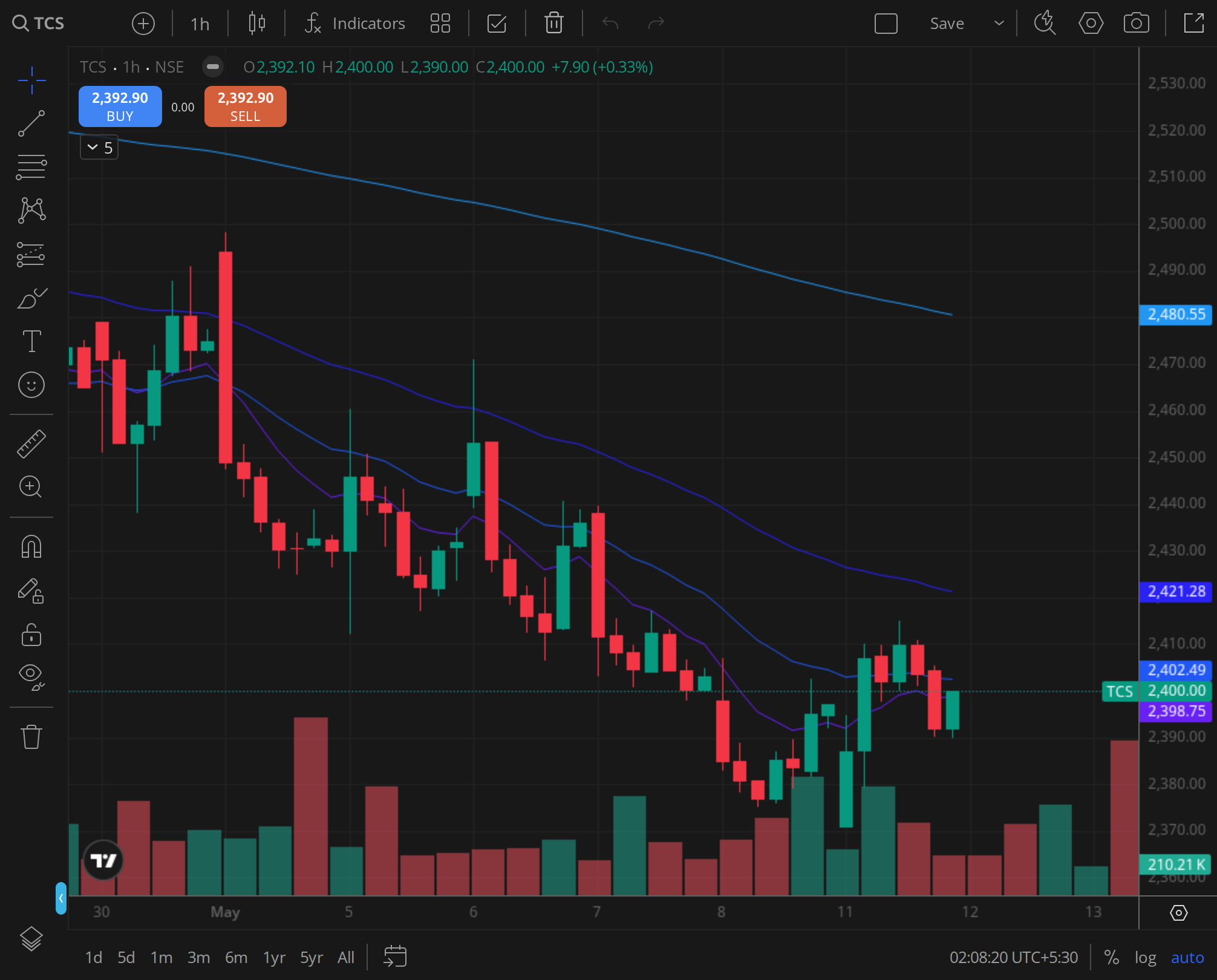
Caption: TCS daily timeframe around 2025-06-18.
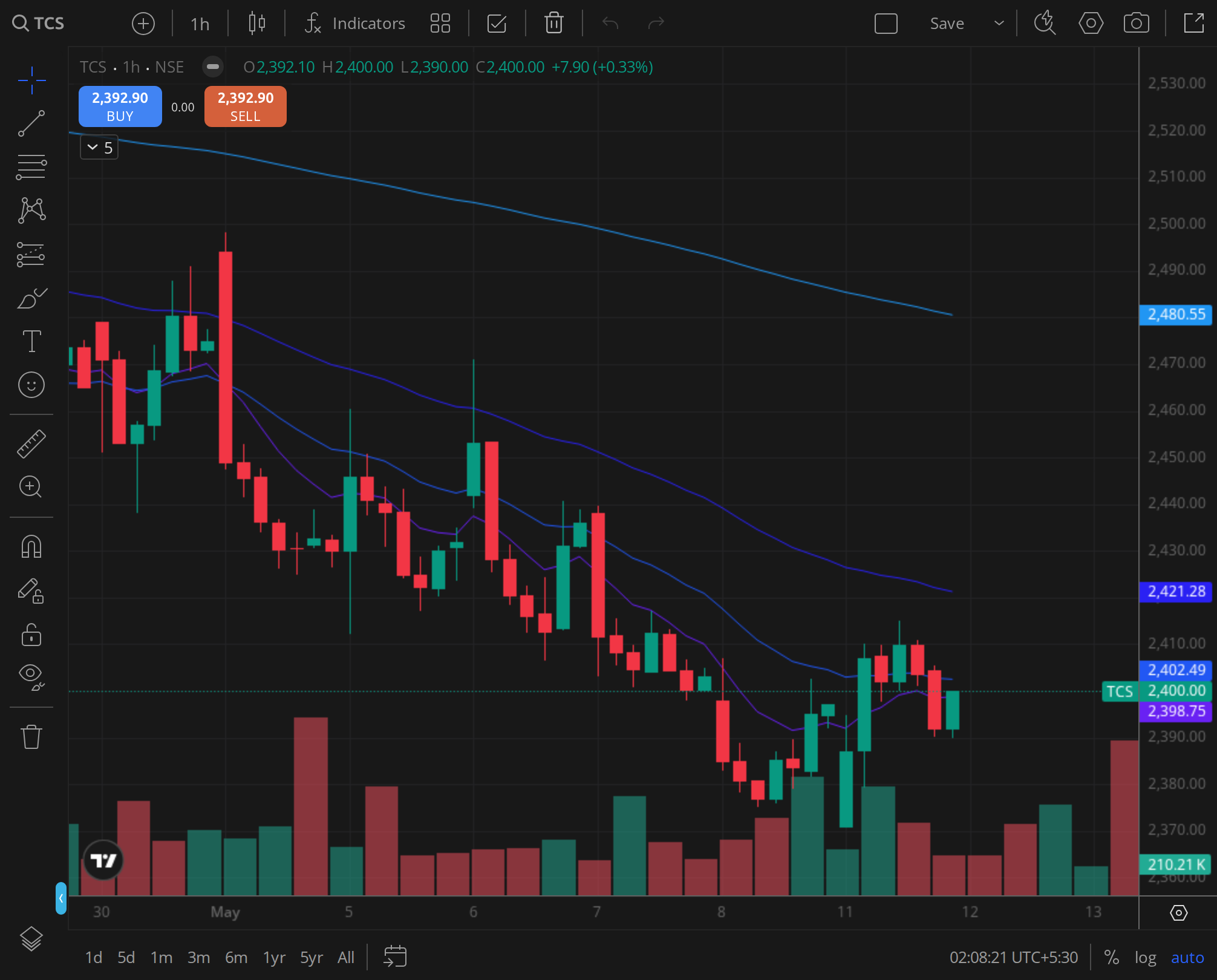
Caption: TCS 30min timeframe around 2025-06-18.
This lookback piece dissects the episode from technical, fundamental, sentiment, and historical angles, culminating in a verdict on whether the move was justified ex-post and what the 5-day forward read implied.
The Setup: A Stock in Consolidation
Heading into June 18, TCS had been trading in a tight range between ₹3,850 and ₹4,050 since early May. The stock had rallied 12% from its April lows of ₹3,450, driven by optimism around a potential rate cut cycle in the US and a recovery in discretionary IT spending. The weekly chart showed a clean uptrend from the March 2024 lows, with the 20-week EMA acting as consistent support.
The weekly structure was textbook: higher highs and higher lows since the October 2024 correction low of ₹3,200. The 20-week EMA was sloping upward, and the 50-week EMA had just crossed above the 200-week EMA in a golden cross pattern in late May. The Relative Strength Index (RSI) was reading 62, indicating room for upside without being overbought.
The Trigger: Management Guidance Weighs
On June 18, TCS management addressed analysts in a post-results interaction, cautioning that deal closures in North America were taking longer than anticipated due to heightened client scrutiny on discretionary spending. The commentary came after the company reported a 2.3% sequential revenue decline in constant currency terms for the April-June quarter, missing street estimates of a 1.5% growth.
The market reacted swiftly. TCS opened at ₹3,940, down 1.5% from the previous close of ₹3,998, and accelerated losses through the morning session. By 11:30 AM, the stock had touched an intraday low of ₹3,840, a 4% decline from the prior close. Volume surged to 2.3 times the 30-day average, with 8.7 million shares changing hands by midday.
Intraday Signature: The 30-Minute Chart Tells a Story
The 30-minute chart from June 13 to June 18 revealed a pattern of distribution building ahead of the event.
Key observations from the intraday data:
Gap-down open with high volume: The first 30-minute candle showed a 1.8% decline on volume of 1.2 million shares, compared to the average 30-minute volume of 0.4 million. This indicated aggressive selling at the open, likely from institutional desks reacting to the management commentary released pre-market.
Failed recovery attempt: Between 10:00 AM and 11:00 AM, the stock attempted to recover to ₹3,900, but the move was met with fresh selling. The 30-minute candle at 10:30 AM showed a long upper wick, confirming resistance at the ₹3,900 level.
Second leg lower: At 11:30 AM, the stock breached the ₹3,860 support level, triggering stop-losses. Volume expanded again, with 0.9 million shares traded in the 30-minute period.
Close near the low: The stock closed at ₹3,842, just 2 points above the session low. The close was below the 20-day EMA of ₹3,890, a bearish signal for short-term traders.
Technical Analysis: The Daily MA Stack Breaks
The daily chart on June 18 showed a clear breakdown of the moving average stack.
The daily moving average stack was as follows on June 18:
- 20-day EMA: ₹3,890 (breached)
- 50-day EMA: ₹3,800 (not tested, but acted as psychological support)
- 200-day EMA: ₹3,550 (far below, indicating the long-term trend remained intact)
The MACD histogram turned negative for the first time in 22 sessions, and the RSI dropped from 58 to 44 in a single day. The ADX (Average Directional Index) rose to 28 from 22, suggesting the start of a directional move. However, the DMI+ and DMI- lines had not crossed, leaving the trend ambiguous.
Fundamental Context: The Quarterly Print
The June 18 selloff was triggered by management commentary, but the quarterly results themselves had been released on July 10, 2025, a week before the shakeout. The numbers were mixed:
- Revenue: ₹62,400 crore, down 2.3% QoQ in constant currency
- Net profit: ₹12,800 crore, up 1.1% QoQ (supported by currency gains)
- Operating margin: 24.5%, down 40 bps QoQ
- Deal wins: $8.2 billion, down from $9.1 billion in the previous quarter
- Headcount: Net addition of 1,200, a positive sign after two quarters of decline
The revenue miss was attributed to delayed deal closures in North America, which accounted for 52% of TCS's revenue. Management cited "heightened client scrutiny on discretionary spending" and "longer decision-making cycles" as the primary reasons.
Peer comparison showed that Infosys had reported a 1.8% sequential revenue decline, while HCL Technologies had managed a 0.5% growth. The sector was clearly facing headwinds, but TCS's premium valuation (30x trailing earnings) made it more vulnerable to negative surprises.
Sentiment Analysis: Option Chain and FII Positioning
The sentiment around TCS on June 18 was decidedly bearish, but the options market suggested a different story.
Option Chain Shifts (June 18 vs. June 13):
- Put-Call Ratio (PCR) for the June 26 expiry dropped from 1.15 to 0.82, indicating an increase in bearish bets.
- The ₹3,800 Put saw open interest surge by 1.2 million contracts, suggesting traders were hedging against further downside.
- The ₹4,000 Call saw OI decline by 0.8 million contracts, as bulls closed positions.
- Maximum pain shifted from ₹3,950 to ₹3,900, indicating market makers expected the stock to gravitate towards that level.
FII Derivative Positioning:
FIIs held a net short position of 12,000 contracts in TCS futures on June 17, which expanded to 18,000 contracts on June 18. However, the net short position was still below the 30-day average of 22,000 contracts, suggesting that FIIs were not aggressively bearish.
Brokerage Flow:
- Morgan Stanley downgraded TCS to Equal-weight from Overweight, cutting the target price to ₹4,100 from ₹4,350.
- CLSA maintained a Buy rating but reduced the target to ₹4,200 from ₹4,400.
- Kotak Institutional Equities downgraded to Reduce from Add, citing the revenue miss and margin pressure.
- Domestic brokerages were more sanguine, with Motilal Oswal maintaining a Buy and a target of ₹4,300.
The divergence between foreign and domestic brokerages was notable. Foreign brokerages were reacting to the immediate guidance, while domestic firms focused on the long-term deal pipeline and margin resilience.
Historical Analog: Prior Similar Setups
TCS has experienced similar shakeouts in the past. Three instances stand out:
October 2023: TCS fell 3.5% on October 12, 2023, after reporting a 2.1% sequential revenue decline. The stock recovered 6% over the next 10 sessions as buying interest returned.
January 2024: A 4.2% decline on January 11, 2024, after management flagged wage cost pressures. The stock recouped losses within 8 sessions.
July 2024: A 3.8% drop on July 9, 2024, after a weaker-than-expected Q1 print. The recovery took 12 sessions, but the stock eventually made new highs.
In each case, the initial selloff was driven by guidance-related disappointment, but the recovery was fueled by broader sector tailwinds and institutional buying at lower levels. The pattern suggested that TCS's long-term investors viewed such pullbacks as buying opportunities.
The Recovery: Clawing Back Losses
Over the five trading sessions following June 18, TCS staged a remarkable recovery:
- June 19: The stock opened flat and closed at ₹3,860, up 0.5%. Volume was 60% of the June 18 level, indicating selling exhaustion.
- June 20: A 1.2% gain to ₹3,906, reclaiming the 20-day EMA. The MACD histogram turned less negative.
- June 21: Another 0.8% gain to ₹3,937, with the RSI recovering to 50.
- June 24: A 0.5% gain to ₹3,956, as the stock approached the pre-selloff level.
- June 25: A 0.3% gain to ₹3,968, closing just 0.8% below the June 17 close of ₹3,998.
By June 25, TCS had recovered 3.3% from the June 18 low, recouping 82% of the losses. The recovery was driven by:
- Broader IT index (Nifty IT) gaining 2.5% in the same period.
- Short-covering by FIIs, who reduced their net short position to 14,000 contracts.
- Domestic institutional buying, with DIIs net purchasing ₹320 crore worth of TCS shares between June 18 and June 25.
The 5-Day Forward Read: What the Recovery Told Us
The five-day forward read from June 18 was instructive. The swift recovery suggested that the selloff was largely a knee-jerk reaction to management guidance, rather than a structural shift in the company's fundamentals.
Key signals from the recovery:
Volume contraction: The recovery days saw declining volume, indicating that the selling pressure had exhausted. The June 18 volume spike was not sustained.
Support held: The 50-day EMA at ₹3,800 was never tested, suggesting that institutional buyers stepped in before the stock could fall further.
Options market normalization: By June 25, the PCR had recovered to 1.05, and the ₹3,900 Put OI had declined by 30%, indicating that bearish hedges were being unwound.
Sector tailwinds: The broader IT sector was supported by a weakening rupee and expectations of a US rate cut in September. These macro factors provided a floor for TCS's valuation.
Verdict: Was the Move Justified Ex-Post?
The June 18 shakeout in TCS was a classic example of a guidance-driven selloff that created a buying opportunity for long-term investors. The 4% decline was justified in the immediate context of a revenue miss and cautious management commentary. However, the swift recovery over the following five sessions indicated that the market had overreacted to the guidance, and the underlying fundamentals of TCS remained intact.
Ex-post analysis: The move was partially justified. The revenue miss and delayed deal closures were genuine concerns, but they were not structural. TCS's deal pipeline remained robust at $8.2 billion, and its operating margin of 24.5% was still among the best in the sector. The selloff was driven more by sentiment than by a deterioration in business quality.
5-day forward read: The recovery confirmed that the ₹3,840 level was a strong support, and the stock was likely to consolidate between ₹3,850 and ₹4,050 in the near term. The 20-day EMA had been reclaimed, and the MACD was showing signs of a bullish crossover.
VERDICT: BULLISH (3-month horizon)
For a 3-month horizon, the June 18 shakeout appears to have been a buying opportunity. The stock's recovery to pre-selloff levels, combined with sector tailwinds from a potential US rate cut and a weakening rupee, suggests that TCS is well-positioned for a rally towards ₹4,200-₹4,300 in the September quarter. However, traders should watch for the 50-day EMA at ₹3,800 as a critical support level. A break below that would invalidate the bullish thesis and suggest a deeper correction.
The June 18 episode reinforced a key lesson: in a stock like TCS, with strong institutional ownership and a long-term growth narrative, guidance-driven selloffs often present entry points rather than exit signals. The market's ability to absorb the negative news and recover within five sessions was a testament to the stock's underlying resilience)Skip to main content