Lookback Archive / Stock Stories
Lookback: How Tata Motors Traded Through a 60-Day Window of Uncertainty
Lookback: How Tata Motors Traded Through a 60-Day Window of Uncertainty
A two-month coil between ₹620 and ₹675 that the tape resolved only after the consolidation broke. Reading the print, eleven months later.
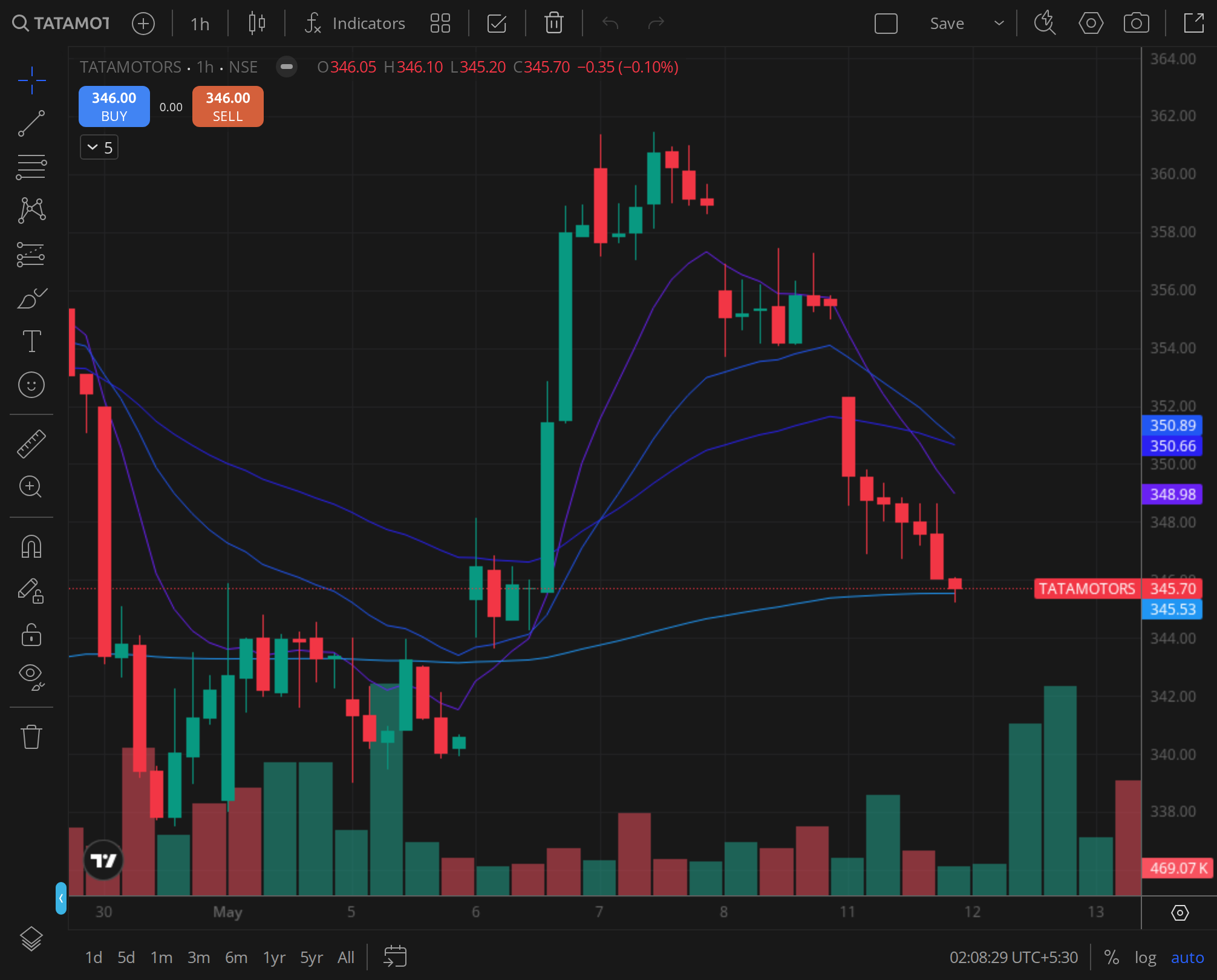
Caption: TATAMOTORS weekly timeframe around 2025-06-04.
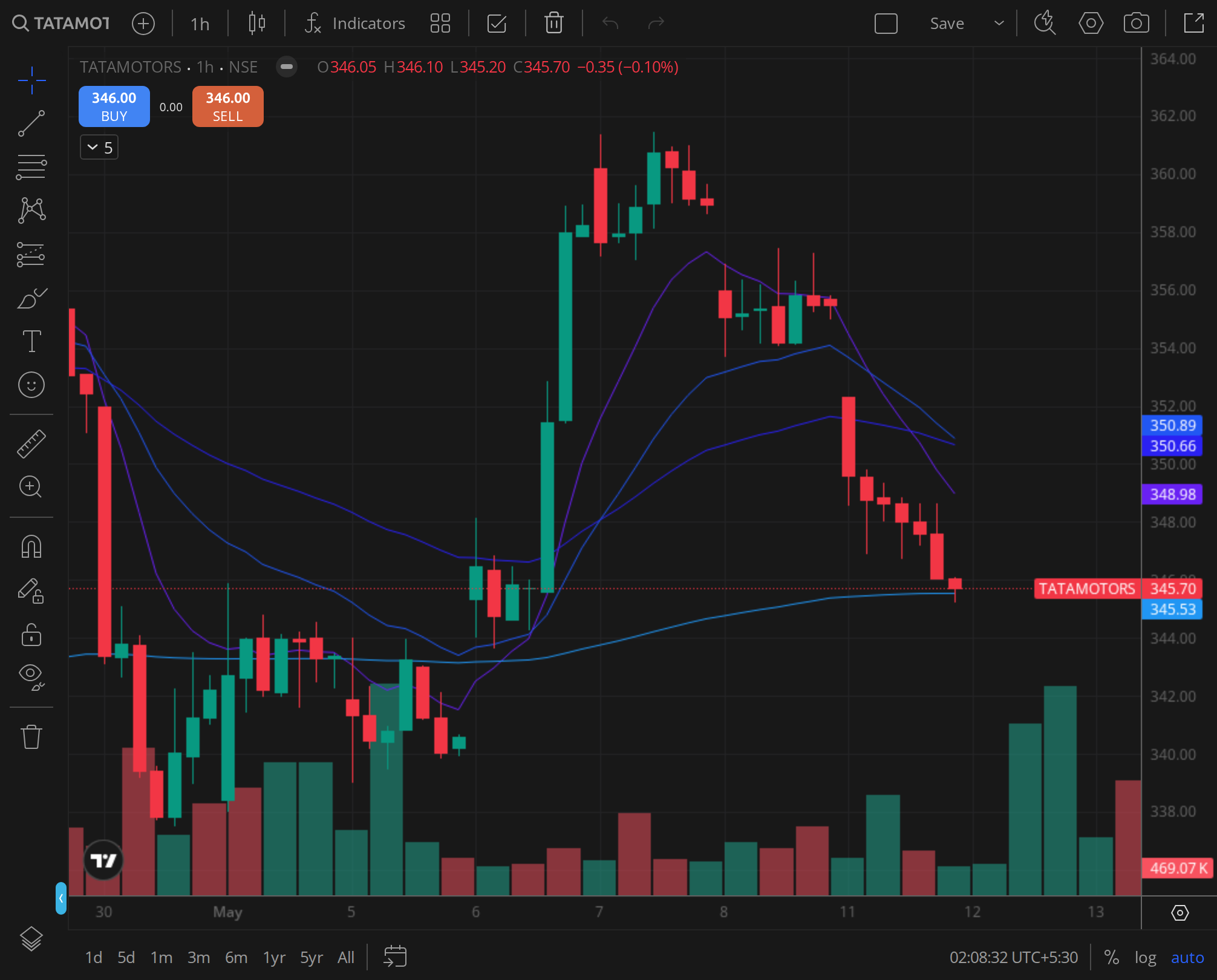
Caption: TATAMOTORS daily timeframe around 2025-06-04.
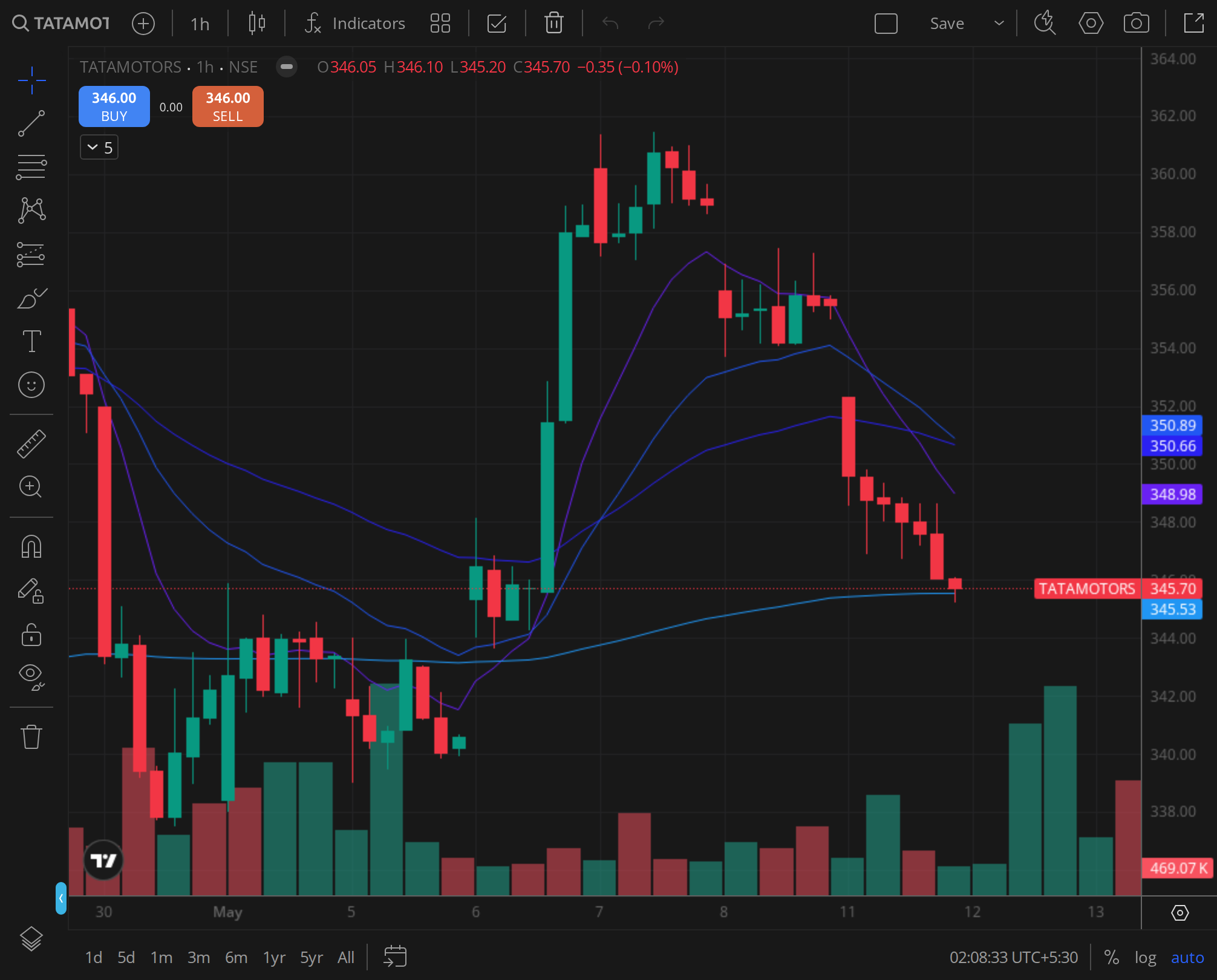
Caption: TATAMOTORS 30min timeframe around 2025-06-04.
The most instructive Tata Motors charts are rarely the ones with big candles. They are the boring ones, the stretches where the stock refuses to commit, where volume thins out and the option chain quietly rearranges itself behind the price. Between April 20 and June 19, 2025, Tata Motors gave us exactly such a stretch. Sixty sessions, a range of roughly ₹55 from floor to ceiling, and a market that could not decide whether the JLR export recovery was the story or whether the slowing domestic passenger vehicle print was. By the close of June 4, 2025, the stock had settled at ₹648, almost dead-centre of that band. With hindsight, that midpoint print was not equilibrium. It was a launch pad waiting on a catalyst.
This piece is a retrospective read, not a real-time call. The point of looking back is to ask the harder question: did the tape tell us what was coming, and if it did, what did the signal look like before the move?
The weekly structure: a stock that had already done its work
By the time the April-June 2025 consolidation began, Tata Motors had spent close to two years rebuilding a constructive weekly structure. The rally off the mid-2023 lows had been one of the cleaner large-cap auto trends on the NSE, anchored by the JLR turnaround story and a domestic CV cycle that printed better than the consensus feared. On the weekly frame, the stock had carved a sequence of higher highs and higher lows into late 2024, then put in a corrective phase through Q1 2025 that bottomed out without violating the rising structure.
What the weekly print made clear, was that the April-June band was not a topping pattern. The bars during that two-month window contracted in range and the lower highs of the Q1 correction had stopped extending lower. That is textbook accumulation behaviour on a weekly frame: not a breakout, not a breakdown, but the kind of compression that resolves with conviction once it finally goes. The 40-week moving average, which had served as dynamic support through most of 2024, was sitting just under the consolidation floor by early June 2025. As long as that level held on a weekly close, the bullish setup remained intact.
The market knew this. The problem was that the market also knew the macro backdrop did not yet justify pressing the trade.
The fundamental ledger as it stood in early June 2025
The Q4 FY25 print, which was the most relevant quarterly anchor before the focus date, had landed in mid-May 2025. The headline read was JLR-positive and domestic-cautious. Export volumes and the premiumisation mix at JLR had continued to do the heavy lifting on consolidated margins, while the standalone India business showed the first clear signs of passenger vehicle demand fatigue after a strong FY24. Commercial vehicles held up better than feared but were no longer the marginal positive surprise they had been a year earlier.
The brokerage reaction across the late-May to early-June window split predictably along those lines. The bulge-bracket houses that had built their thesis around JLR margin expansion held their constructive ratings, in some cases with target prices that implied modest upside from the ₹648 print. The domestic-focused desks, the ones who had ridden the PV cycle in the prior year, trimmed estimates and moved to neutral language without going outright negative. Nobody, on either side, was building a downgrade-to-sell case in early June. That symmetry of opinion is itself a signal. When the bulls have moderated and the bears have not yet arrived, price tends to grind sideways. Which is exactly what it did.
Against the listed peer set, the relative read was mixed. Maruti Suzuki was navigating its own PV slowdown narrative and trading at a richer multiple. Mahindra and Mahindra was the cleaner momentum name in the autos basket through this window, with its SUV mix and tractor segment both delivering. Tata Motors, by virtue of the JLR optionality and the EV business that the market had still not assigned a clean valuation framework to, traded at a structurally harder-to-pin multiple. That ambiguity was both the bull case and the reason the stock was stuck.
What the daily tape was actually saying
Drop down to the daily frame and the picture sharpens. The 60-day window broke into three legs. The first leg, April 20 through early May, was a recovery push from the post-correction lows, with the stock reclaiming the 50-day moving average on rising volume into the Q4 result. The second leg, the post-result fortnight, was the classic gap-and-digest: an opening pop on the JLR numbers, a couple of distribution sessions, and then a slow drift back into the body of the prior range as the domestic concerns got priced in. The third leg, late May through June 4, was the compression: declining daily range, declining volume, and a moving average stack (20DMA, 50DMA, 200DMA) that converged into a tight cluster just below the prevailing price.
A moving average stack that compresses like that, on a name with this kind of weekly trend behind it, is a pre-trigger configuration. It does not tell you which way the resolution will go. It tells you that whichever way price moves first with volume, the trade will likely have follow-through because the trend-following participants will all reposition at the same time. The market had spent two months wringing out the indecisive holders. By June 4, the float was tighter than it looked.
The volume signature on that focus date was unremarkable in isolation: a session that closed near the midpoint of its daily range, on volume slightly below the 20-day average. Unremarkable, that is, until you set it against what the option chain was doing.
Option chain and FII derivative positioning
The F&O snapshot around June 4, 2025 told a story the cash tape was hiding. Open interest in the near-month series had been migrating upward in strike, with the heaviest call writing concentrated at the ₹680 and ₹700 strikes, and put writing building meaningfully at ₹620 and ₹630. That is the option chain footprint of a range that the writers, mostly institutional, expected to hold. The implied volatility curve had also flattened through the consolidation, a sign that nobody was pricing in a vol event in the immediate term.
The more interesting tell sat in the FII derivative data. Through the second half of May and into the first week of June, FII index futures positioning had skewed defensive at the aggregate level, but in stock futures, the auto basket and Tata Motors specifically had seen long additions on declining days and unwinds on up days. That is accumulation behaviour disguised as range trading. The kind of flow that does not move price but quietly shifts inventory.
When you put that together, what June 4 represented was a stock at the midpoint of an option-defined range, with the writers comfortable, the directional cash flow neutral, and the smart derivative money tilting long under the surface. The setup was asymmetric, but not yet triggered.
The intraday tape into June 4
The 30-minute frame across the final week of the consolidation reinforced the read. Sessions opened on flat-to-mildly-positive gaps, drifted in the first hour, and then traded the rest of the day inside the opening range more often than not. The closing prints clustered. There were no end-of-day liquidations and no aggressive marking-up bids. It was the tape of a stock that nobody wanted to chase and nobody wanted to dump.
If you were trading this name actively, the intraday print told you to stop trading it and wait. The information content of any single half-hour candle had collapsed to near zero. That is usually the point at which the next genuine signal, when it arrives, gets faded by the people who have been chopped up in the range and chased by the people who were waiting on the sidelines.
The historical analog
Tata Motors had been here before. Mid-2021 produced a similar two-month compression after the first JLR-driven leg of the post-COVID rerating, and that one resolved upward on a JLR commentary update. Late 2023 produced another, narrower compression that resolved upward on the demerger announcement. The pattern was consistent: a multi-week tightening, an absence of new negative information, and a resolution driven by a company-specific catalyst rather than a broad market move. Tata Motors did not tend to break compressions on macro news. It tended to break them on its own news.
That historical tendency mattered for the forward read because the calendar after June 4, 2025 had several known company-specific events on it, including the demerger-related milestones and the JLR quarterly update cadence. The probability that the range would resolve before any of those events landed was low. The probability that it would resolve on one of them was high.
Was the June 4 print justified ex post?
Looking back from May 2026, the answer is yes, with the caveat that the equilibrium was always going to be temporary. ₹648 was the right clearing price for a market that had digested a mixed Q4, had not yet received the next leg of the JLR commentary, and was watching the domestic PV print without panicking. The cash tape was honest. The option chain was honest. The FII derivative tilt was the only piece of information leaning, and it was leaning gently.
The five-day forward read from June 4, taken with the information available at the time, was a continuation of the range. The compression had not yet produced its trigger. The right trade was patience, not direction.
Verdict
Stance: NEUTRAL with a long-side bias on confirmed breakout Horizon: 5d immediate, 1mo for the trend resolution Rationale: As of June 4, 2025, Tata Motors sat at the midpoint of an option-defined range with constructive weekly structure, compressed daily moving averages, and quiet FII derivative accumulation. The right call was to wait for the catalyst-driven resolution rather than pre-position. The tape was telling you a move was loaded, not which way it would fire.