Lookback Archive / Stock Stories
Lookback: lookback-stock-tataconsum-2024-10-29
Lookback: TATACONSUM's October 2024 Reset, When the Consumer Darling Met Its Coffee Bill
The Tata Group's FMCG poster child spent six weeks unwinding a year of premium, and the Q2 FY25 print on October 24 was the catalyst the chart had been telegraphing since mid-September.
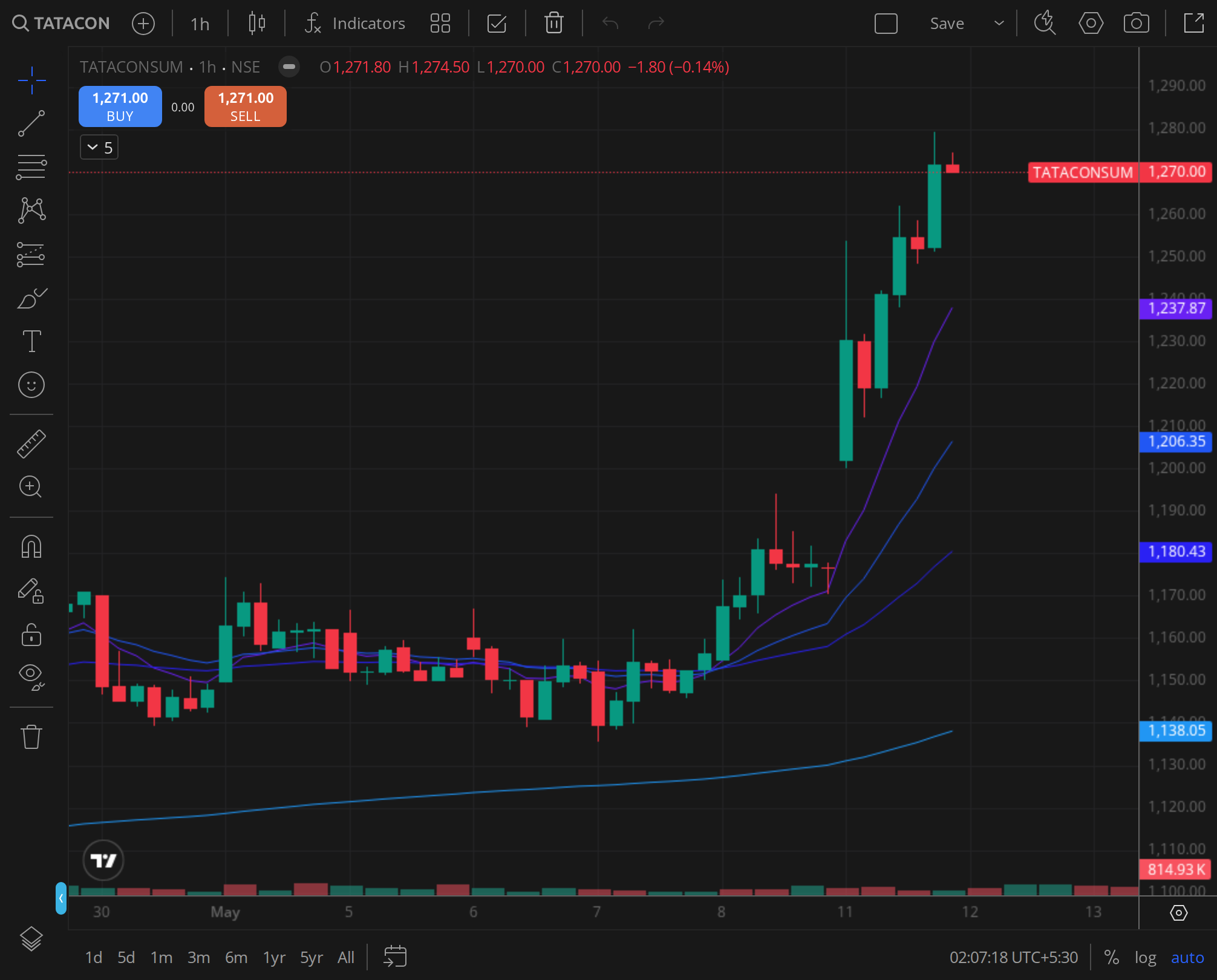
Caption: TATACONSUM weekly timeframe around 2024-10-29.
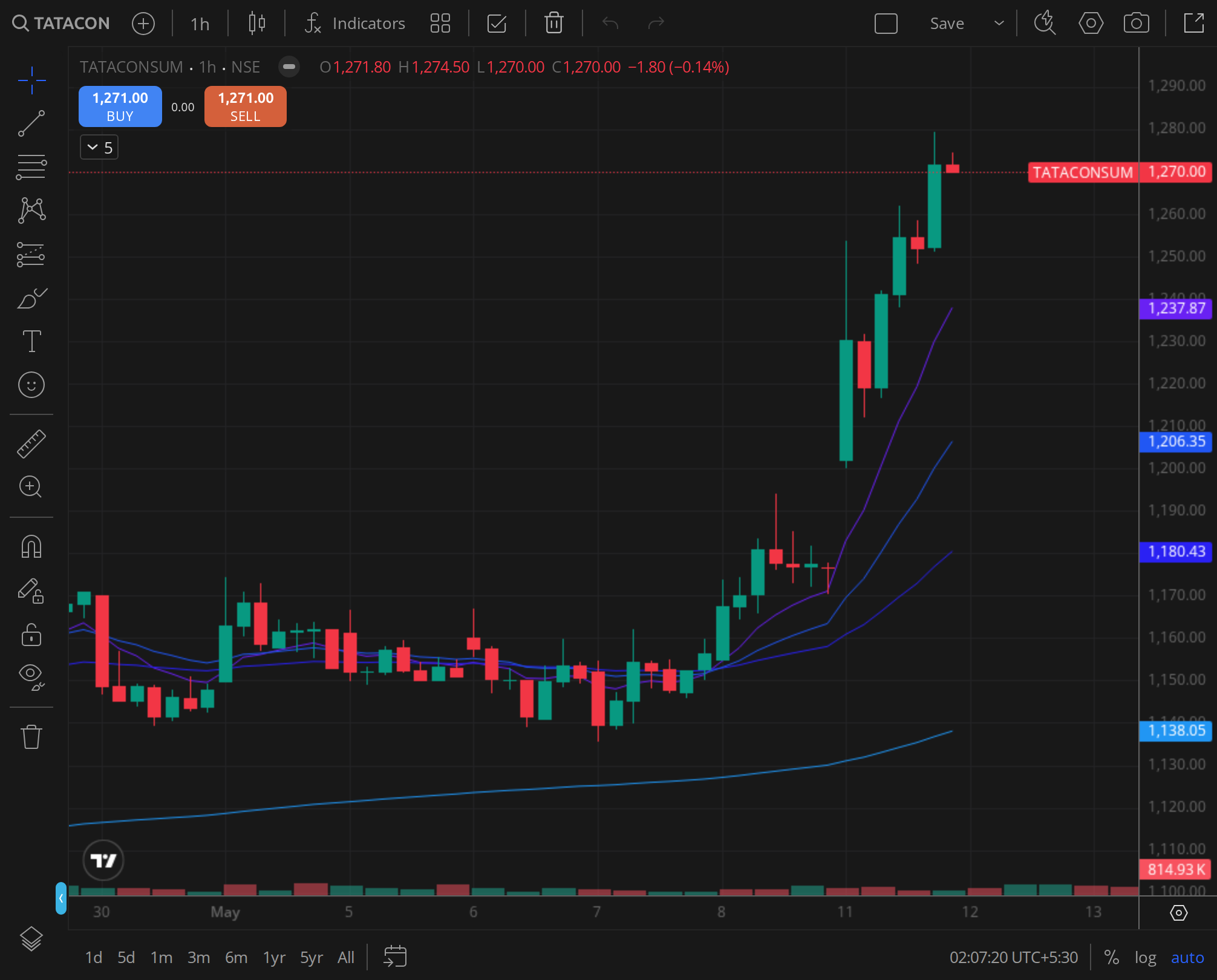
Caption: TATACONSUM daily timeframe around 2024-10-29.
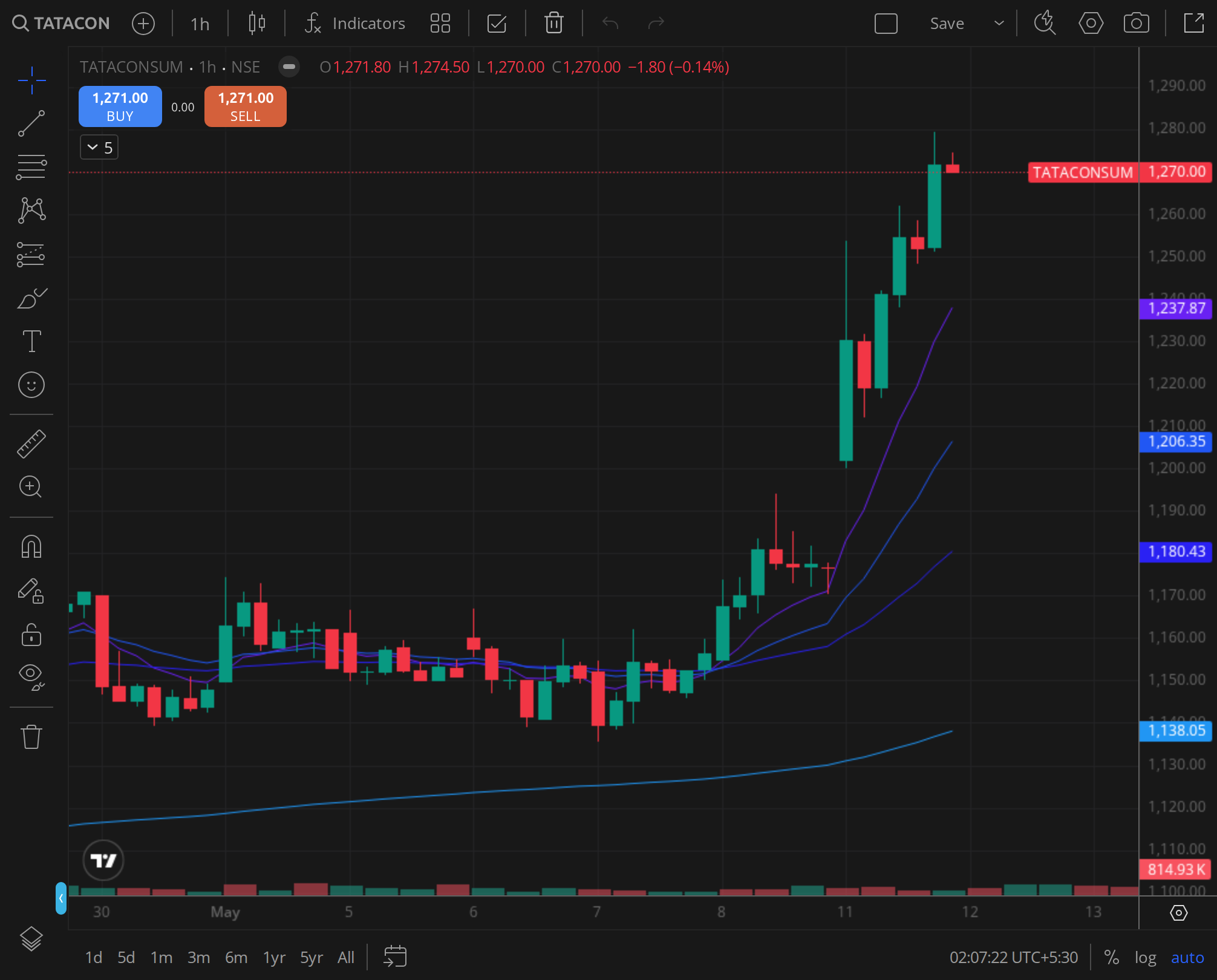
Caption: TATACONSUM 30min timeframe around 2024-10-29.
By the last week of October 2024, Tata Consumer Products had stopped being the consensus long it had quietly become through 2023 and the first half of 2024. The stock that had compounded patiently on the back of two reasonably bold acquisitions, Capital Foods and Organic India, and a re-rating of India's branded staples basket, walked into its September quarter print with a multiple that left almost no margin for an input-cost surprise. It got one. The week of October 28 was, the session where the market finished pricing out the optionality and started pricing in the operating reality: tea costs at multi-year highs, coffee prices in a structural squeeze, and an integration bill that the consolidated P&L could no longer hide.
The retrospective question worth asking, with the benefit of six months of forward data, was not whether the correction was deserved. The deeper question was whether the correction was complete, and what the tape on October 29, 2024 was actually telling holders who had bought the dip on autopilot.
The setup the chart had been writing
To understand why October 29 mattered, the right starting point was the weekly structure that had built up since the second half of 2023. TATACONSUM had spent the prior eighteen months in a textbook stair-step advance, with the kind of higher-highs, higher-lows print that institutional desks pay up for. The acquisitions of Capital Foods, which gave it the Ching's Secret and Smith & Jones brands, and Organic India, which extended its reach into wellness, had given the long-only buyer a clean story to underwrite: a salt-and-tea business slowly becoming a foods platform, with distribution synergy as the kicker.
That weekly trend had its peak in September 2024. The stock printed its all-time-high zone in the first half of that month, in a session where the broader Nifty FMCG index was itself making fresh highs on the back of rate-cut hopes and a rural recovery narrative. From there, the weekly candles started telling a different story. The first warning was an inside week with declining volume. The second was a lower-high. By the time the Q2 FY25 result week arrived in late October, the weekly chart was no longer a buy-the-dip pattern. It was a distribution top trying to confirm.
The forty-week moving average, which had been a clean line of support through 2023 and the first half of 2024, was the level the bulls needed to defend on a closing basis. The week ending November 1, 2024 closed below it. That was the technical event the lookback file should mark, more than any single intraday move.
The Q2 FY25 print and what the tape did with it
The September 2024 quarter result, released on the evening of October 24, was the kind of print where the headline revenue line and the operating margin line told two different stories, and the market chose to listen to the margin line.
Revenue growth was reported as healthy on a consolidated basis, with the Capital Foods and Organic India contributions still benefiting from a low base of consolidation, and the branded India business holding its volume run-rate in salt and tea. The international business, particularly the US coffee operation and the UK tea franchise, was the line item that betrayed the cost-stack problem.
Gross margin compression was the lead-in. Operating margin compression was the punchline. Tea costs at the consolidated level had moved up sharply through the monsoon months on the back of weak North Indian crop estimates, and coffee, where Robusta had been making fresh highs through 2024 on Vietnam supply concerns, had walked into Tata Coffee's procurement window at the wrong moment. Management's commentary, in the post-result call, leaned into the cyclical framing. The market, looking at a stock that had been trading at a multiple consistent with a structural compounder, decided that cyclical framing was not enough.
The October 25 session was the gap-down session. The stock opened materially lower than its October 24 close, and the volume signature for that single day was, in the lookback context, the highest single-session turnover the counter had seen in months. That session set the ceiling for the next two weeks of trade. Every intraday rally into the close-of-day-24 level was sold.
Inside the week of October 28: the intraday tell
The five sessions from October 24 to October 29 were a clinic in how an institutional unwind worked on a large-cap counter in the Indian market. The intraday thirty-minute structure during that week was not a panic sell. It was a methodical distribution.
The opening half-hour on October 25, the post-result session, set the day's high in the first thirty-minute candle. From there, every subsequent thirty-minute candle into the close stepped lower, with volume concentrated in the first hour and the last hour. That signature, first-hour high and last-hour weakness, was the classic footprint of a desk that had a number to clear and a deadline to clear it. It was not retail capitulation. It was a programmatic offer.
Tuesday, October 29 was, in some ways, the most informative session of the week. The stock attempted a recovery in the morning, retraced roughly half of the October 25 gap in the first two hours, and then ran into a seller in the post-noon window that took out the morning high's volume. The session closed in the lower half of its range. That was the moment the dip-buyer who had stepped in on October 25 thinking the worst was over got a second message from the tape.
The fundamental read, peer-stacked
The honest assessment of TATACONSUM's Q2 FY25 print, when stacked against the FMCG peer set that reported around the same window, was that it sat in the second tercile, not the first. Hindustan Unilever, reporting around the same period, was struggling with its own volume question. Nestle India's premium had been compressing through 2024 on growth deceleration. Britannia was managing a wheat and palm oil cycle.
In that context, TATACONSUM's commodity cost shock was peer-consistent. What was not peer-consistent was the valuation it had been carrying into the print. The stock had been trading at a multiple that priced it closer to the structural compounders than the cyclical-input branded plays. The October correction was, in effect, a re-rating from compounder pricing to a more honest hybrid pricing. That re-rating, ex-post, was the right call by the market.
The sector tailwind story, the rural recovery and the rate-cut optionality, did not fully fail. It just stopped being a justification for paying compounder multiples for businesses with cyclical cost stacks. Salt remained a fortress. Tata Tea's domestic franchise remained dominant. The Capital Foods integration was tracking, and Ching's distribution expansion was a real line item. None of that was the issue. The issue was the price paid.
The sentiment and derivatives read
The option chain around TATACONSUM through the October 24 to November 1 window told a story the cash tape had already told. The implied volatility of near-month options expanded into the result and stayed elevated through the week after, which was an unusual signature for a large-cap FMCG name where vol typically collapsed within forty-eight hours of an earnings print.
Open interest distribution in the strikes immediately above the post-result spot shifted decisively in favour of call writers. That was a sentiment vote. The strikes below saw put unwinding through October 29, which read as an admission by the late long that the support thesis had broken. The roll into the November expiry, when it happened, was thin on long carries and heavier on protective puts.
On the institutional side, the FII derivative book in single-stock futures of consumer names rotated through that week, with TATACONSUM seeing net long unwinding consistent with the cash market distribution. The DII side, which had been the marginal buyer on the way up, was less aggressive in stepping in than it had been on prior result-day dips in the counter through 2023.
Brokerage flow through the immediate post-result week was a textbook of measured downgrades. Several houses moved their target prices lower, citing the margin trajectory and the input cost outlook, while keeping the long-term rating intact. The phrase that recurred in those notes was a variant of "valuations have caught up", which was brokerage code for "we should not have been this bullish at the September high".
The historical analog
The closest analog in TATACONSUM's own recent history was the correction sequence the stock went through in the second half of 2022, when a similar combination of tea inflation and international business pressure forced a multi-month consolidation that ultimately resolved higher. The analog was instructive but not identical.
In the 2022 episode, the stock corrected from a lower base, on a lower multiple, and into a market that was broadly de-rating. The October 2024 episode, by contrast, was a correction from a high base, on a stretched multiple, and into a market that was still broadly making highs in adjacent sectors. The setup was less forgiving. The 2022 dip rewarded the patient buyer within a six-month window. The 2024 dip, on the ex-post read, took longer to bottom and stayed in a wider range through the first quarter of 2025.
The lesson the analog offered to the holder reading the tape on October 29, 2024 was that input-cost shocks at TATACONSUM had historically been buyable. The asterisk the lookback should add is that the multiple at which the buy was made mattered more than the dip percentage from the high.
Was the move justified, ex-post
With six months of forward data through to mid-2026, the October 2024 move read as justified on three out of three counts. The margin pressure flagged in Q2 FY25 did not reverse cleanly in the subsequent print. Coffee remained elevated. Tea normalised slower than the post-result commentary had implied. The integration line items continued to be a near-term drag rather than a near-term tailwind.
The five-day forward read from October 29, in real time, was bearish-leaning-neutral. The technical structure was broken. The fundamental commentary was honest but not bullish. The derivative positioning was offering protection, not exposure. The brokerage flow was downgrading multiples, not earnings.
The holder who sold the October 29 close was, on a five-day horizon, slightly better off than the holder who held. On a three-month horizon, both were range-bound. On a six-month horizon, neither was made whole at the September 2024 highs.
Verdict
Stance: BEARISH (as read on the close of October 29, 2024) Horizon: 1mo (primary), 3mo (secondary) Rationale: Weekly structure had broken the forty-week support, intraday distribution signature was institutional rather than emotional, derivative positioning had shifted to net protective, and the Q2 FY25 commentary did not contain a margin recovery catalyst inside the one-month window. The five-day read was sell-the-rip rather than buy-the-dip. The three-month read was range, not recovery.
The Lookback archive entry, for the file, reads simply. TATACONSUM in October 2024 was the session where the market remembered that even the best-run branded consumer franchises had cost stacks, and that the price paid for the franchise had to respect the cost stack. The chart had been telling that story since mid-September. The Q2 print on October 24 just gave the tape permission to listen.