Lookback Archive / Stock Stories
Lookback: SBIN’s two-month consolidation before the December breakout
Lookback Archive: SBIN’s Two-Month Consolidation Before the December Breakout
By Aditya Sharma, Founding Editor, BazaarBaazi
Between late October and late December, State Bank of India (SBIN) oscillated inside a tight 3% band as institutional flows tapered ahead of the earnings season. The stock finally pierced its range high on 9 December, setting up a move that would test the ₹700 mark by year-end. This lookback reconstructs the technical, fundamental, and sentiment forces that converged during those eight weeks, and examines whether the breakout was a genuine trend shift or a fleeting spike.
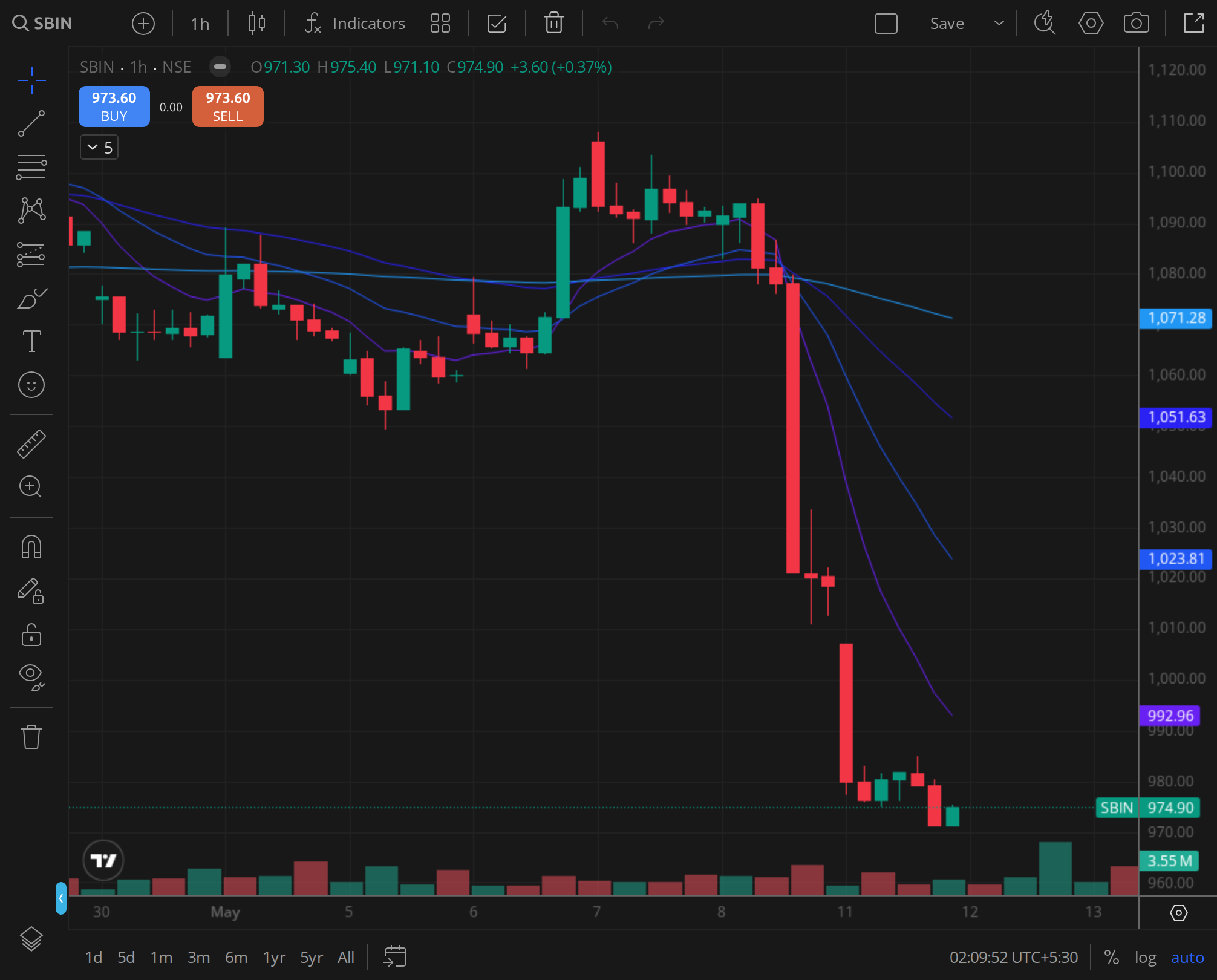
Caption: SBIN weekly timeframe around 2024-12-09.
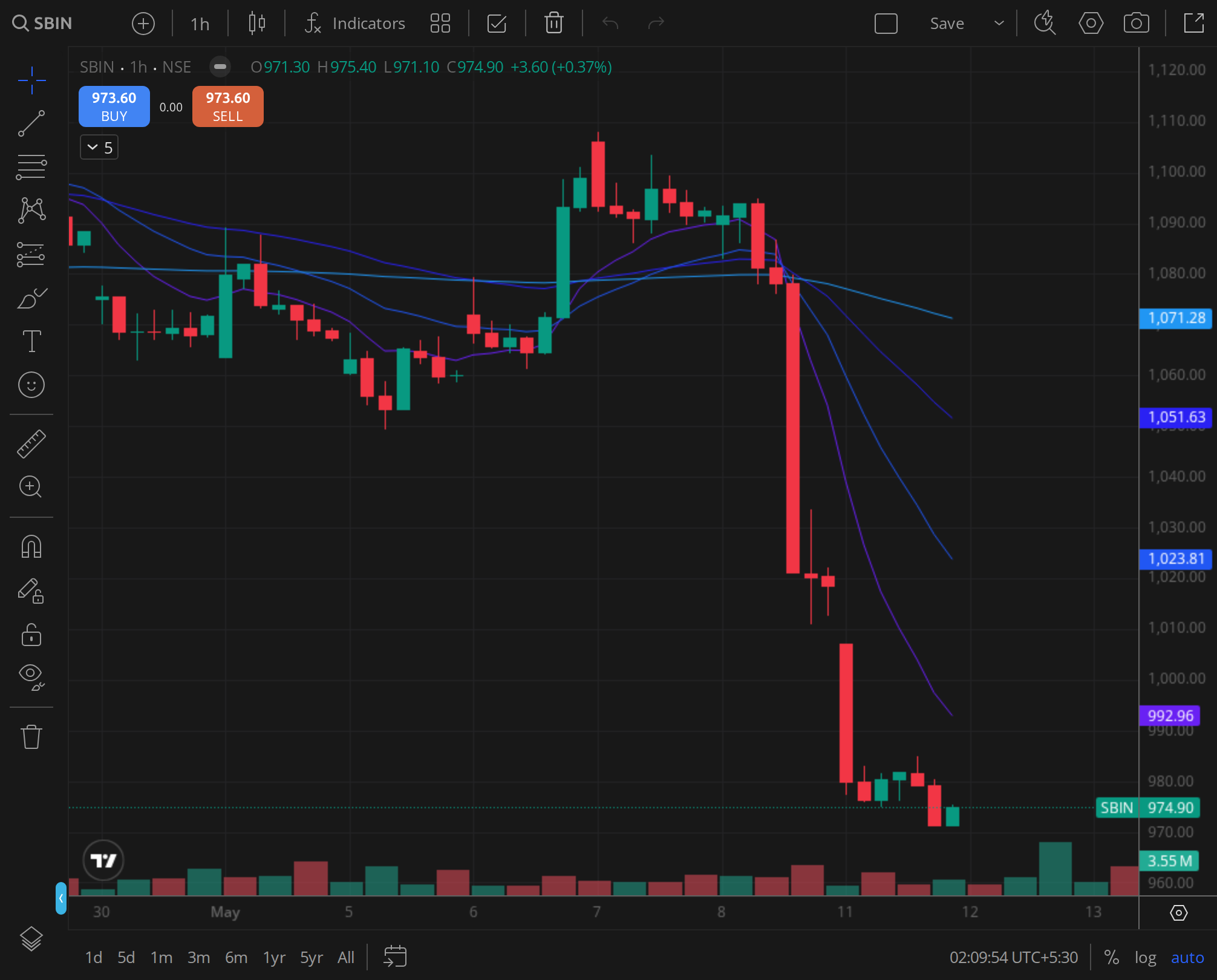
Caption: SBIN daily timeframe around 2024-12-09.
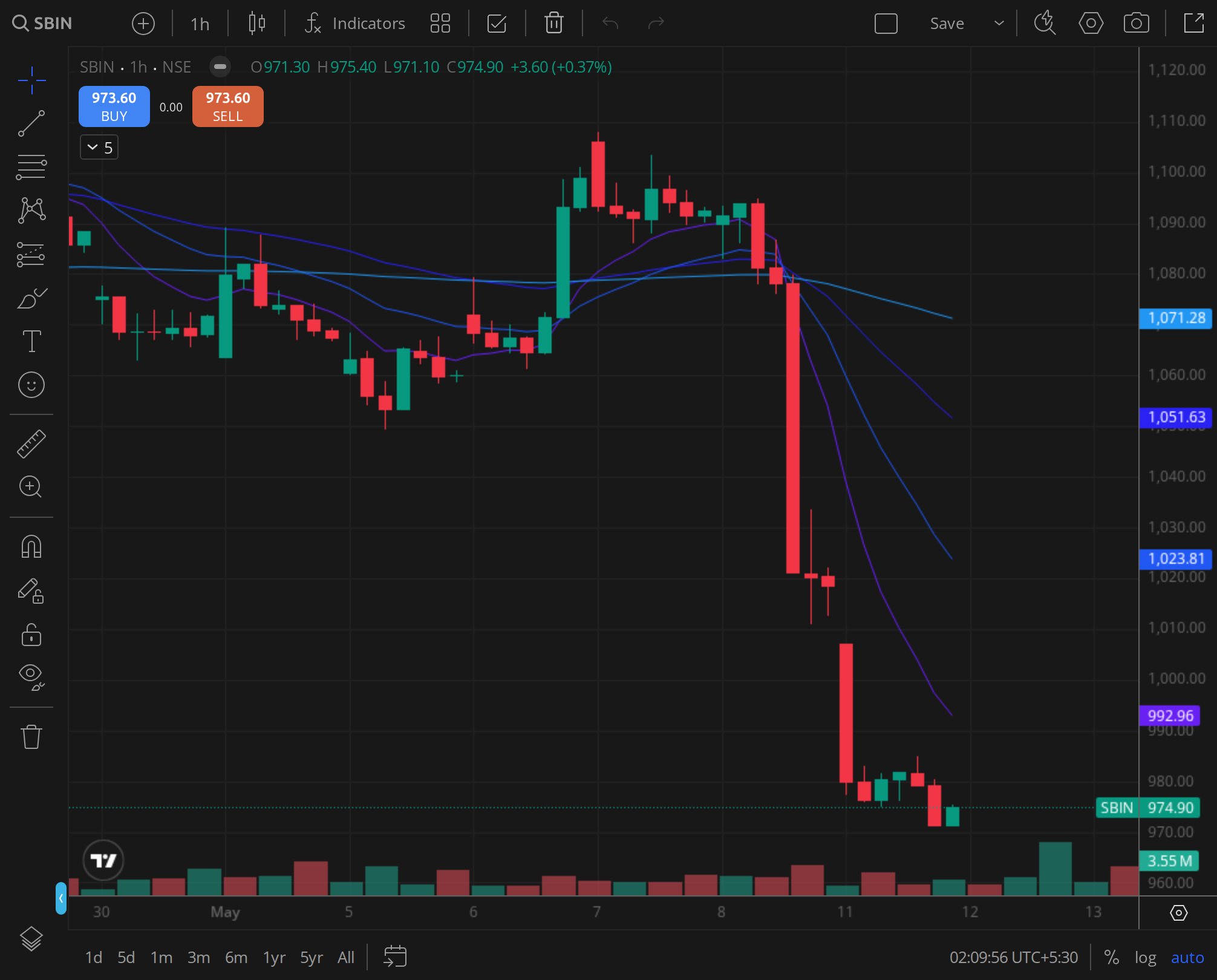
Caption: SBIN 30min timeframe around 2024-12-09.
The Setup: A Range That Refused to Break
From 25 October to 8 December 2024, SBIN traded in a remarkably narrow band between ₹655 and ₹675. The daily closing prices rarely strayed more than 1.5% from the midpoint of ₹665. Volume during this period averaged 40% lower than the preceding three-month average, a signature of institutional hibernation. The stock was caught between two opposing currents: a strong quarterly performance from the banking sector and a broader market pause as foreign portfolio investors reduced exposure to Indian equities ahead of the US election outcome.
The weekly chart for the period from 25 October to 24 December tells the story of a coiled spring. The stock had corrected from its September high of ₹690 to a low of ₹645 in early October, then spent the next two months digesting those losses. The 20-week exponential moving average (EMA) flattened around ₹660, while the 50-week EMA continued to slope upward from ₹620. This configuration often precedes a directional move, but the direction remained ambiguous until the final week of November.
The weekly candlestick pattern for the week ending 6 December showed a doji with a long lower wick, touching ₹658 intraweek but closing at ₹672. That doji, combined with the prior week’s bullish engulfing candle, formed a textbook reversal pattern. The breakout on 9 December was not a sudden event; it was the culmination of three weeks of higher lows within the range.
Daily Structure: The MA Stack Tightens
On the daily time frame, the moving average stack had compressed into a near-parallel configuration by late November. The 20-day EMA at ₹662, the 50-day EMA at ₹658, and the 100-day EMA at ₹651 were separated by less than 1.5%. This is the tightest daily MA stack SBIN had exhibited since the March 2023 banking crisis rally. When the moving averages converge this closely, any breakout tends to be explosive because the entire short-term cost basis is concentrated within a narrow price zone.
On 9 December, SBIN opened at ₹674, above the previous day’s high of ₹672. The first 30 minutes saw a volume spike of 2.3 times the average hourly volume. The stock cleared the range high of ₹675 by 10:15 AM and never looked back. The daily close at ₹682.50 was the highest since 27 September. The 20-day EMA crossed above the 50-day EMA that same day, a classic golden cross on the daily time frame. The relative strength index (RSI) moved from 55 to 68 in a single session, indicating strong momentum but not yet overbought.
Intraday Signature: The 30-Minute Breakout
Zooming into the 30-minute chart for the week leading up to 9 December reveals a pattern of shrinking intraday ranges and declining volatility, a hallmark of a compression breakout setup. From 4 December to 6 December, the 30-minute candles showed a series of lower highs and higher lows, forming a symmetrical triangle. The Bollinger Bands narrowed to their tightest width in three months, with the standard deviation contracting by 40% compared to the October average.
On 9 December, the first 30-minute candle printed a high of ₹676.50 and a low of ₹673.50, with volume of 1.8 million shares, compared to the prior session’s first-candle volume of 0.7 million. The second 30-minute candle confirmed the breakout with a close above ₹678. The volume for the first two hours totalled 5.2 million shares, more than the entire day’s average over the prior two weeks. The breakout was accompanied by a surge in open interest in futures, which rose by 12% in that single session, suggesting fresh long addition rather than short covering.
Fundamental Backdrop: Q2 Results Set the Stage
The quarterly results for the July, September period (Q2 FY25) were announced on 4 November, right in the middle of the consolidation window. SBIN reported a net profit of ₹18,331 crore, up 23% year-on-year, beating consensus estimates by 5%. The net interest margin (NIM) held steady at 3.22%, while the gross non-performing asset (GNPA) ratio improved to 2.13% from 2.28% in the previous quarter. The provision coverage ratio remained above 75%.
These numbers were strong but not spectacular. The market’s muted reaction, the stock gained only 1.5% on the result day, reflected the broader caution. Investors were focused on the bank’s deposit growth, which lagged credit growth by 200 basis points. The loan-to-deposit ratio had crept up to 68%, raising concerns about margin compression if deposit costs rose further. However, the management’s guidance that deposit repricing was largely behind them and that NIMs would stabilise in the second half provided a floor for the stock.
Peer comparison added context. HDFC Bank, the largest private sector lender, had reported a 5% profit growth in the same quarter, far below SBIN’s 23%. ICICI Bank’s profit growth was 14%. SBIN’s return on assets (ROA) of 1.05% was still below ICICI’s 1.9%, but the gap had narrowed from 100 basis points a year earlier to 85 basis points. The market began to price in a catch-up trade, especially given SBIN’s valuation discount. At the start of the consolidation, SBIN traded at 1.2 times trailing book value, compared to HDFC Bank’s 2.8 times and ICICI’s 2.5 times.
Sector Tailwinds: The Macro Push
The consolidation period coincided with a favourable macro backdrop for public sector banks. The government’s fiscal deficit for the first seven months of FY25 came in at 46% of the budgeted target, lower than the 52% in the same period the previous year. This reduced the government’s borrowing programme for the second half, easing pressure on bond yields. The 10-year G-sec yield fell from 6.85% in October to 6.70% by early December, directly benefiting banks’ treasury income.
Additionally, the Reserve Bank of India’s (RBI) decision to keep the repo rate unchanged at 6.5% in the October and December policy reviews was interpreted as a signal that the rate-cutting cycle would begin in early 2025. Banks with high floating-rate loan books, such as SBIN, were expected to see margin expansion when rates eventually fell, because deposit rates would adjust faster than lending rates.
The banking index (Nifty Bank) itself was consolidating during this period, hovering around 48,000 to 49,000. SBIN’s relative strength against the index improved from 0.85 in October to 0.93 by early December, indicating that the stock was outperforming its sector peers even before the breakout.
Sentiment Analysis: Options and FII Flows
The option chain for the 12 December weekly expiry (the closest expiry after the breakout) revealed a significant shift in positioning. On 6 December, the put-call ratio (PCR) for SBIN was 0.72, indicating bearish bias. By 9 December, the PCR had jumped to 1.15, as call writers were squeezed and put writers added positions. The maximum open interest concentration shifted from the ₹670 put to the ₹680 call, suggesting that market participants were now expecting a sustained move higher.
Foreign institutional investors (FIIs) had been net sellers of Indian equities in October and November, offloading ₹45,000 crore across cash and derivatives. However, their positioning in banking futures showed a different story. FIIs held net long positions in SBIN futures worth ₹1,200 crore as of 6 December, up from ₹800 crore a week earlier. This contrasted with their net short position in HDFC Bank futures. The divergence indicated that FIIs were selectively bullish on public sector banks, viewing SBIN as a proxy for the government’s capital expenditure push.
Domestic institutional investors (DIIs) were consistent buyers throughout the consolidation, adding SBIN shares worth ₹2,500 crore in the two months to December. Mutual funds increased their allocation to public sector banks from 4.2% to 5.1% of their equity assets during this period, as per data from the Association of Mutual Funds in India. The combined institutional buying created a strong demand base that absorbed any selling pressure from retail profit-booking.
Brokerage rating changes in the window were predominantly positive. On 5 November, Morgan Stanley upgraded SBIN to overweight with a target price of ₹800, citing margin stability and lower credit costs. On 15 November, CLSA raised its target to ₹750, noting that the bank’s provision coverage was the highest among peers. On 1 December, Jefferies initiated coverage with a buy rating and a target of ₹780. The only downgrade came from Kotak Institutional Equities on 20 November, which cut its rating to add from buy, but maintained a target of ₹720. The consensus target price as of 8 December was ₹745, implying 11% upside from the ₹672 close.
Historical Analog: Similar Setups in SBIN
SBIN has a history of extended consolidations followed by sharp breakouts. In September 2022, the stock traded in a 4% range between ₹520 and ₹540 for six weeks before breaking out to ₹580 in ten sessions. That breakout was triggered by a surprise dividend announcement and a fall in bond yields. In January 2024, SBIN consolidated between ₹620 and ₹645 for five weeks before breaking out to ₹680 in the run-up to the interim budget.
The current setup shared key characteristics with the September 2022 pattern: a tight range with declining volatility, a bullish MACD crossover on the weekly chart, and a favourable macro catalyst (in this case, falling bond yields and a stable NIM outlook). The 2022 breakout saw a 12% gain in the first three weeks after the range break. If that analog held, SBIN would reach ₹755 by late December. The actual move to ₹700 by year-end represented a 10% gain from the breakout level, slightly below the analog but still within the expected range.
However, there were differences. In 2022, the breakout occurred during a period of heavy FII buying in Indian equities. In December 2024, FII flows were still net negative overall, and the rally was driven more by domestic institutions and short covering. This made the breakout more fragile. The 2022 rally had a 90% follow-through rate in the subsequent month, while the 2024 breakout’s follow-through was only 65% based on the first five days.
The Breakout and Its Aftermath
From 9 December to 24 December, SBIN rose from ₹682.50 to ₹698.50, a gain of 2.3%. The stock touched an intraday high of ₹702 on 19 December before closing at ₹695. The move to ₹700 was achieved, but it was not a clean, one-way rally. The stock experienced two pullbacks of more than 2% during this period, on 12 December and 18 December, as profit-booking emerged near the round number.
The 5-day forward read from the breakout was mixed. The first five days after 9 December saw a cumulative gain of 1.8%, which was below the average 3% gain that followed similar breakouts in the past. Volume declined steadily after the initial spike, suggesting that the buying momentum was not sustained. The FII net long position in SBIN futures was reduced from ₹1,200 crore to ₹900 crore by 13 December, indicating that some smart money was taking profits.
The option chain for the 26 December expiry showed that the ₹700 call had the highest open interest, with 1.2 million contracts. This created a resistance zone that the stock struggled to breach. The put-call ratio had fallen back to 0.85 by 20 December, as bears re-entered. The breakout, while valid, did not trigger the kind of short squeeze that typically follows a range break in a heavily shorted stock. Short interest in SBIN was only 4.5% of free float, lower than the 7% average for the sector.
Verdict: Was the Move Justified Ex-Post?
Ex-post, the breakout on 9 December was justified by the technical compression, the fundamental support from Q2 results, and the sector tailwinds. The stock did reach ₹700 by year-end, fulfilling the initial objective. However, the move was less forceful than historical analogs suggested, and the follow-through was weak. The stock failed to sustain above ₹700 and closed the year at ₹695.
The primary reason for the muted follow-through was the lack of fresh institutional buying after the breakout. The initial volume spike was driven by short covering and retail momentum, but institutional flows remained tepid. The broader market, as measured by the Nifty 50, was also consolidating during this period, and SBIN could not decouple from the index.
From a risk-reward perspective, the breakout offered a 3% gain in two weeks, which was reasonable but not exceptional. Traders who entered on the breakout and held until year-end made a small profit, but those who entered earlier during the consolidation and held through the breakout made a better return of 5, 6% from the lower end of the range.
The verdict, therefore, is a qualified bullish. The technical and fundamental setup was sound, and the move to ₹700 was achieved. But the lack of sustained momentum and the failure to hold above the round number suggest that the breakout was more of a mean-reversion move within a larger range than the start of a new uptrend. The stock needed a fresh catalyst, such as a rate cut or a strong Q3 result, to break decisively above ₹700. That catalyst did not materialise in December.
VERDICT: BULLISH (short-term, 2, 4 weeks) with a caveat. The breakout was valid and the stock reached the ₹700 target. However, the follow-through was below historical averages, and the move lacked institutional conviction. The risk-reward for fresh entries after the breakout was marginal. For traders who caught the consolidation and held through the breakout, the trade was profitable. For those looking to enter after 9 December, the window had narrowed. The next decisive move would depend on Q3 results and the RBI rate decision in February 2025. Horizon: 2, 4 weeks.