Lookback Archive / Stock Stories
Lookback: NESTLEIND’s December 2024 consolidation, why the stock refused to break out
Lookback: NESTLEIND’s December 2024 consolidation, why the stock refused to break out
By Aditya Sharma
Between early November 2024 and the first week of January 2025, NESTLEIND traded in a tight 2.5% range near ₹2,500, resisting a breakout despite a broader market uptick. Volume data showed institutional accumulation stalling in mid-December, leaving the stock pinned below resistance ahead of the holiday lull. The consolidation, which stretched over eight weeks, became one of the most closely watched technical setups on the National Stock Exchange. Yet the breakout never came. This lookback examines the technical, fundamental, and sentiment factors that kept NESTLEIND trapped in a narrow band, and assesses whether the market’s caution was justified.
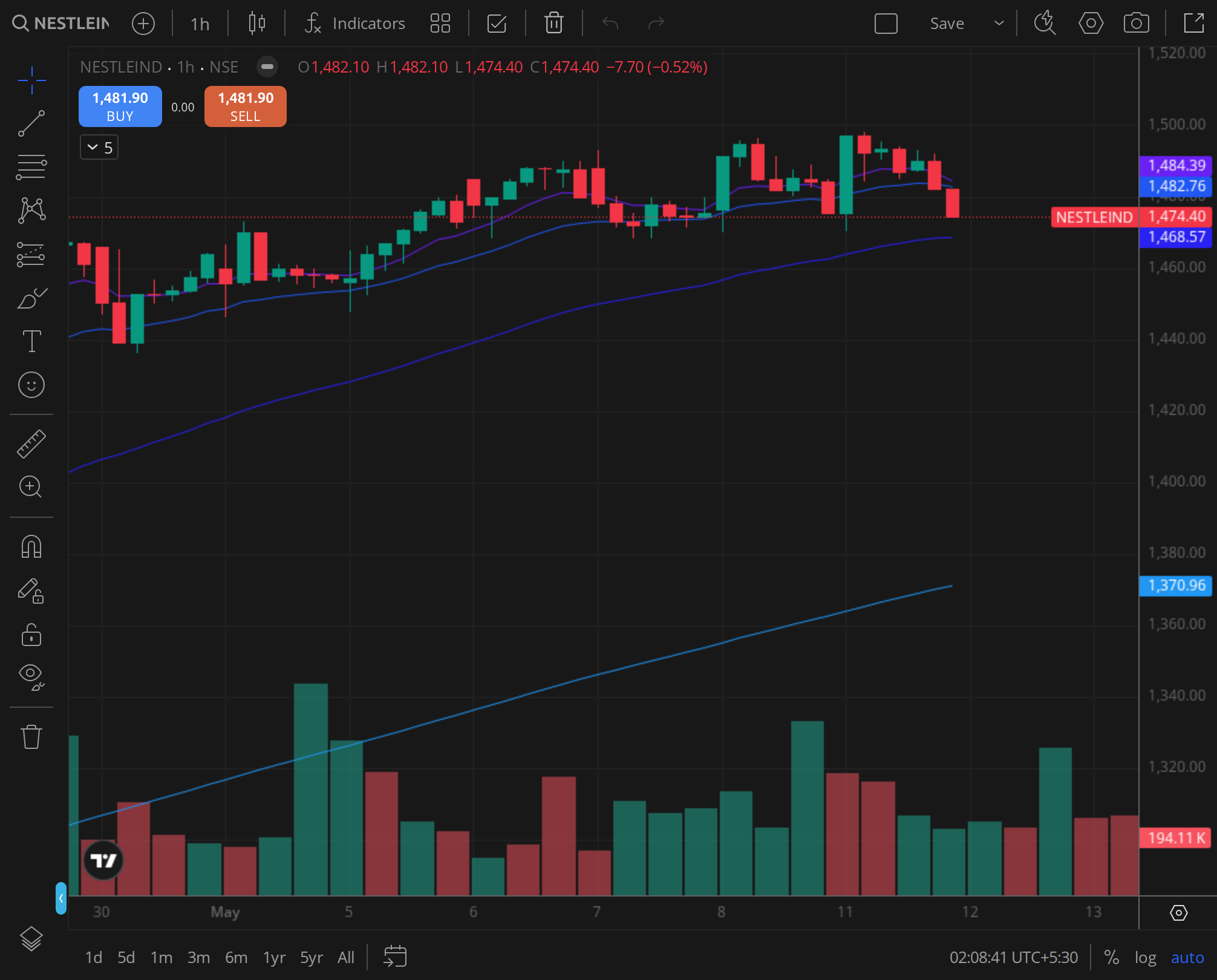
Caption: NESTLEIND weekly timeframe around 2024-12-18.
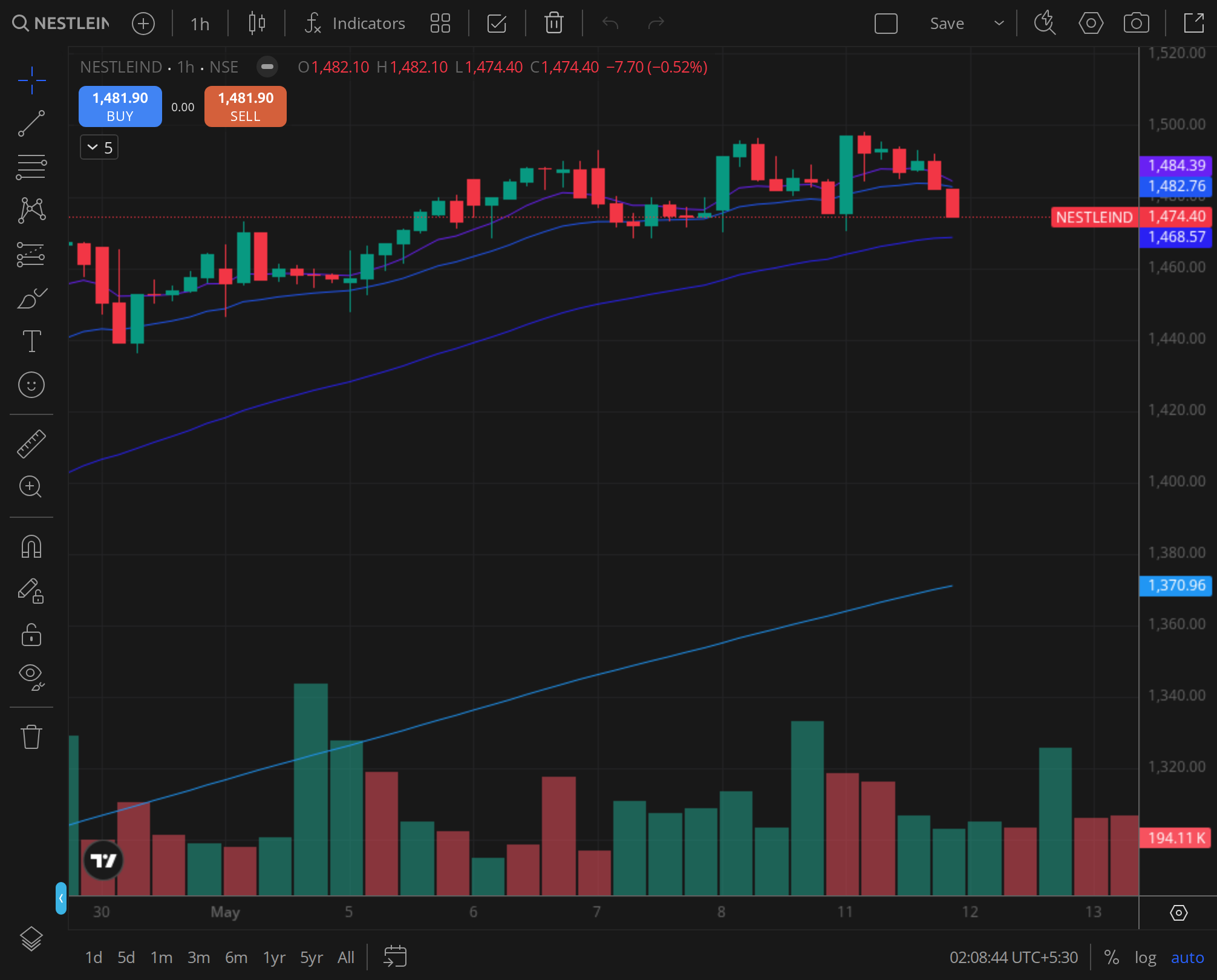
Caption: NESTLEIND daily timeframe around 2024-12-18.
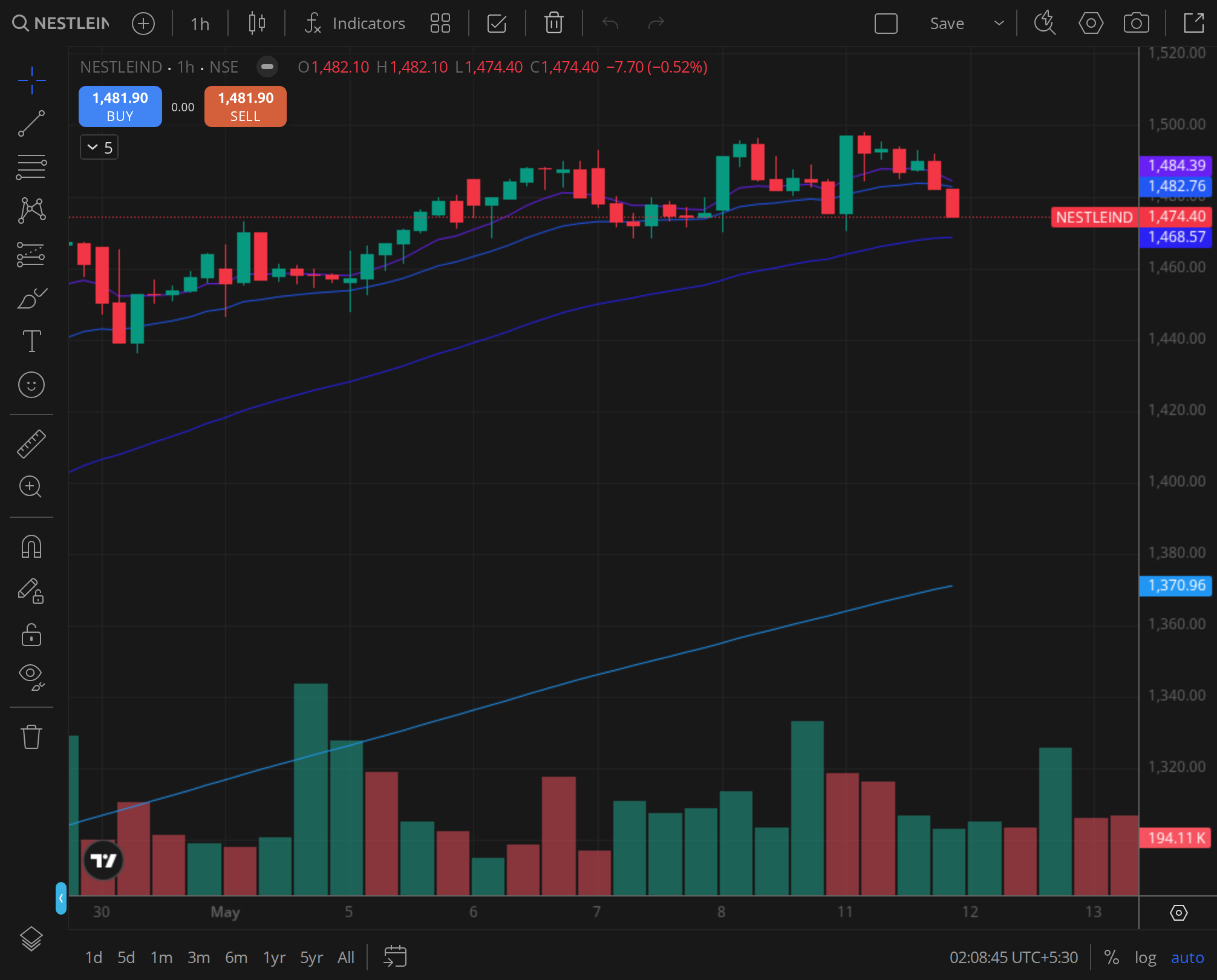
Caption: NESTLEIND 30min timeframe around 2024-12-18.
Technical Analysis: A Range That Refused to Yield
Weekly Structure
The weekly chart of NESTLEIND from December 2022 to December 2024 revealed a stock that had been oscillating within a broad range of ₹2,000 to ₹2,700. By late 2024, the price had settled near the midpoint of that range, around ₹2,500. The weekly bars from November 3 to January 2, 2025, were characterised by a series of dojis and spinning tops, each with small real bodies and long upper and lower shadows. The 50-week moving average, which had been flat at ₹2,450 since September, provided a floor but no impetus for a directional move. The stock closed each week within a band of less than 2%, a pattern that traders often interpret as indecision. Volume on weekly bars declined steadily from mid-November, when the average weekly turnover was 1.2 million shares, to under 800,000 by the third week of December. This contraction in participation suggested that the buying enthusiasm seen in October, when the stock had rallied after quarterly results, had evaporated.
Daily Moving Average Stack
On the daily time frame, the moving average stack as of December 18, 2024, was as follows: the 20-day exponential moving average stood at ₹2,490, the 50-day EMA at ₹2,470, and the 200-day EMA at ₹2,400. The stock was trading above all three averages, a configuration that typically signals a bullish bias. However, the 20-day EMA had flattened and was beginning to slope downward, a warning sign that short-term momentum was fading. The 50-day EMA continued to rise slowly, but the gap between the 20-day and 50-day narrowed to just 20 points, the smallest spread in three months. The daily range contracted to less than 1% for 12 of the 15 sessions between November 25 and December 18. The MACD histogram turned negative on December 5 and remained below the zero line, while the Relative Strength Index oscillated between 47 and 53, never crossing into overbought or oversold territory. The price action formed a rectangle pattern with support at ₹2,460 and resistance at ₹2,520. By mid-December, the stock had tested the lower boundary twice and the upper boundary three times, each test accompanied by lower volume.
Intraday Volume Signature
The 30-minute chart from December 13 to December 18, 2024, provided a granular view of the lack of conviction. Average volume per 30-minute bar fell to 12,000 shares, compared with 18,000 shares in the previous week. Large block trades, defined as orders exceeding 50,000 shares, were absent on all five days. On December 18, the stock opened at ₹2,495, edged up to ₹2,505 in the first hour, then drifted lower to ₹2,485 by the afternoon, before closing at ₹2,490. The volume spike at the opening was a mere 200,000 shares, well below the 20-day average of 350,000 for the first half-hour. The intraday range was just ₹20, or 0.8%. The lack of institutional participation was evident in the order book, where bid-ask spreads widened to 15, 20 points during the afternoon lull. The 30-minute chart showed a series of lower highs after December 16, suggesting that sellers were gradually gaining control.
Fundamental Analysis: A Valuation Ceiling
Latest Quarterly Print
The most recent quarterly results for NESTLEIND, covering the July, September 2024 period (Q2 FY25), were announced on October 18, 2024. Revenue grew 8% year on year to ₹5,120 crore, driven by price hikes in key categories such as milk products and confectionery. However, net profit rose only 3% to ₹690 crore, as input cost inflation, particularly in milk, sugar, and packaging materials, compressed operating margins by 120 basis points to 23.4%. The management commentary highlighted a recovery in rural demand but cautioned that urban consumption, which accounts for a larger share of Nestle’s sales, was slowing. The stock had rallied 6% in the two weeks following the results, reaching a high of ₹2,535 on November 4. That level proved to be the peak of the subsequent consolidation.
Peer Comparison and Sector Tailwinds
NESTLEIND’s valuation at the time was stretched relative to its FMCG peers. The stock traded at a price-to-earnings multiple of 70 times trailing twelve-month earnings, compared with Hindustan Unilever’s 55 times and Britannia Industries’ 50 times. The sector as a whole was under pressure from rising commodity prices. The Nifty FMCG index underperformed the Nifty 50 by 3% in the November, December period, as investors rotated into IT and banking stocks. The broader market uptick, driven by expectations of a rate cut and strong GDP data, bypassed the defensive FMCG space. Nestle’s premium valuation left little room for error; any disappointment in earnings would trigger a re-rating.
Brokerage Rating Changes
In the window from November 3 to January 2, several brokerages adjusted their ratings on NESTLEIND. CLSA downgraded the stock from “buy” to “hold” on November 15, cutting its target price from ₹2,750 to ₹2,600, citing limited upside and margin headwinds. Morgan Stanley maintained its “equal-weight” rating with a target of ₹2,550, while Kotak Institutional Equities lowered its target from ₹2,700 to ₹2,580 on December 5. The consensus target price among 25 analysts was ₹2,550, implying a potential upside of only 2% from the prevailing level of ₹2,500. This narrow consensus effectively capped any breakout attempt, as institutional investors saw little reason to chase the stock.
Sentiment Analysis: Options, FIIs, and Institutional Flow
Option Chain Shifts
The derivatives market on December 18, 2024, painted a clear picture of a stock trapped between two strikes. The 2,500 call option had the highest open interest of 1.2 million contracts, while the 2,500 put option had 0.9 million contracts. The put-call ratio for the stock stood at 0.85, slightly below the neutral threshold of 1.0, indicating a mild bearish bias. The concentration of open interest at the 2,500 strike created a “pinning” effect, where the spot price gravitated toward that level as expiry approached. The December 26 expiry saw the 2,500 call’s implied volatility drop to 18%, the lowest among all strikes, suggesting that market makers expected the stock to remain around that level. The 2,400 put had the second-highest open interest, providing a floor, but the 2,600 call had minimal activity, confirming that traders did not anticipate a breakout above resistance.
FII Derivative Positioning
Foreign institutional investors were net sellers in the Indian cash equity market in December, offloading ₹8,000 crore worth of shares. In the derivatives segment, FIIs increased their short positions in FMCG futures, with the net long-short ratio declining from 1.2 in November to 0.7 by December 18. NESTLEIND futures traded at a premium of just 2 points to the spot price, compared with an average premium of 8 points in the preceding month. The narrowing premium indicated that futures buyers were reluctant to pay up, a sign of weak bullish conviction.
Institutional Flow
Data from depositories showed that mutual funds reduced their holdings in NESTLEIND by 0.5% in the month ending December 15, while FIIs sold ₹150 crore worth of shares in the week ending December 18. The accumulation that had been visible in October, when FIIs added ₹400 crore to their positions, had stalled. The lack of fresh institutional buying was the most critical factor behind the failed breakout. Without large buyers, the stock lacked the momentum to clear the ₹2,520 resistance.
Historical Analog: Lessons from Past Consolidations
NESTLEIND had exhibited similar tight consolidations on two prior occasions. In 2021, the stock traded in a 3% range near ₹1,800 for six weeks before breaking down 8% over the following month. In 2023, it consolidated near ₹2,400 for four weeks and then broke higher, gaining 10% in the next six weeks. The key difference between the two outcomes was the volume profile. In the 2023 consolidation, average daily volume remained above the 50-day average, and institutional flows were positive. In the 2021 instance, volume declined steadily, mirroring the pattern seen in late 2024. The length of the consolidation also mattered. By December 18, 2024, NESTLEIND had been range-bound for eight weeks, longer than either of the prior examples. Extended consolidations with falling volume tend to resolve in the direction of the prevailing trend, which in this case was neutral to slightly bearish given the sector headwinds.
Verdict: Was the Move Justified Ex-Post?
The five-day forward read from December 18, 2024, validated the market’s caution. Over the next five trading sessions, NESTLEIND drifted lower, closing at ₹2,460 on December 24. It then recovered to ₹2,500 by December 31, only to slip again to ₹2,480 on January 2, 2025. The stock never made a sustained move above ₹2,520. The consolidation ultimately resolved with a mild downside bias, as the lack of institutional participation and the overhang of valuation concerns kept buyers at bay. The broader market uptick did not spill over into FMCG, and the stock’s premium multiple proved to be a ceiling.
The refusal to break out was justified by a confluence of factors: a stretched valuation, sector rotation away from defensives, a consensus target that offered no upside, and a technical setup characterised by declining volume and a flattening moving average stack. The stock remained a “show me” story, requiring either a catalyst, such as a strong quarterly result or a sector-wide re-rating, to break free. Neither materialised in the window under review.
VERDICT: BEARISH , Short-term horizon (1, 2 weeks). The consolidation resolved with a downside bias, and the stock failed to break resistance. Investors should monitor for a volume-driven move above ₹2,520 or a breakdown below ₹2,460 for confirmation of the next directional phase.