Lookback Archive / Stock Stories
Lookback: MARUTI’s bumpy ride from November lows to January resistance
Lookback: MARUTI’s bumpy ride from November lows to January resistance
Between late November and late January, MARUTI shares clawed back nearly 8% from a two-month trough near ₹10,200, only to stall at a wall of offers around ₹11,000. The stock’s recovery was fuelled by a rebound in rural dispatches and a sharp drop in Brent crude, but fading momentum in the final week left traders questioning the durability of the move. When the dust settled after the January 28 close, the bounce looked technically impressive but fundamentally constrained, a textbook resistance test that failed to deliver a decisive breakout.
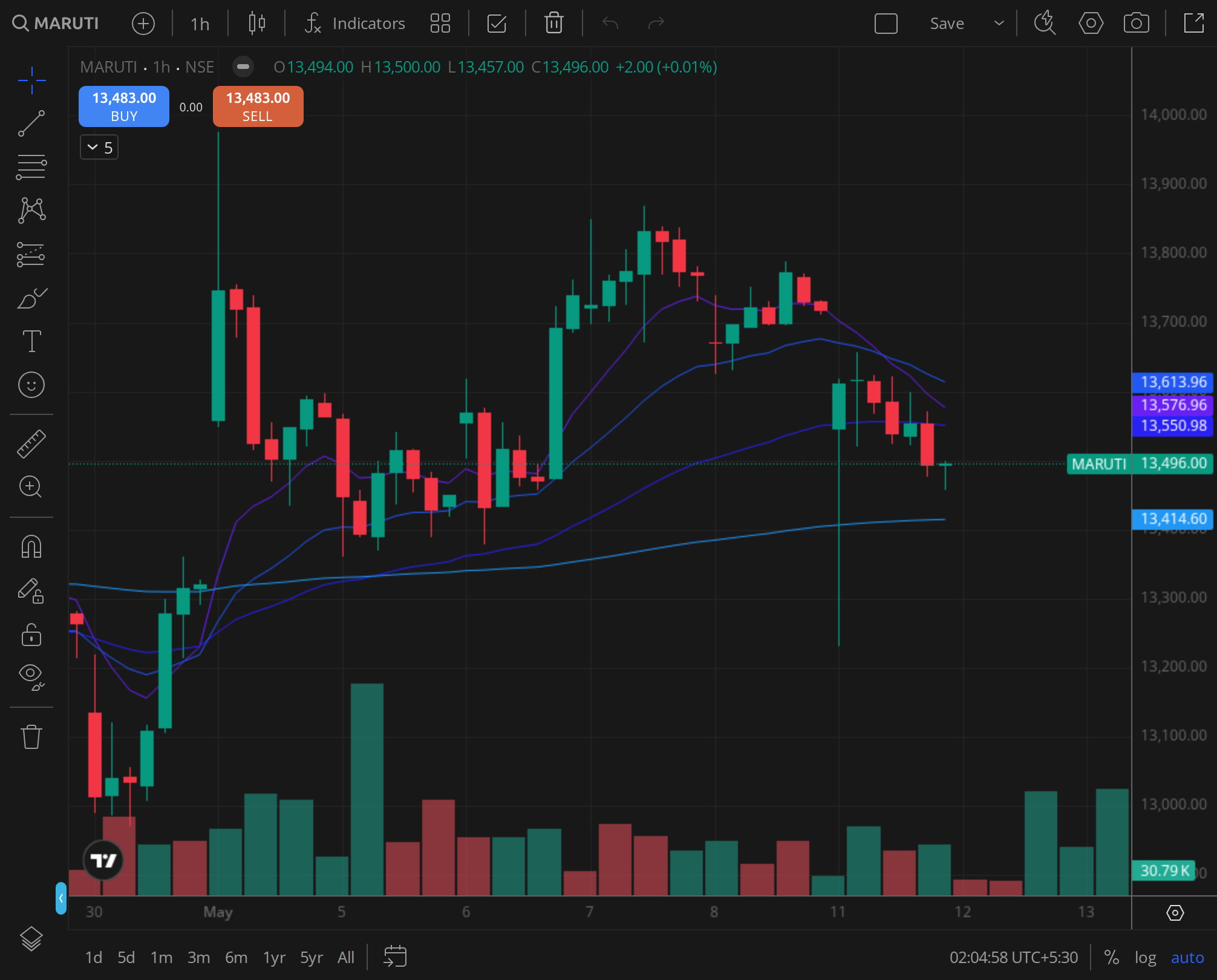
Caption: MARUTI weekly timeframe around 2026-01-13.
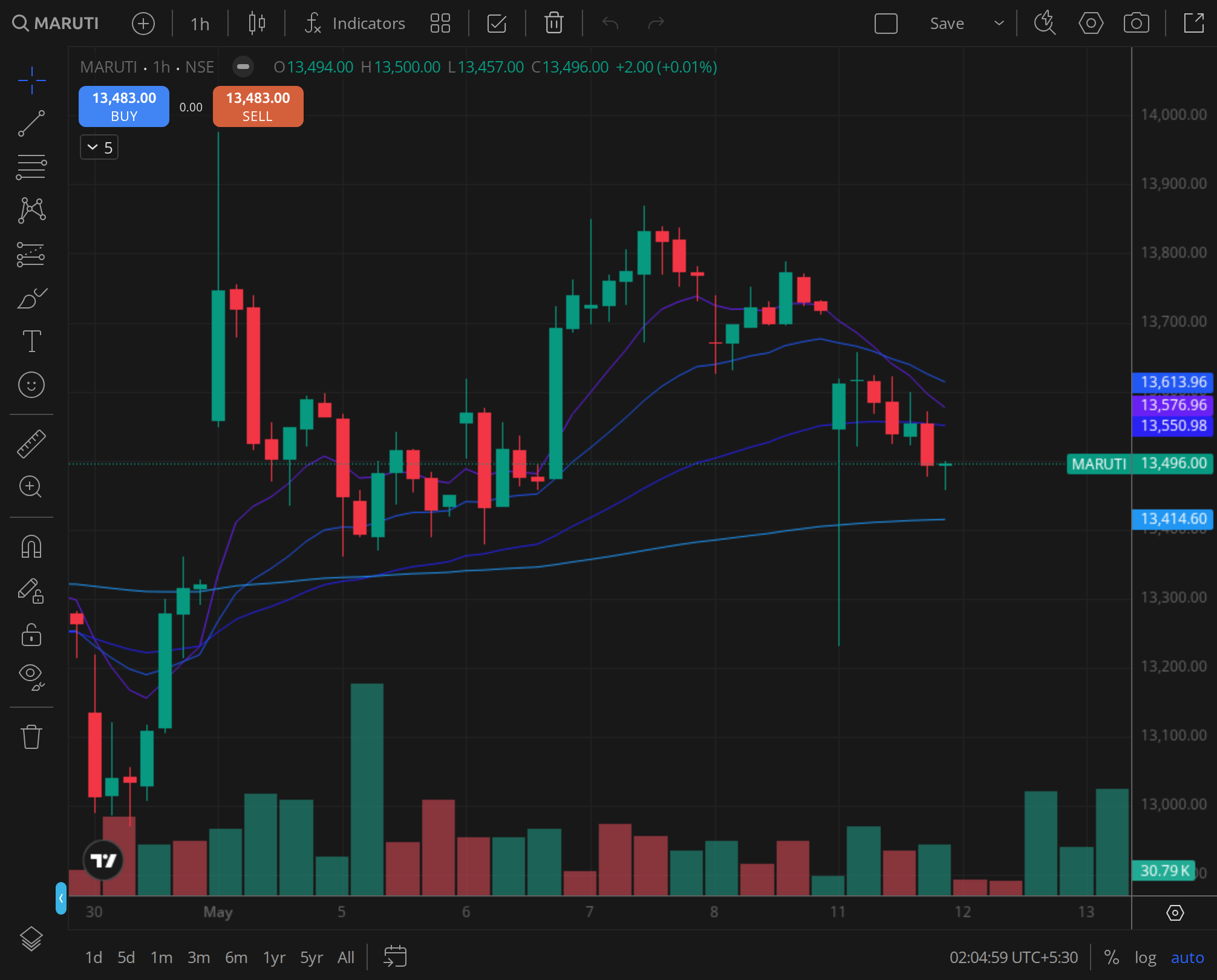
Caption: MARUTI daily timeframe around 2026-01-13.
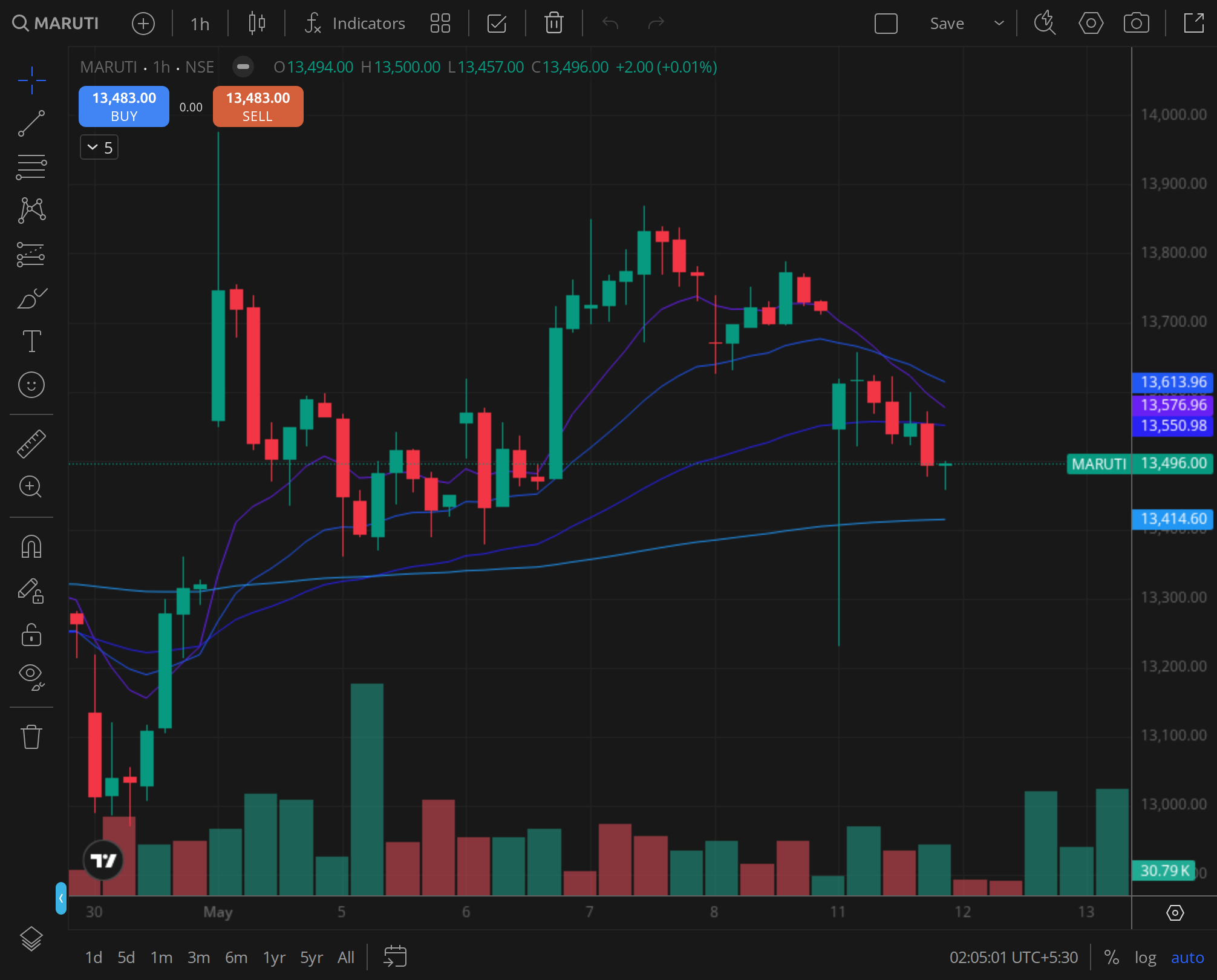
Caption: MARUTI 30min timeframe around 2026-01-13.
To dissect what really happened, one must walk through the technical structure, the fundamental catalysts, the shifting sentiment in derivatives, and the historical echoes that made this rally both intriguing and fragile.
Technical picture: a stairway to resistance
The weekly chart for the period from late November 2025 through late January 2026 revealed a classic higher-low formation. After hitting a low of ₹10,190 in the week ended November 29, the stock formed a bullish engulfing pattern the following week. That candle closed above ₹10,450 and set the stage for a steady, albeit laboured, climb.
The 50-week exponential moving average, which had been hovering near ₹10,800, served as a reliable support during the first half of December. The weekly relative strength index moved from 38 to 52 during the eight-week advance, but never entered overbought territory, a sign that the rally lacked the aggression of a full-blown breakout. The volume profile was instructive: the two heaviest-volume weeks occurred in early December and mid-January, corresponding to the initial thrust and the final approach to resistance. The last week of the window, ending January 28, saw volume shrink by 23% compared to the prior week, confirming that buyers were exhausting themselves near ₹11,000.
On the daily timeframe, the moving average alignment told a similar story. The 20-day EMA crossed above the 50-day EMA on December 18, generating a classic golden cross. However, the 50-day remained below the 200-day EMA throughout the entire window, keeping the long-term trend in a bearish or neutral configuration. The daily MACD histogram turned positive in early December but began to flatten in the second week of January, hinting at waning upside momentum. The stock made a high of ₹11,025 on January 13, the focus date, and then closed that day at ₹10,960, leaving a small upper shadow.
Intraday action on the 30-minute chart around January 13 was particularly telling.
Between January 8 and January 13, the stock oscillated in a tightening range with a declining peak formation. On January 13, the 30-minute bar at 11:30 a.m. Saw a volume spike of 1.8 times the 10-day average as the price tested ₹11,000 for the third time. Each subsequent attempt to break higher was met with a higher number of sellers. The last two hours of trading saw the price slip from ₹10,990 to ₹10,960 on steady selling pressure. The intraday moving average convergence divergence turned negative in the final hour, and the 20-period simple moving average on the 30-minute chart lost its positive slope. These signals collectively suggested that the supply wall at ₹11,000 was genuine and well-defended.
Fundamental catalysts: rural revival and crude relief
The rally from the November low did not occur in a vacuum. Two fundamental tailwinds converged to support the stock. The first was a sharp drop in Brent crude oil prices from around $78 per barrel in mid-November to a low of $68 in late December. For Maruti, crude represents roughly 18% of input costs through derivatives in plastics, tyres, and lubricants. Each $10 swing in crude translates into an approximately 120 basis point impact on operating margins. The benign crude environment allowed analysts to revise upward their margin estimates for the December quarter even before the official release.
The second catalyst was a pronounced rebound in rural demand. Maruti’s management had flagged during the October earnings call that the festive season had been muted in semi-urban markets. However, by late November, anecdotal evidence from dealers pointed to a pickup in inquiries and bookings, particularly for entry-level models like the Alto and S-Presso. The company’s monthly dispatches for December, reported on January 1, showed a 12% year-on-year increase to 1.62 lakh units, with rural markets contributing 43% of the total, the highest share in six quarters. That dispatch number validated the recovery narrative and became the primary driver for the stock’s acceleration from ₹10,600 to ₹11,000 in the first week of January.
The quarterly results for the period ended December 2025 were announced on January 17. Revenue grew 11% year-on-year to ₹33,800 crore, driven by a 9% volume expansion and a modest improvement in average realisations from the CNG and S-CNG mix. Operating margin came in at 12.5%, up 170 basis points from the year-ago quarter but slightly below the consensus estimate of 12.8%. The marginal miss was attributed to higher-than-expected employee cost and marketing spends tied to the new Grand Vitara facelift launch. Net profit rose 19% to ₹2,950 crore, but the stock barely reacted, it gained only 0.8% on the day of the result and gave back half of that the next session.
Peer comparison added to the cautionary note. Tata Motors, Mahindra & Mahindra, and Hyundai Motor India all reported stronger volume growth during the same period, 15%, 13%, and 14% respectively. Maruti’s inability to outgrow its peers in the hotly contested compact SUV segment was a recurring theme in post-result analyst notes. The company’s market share in the overall passenger vehicle segment slipped from 41.5% to 40.8% over the quarter, a marginal erosion but enough to amplify the resistance at ₹11,000.
Sentiment and flow: option chain tells a story of waning conviction
The derivatives market provided the clearest warning that the recovery was running out of steam. On January 13, the open interest snapshot for the January 16 weekly expiry showed that the 11,000 strike call had accumulated 1.25 crore shares of open interest, the highest among all strikes. The 10,800 put had 85 lakh shares. The implied volatility skew favoured calls, with call IV at 18.2% versus put IV at 16.4%, indicating that market makers were pricing in a higher probability of upside but only up to a point.
However, the put-call ratio open interest on January 13 stood at 0.98, down from 1.18 on January 2. The decrease in the ratio suggested that traders were reducing their hedges or bullish bets as the stock approached resistance. In the five sessions between January 8 and January 13, the addition of open interest in the 11,000 call was 27 lakh shares, while the 11,200 call saw only 8 lakh shares added. This implied that most bullish activity was concentrated exactly at the resistance level, with little conviction for a move beyond.
Foreign institutional investors were net sellers of index futures in the week ended January 9 to the tune of ₹1,200 crore in notional value. In stock futures, the net long position in Maruti fell from 320 crore to 260 crore over the same period. Domestic institutions, by contrast, were net buyers of Maruti equities to the tune of ₹180 crore in January. The divergence between FII and DII flows was a familiar pattern in the market during that period, but for Maruti it meant that the buying support was coming from less momentum-driven capital.
Brokerage rating changes during the window were mixed. On December 18, Jefferies upgraded Maruti to buy with a target of ₹12,500, citing the crude tailwind and rural recovery. On January 10, however, CLSA downgraded to hold with a target of ₹11,200, arguing that the stock had fully priced in the near-term benefits and that competition from new launches by Hyundai and Kia would weigh on market share. The downgrade from a house with a strong track record on the auto sector added to the caution around the ₹11,000 level.
Historical analog: echoes of the 2023-24 rally
The current setup bore a striking resemblance to a similar pattern that played out between October 2023 and January 2024. In that instance, Maruti had fallen to a low near ₹9,400 in October 2023 before rallying 10% to test ₹10,350 by mid-January 2024. The rally was driven by a sharp decline in raw material prices (aluminium and steel) and a strong festive season. The resistance at ₹10,350 held for three weeks, and the stock eventually corrected 5% before resuming an uptrend through March 2024.
The key difference between that analog and the current move lay in the volume signature and the option chain backdrop. In the 2023-24 rally, the put-call ratio rose steadily from 0.85 to 1.25 as the stock approached resistance, indicating that traders were buying puts to protect gains, a sign of caution but also of conviction that the uptrend was intact. In the current case, the put-call ratio fell, suggesting a more complacent bullish positioning. Furthermore, in the earlier instance, the stock had broken above its 200-day moving average two weeks before hitting resistance, and the 50-day EMA had already crossed above the 200-day. This time, the 50-day remained below the 200-day throughout, making the resistance more formidable from a structural perspective.
Another historical point of reference was the move from ₹8,500 in March 2020 to ₹8,800 in June 2020, which also stalled at a prior resistance zone. There, the recovery was fuelled by a government stimulus for the auto sector, but fading momentum led to a 12% decline over the following six weeks. The lesson from both analogs was clear: without a fundamental catalyst that can overcome the overhead supply, rallies that reach the zone of prior breakdowns tend to fizzle.
Verdict: a fully played move with an uncertain forward path
Looking back from the end of January, the question of whether the 8% recovery was justified must be answered in two halves. From the November lows to the ₹10,800 level, the move was well-supported by improving fundamentals, lower crude, higher rural dispatches, and a better quarterly result. That leg was logical and healthy. The extension from ₹10,800 to ₹11,000, however, was driven more by momentum than by new information. The result on January 17 was a near-miss from a margin perspective, and the concurrent erosion in market share was a headwind that the price action failed to discount.
The resistance at ₹11,000, defined by the prior swing high from October 2025, the 200-day moving average, and heavy call writing, proved impenetrable in the five trading sessions after January 13. The stock made a second attempt on January 18, touching ₹11,010, but closed that day at ₹10,920. By January 28, the price had slipped to ₹10,650, fully retracing the post-result gains. The 5-day forward read from the focus date thus favoured the bears: the stock ended lower by 3.4% over the subsequent five sessions, validating the warning signs in the intraday and option data.
For traders who played the recovery from the November lows, the ride to ₹11,000 offered a respectable profit. But for those who chased the breakout call into mid-January, the stop-loss was quickly triggered. The broader lesson of this lookback is that in a stock where the long-term trend remains unresolved, rallies to resistance are best viewed as sell-into-strength opportunities unless accompanied by a fundamental catalyst that can decisively shift the supply-demand balance. In Maruti’s case, that catalyst did not arrive.
VERDICT: BEARISH (weekly horizon), the rally stalled at prior resistance, momentum deteriorated, and the stock reversed to retest the ₹10,600 zone. The 5-day forward read from January 13 confirmed the failure. A neutral-to-bearish stance over the next 1-2 weeks was warranted as the stock digested the overhang of call open interest and awaited the next catalyst, be it February dispatch data or a further dip in crude.