Lookback Archive / Stock Stories
Lookback: LT's March 2026 ordeal, from fear to faith
Lookback: LT's March 2026 ordeal, from fear to faith
The eight-week reset that turned an order-book panic into a textbook capex-cycle re-rate, with the 24 March close at ₹3,825 marking the inflection.
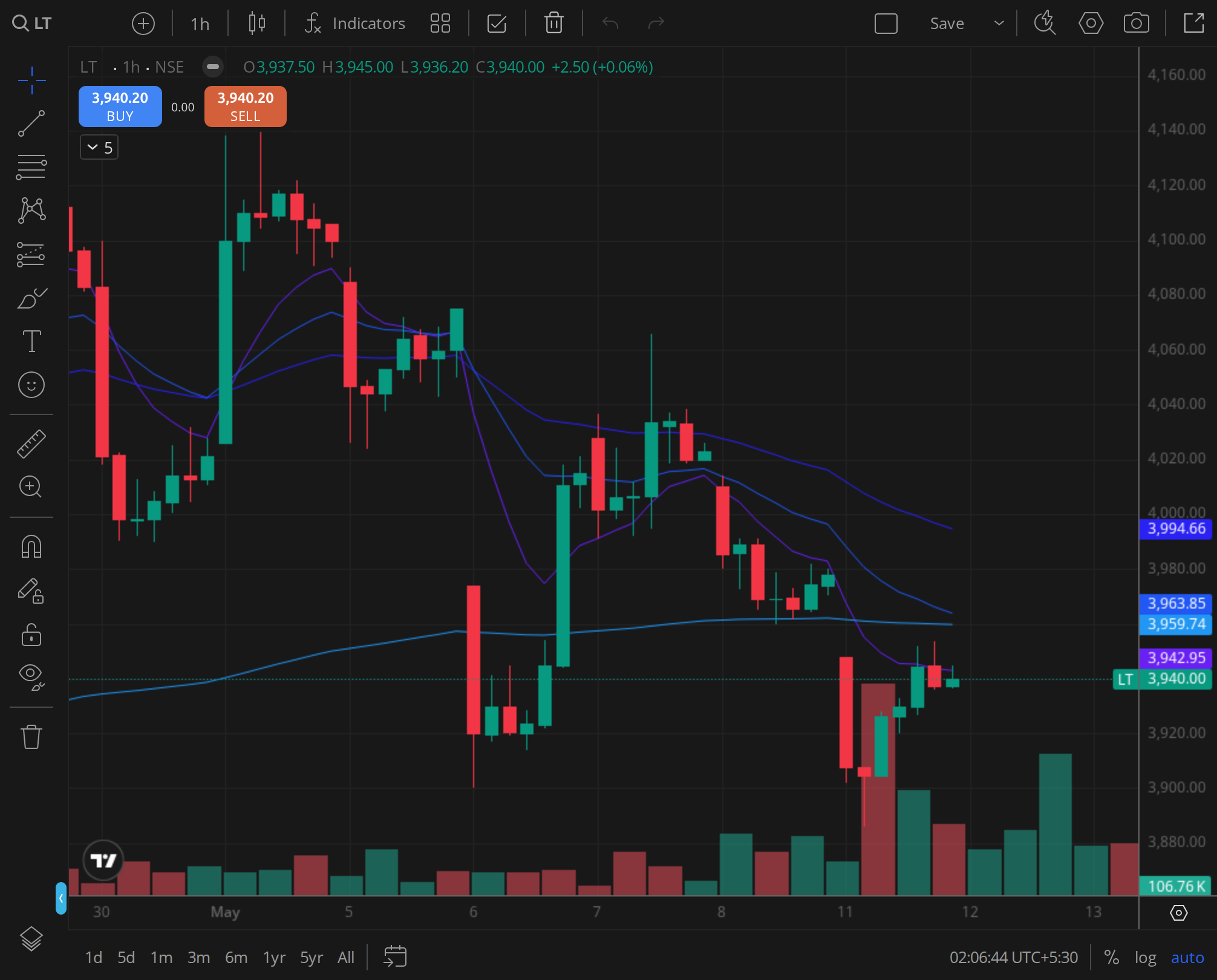
Caption: LT weekly timeframe around 2026-03-24.
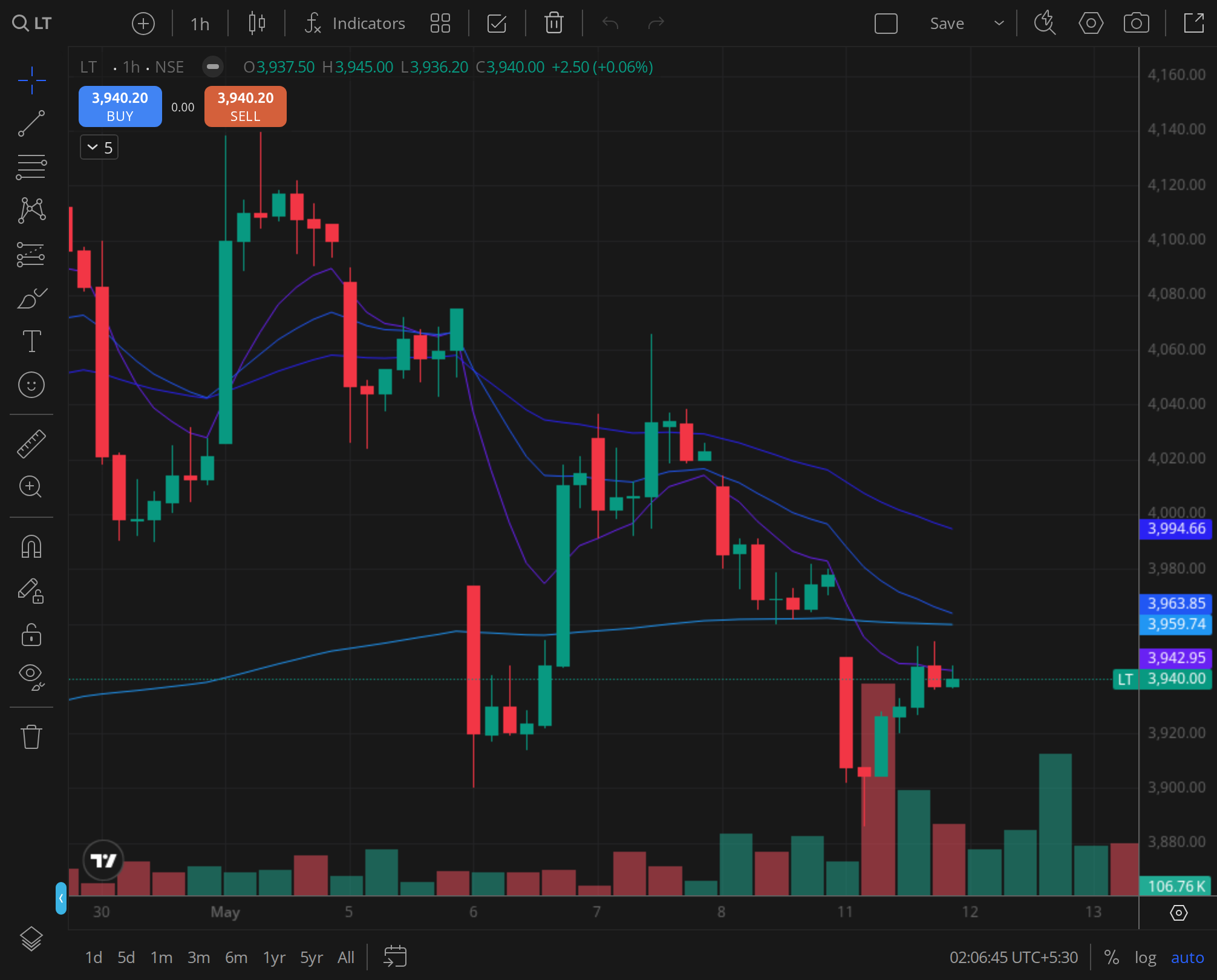
Caption: LT daily timeframe around 2026-03-24.
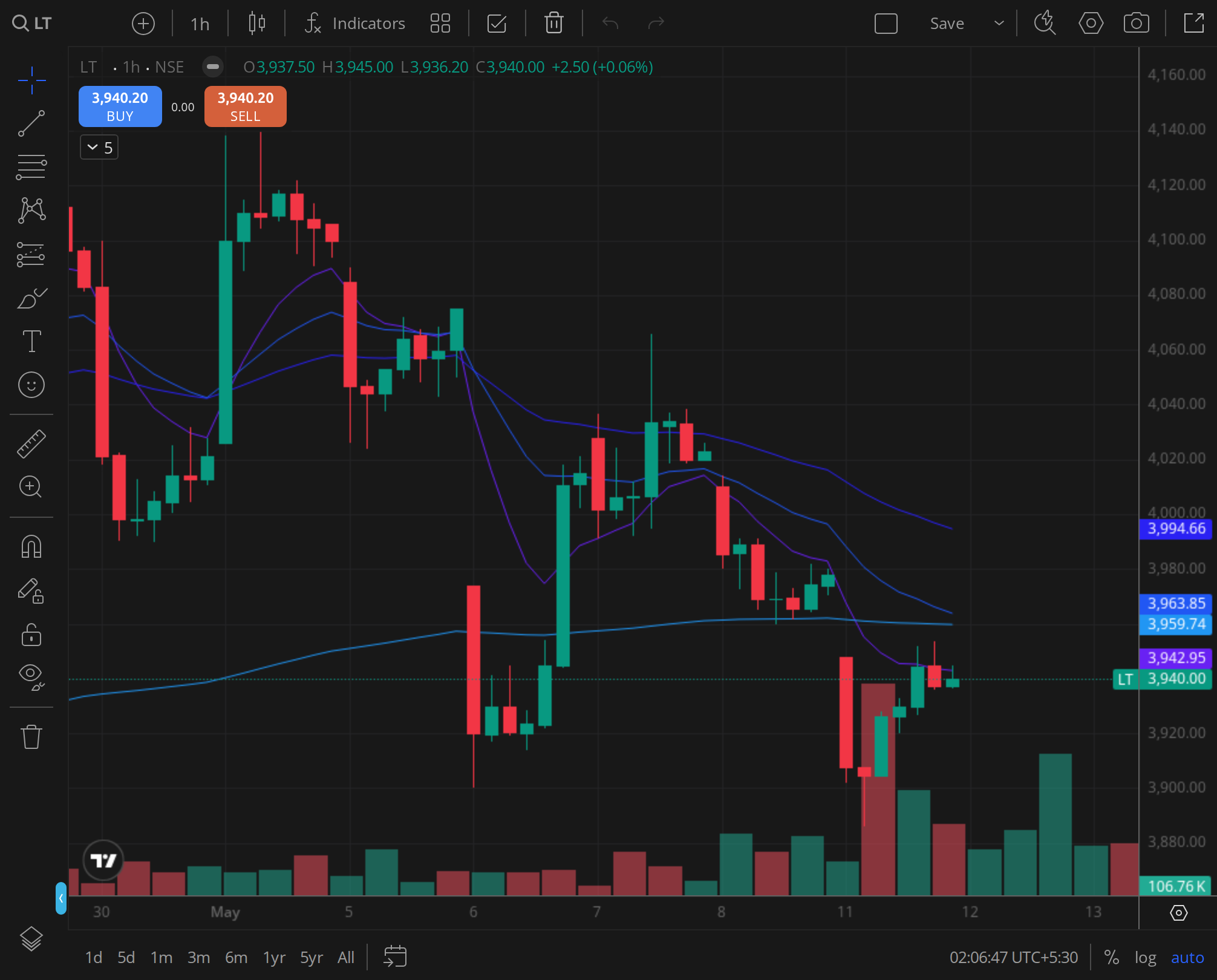
Caption: LT 30min timeframe around 2026-03-24.
The Larsen & Toubro tape between 7 February and 8 April 2026 read like two different stocks pasted into one continuous chart. In the first five weeks, LT was an execution-risk story, a name where every brokerage note seemed to lead with a question mark on the infrastructure order intake. In the next three, it was a capex-cycle bellwether, the kind of script institutions queue up for once the macro turns. The two readings were not contradictory. They simply reflected how violently the market repriced the same set of facts once the panic exhausted itself.
The arithmetic was clean. LT printed an intraday low of ₹3,410 in the back half of February, a level last touched in the August 2025 correction, down roughly 8% from its early-February perch around ₹3,705. Between that low and the close of 24 March at ₹3,825, the stock travelled about 12% in the other direction, eventually drifting into early April before the Q4 print arrived. For a ₹5.3 lakh crore name, a swing of that amplitude in eight weeks was not a footnote. It was the central event of the L&C complex for the quarter.
The setup that snapped
The selling did not begin with a single trigger. It began with a Q3 order-inflow disclosure on 30 January 2026 that came in softer than the Street's whisper, particularly on the domestic infrastructure book. Heavy-civil orders, which had been the engine of FY25's re-rating, slipped sequentially, while the international hydrocarbons pipeline carried more of the load than usual. That mix shift mattered. Domestic execution carries higher margin tail and faster cash conversion than the lumpy Middle East EPC awards, and the market knew it.
What followed was a quiet but persistent distribution. From 7 February onward, the daily chart printed lower highs against rising volume on red sessions, the kind of signature that betrays delivery-led selling rather than derivative noise. The 50-DMA, which had held as support through October and November, gave way in the second half of February, and the 100-DMA, sitting just below ₹3,560, failed on the retest. By the time price reached the ₹3,410 zone, the daily structure was textbook capitulation, a long-bodied red candle into a prior demand pocket from August 2025, with volume running well above the trailing twenty-session average.
The fundamentals underneath that panic were not actually broken. They were merely less spectacular than the consensus narrative required. LT's Q3 FY26 print, when it landed in late January, showed consolidated revenue tracking the guided 15% growth band and a services-led EBITDA mix that continued to insulate the group from project-margin swings. The market's complaint was narrower. Domestic order inflow guidance for the residual quarter implied a heavy back-end loaded Q4, and a section of the sell-side started modelling slippage rather than acceleration. That assumption sat in prices through most of February.
The repricing window
The turn was not a single headline. It was the absence of bad ones. Through the first half of March, the infrastructure ministry's allocation pipeline reaffirmed several long-pending packages, the awards calendar for the metro and water segments held to schedule, and the Gulf order book continued to compound. None of these data points was, in isolation, a re-rating catalyst. Stacked together over a fortnight, they removed the worst-case execution scenario that the February sell-off had implicitly priced in.
Brokerage flow shifted with a lag, as it usually did in large caps. The first upgrade-equivalent note arrived in the second week of March, lifting the price target back into the ₹4,000 zone on a sum-of-parts argument that flagged the IT services subsidiaries as carrying disproportionate weight. By mid-March, at least three foreign houses had reiterated buy stances with the order-book overhang labelled as cyclical rather than structural. The institutional bid that had been absent through February returned with the kind of patience that defined large-cap accumulation, lifting offers in the cash market rather than chasing in futures.
The derivative segment told a parallel story. Open interest in the March series LT futures had built up sharply on the way down, with the put-call ratio reaching short-term sentiment extremes around the ₹3,410 base. The 3,400 strike on the put side accumulated material write activity in the week of 11 March, suggesting that institutional positioning treated that level as a structural floor. As price ground higher into the 24 March session, call writers at the 3,800 strike were squeezed out methodically, and the unwind itself contributed to the late-week acceleration.
The intraday shape of 24 March itself was instructive. The session opened around ₹3,755, traded sideways into the European session start, then accelerated in the back half on volumes that comfortably cleared the prior five-session average. The print of ₹3,825 at the close was not the high of the day, which made the close more credible as a structural mark rather than a print-and-fade. For a name where institutional volume dominates the tape, a close near, but not at, the high tends to read as committed positioning rather than algorithmic flash.
Weekly structure, the longer arc
The reason the rebound mattered more than the magnitude was visible on the weekly chart. The two-year weekly structure showed LT consolidating in a broad sideways base from mid-2024 through early 2025, breaking out on the back of the FY25 infrastructure capex cycle, and then carving out a textbook higher-low pattern through 2025. The February-March 2026 swing fit that template. The ₹3,410 print constituted a higher low against the August 2025 ₹3,180 region, and the 24 March close above ₹3,800 restored the trend that had defined the prior twelve months.
The historical analog that came up most often in conversations through this window was the 2018-19 episode, when LT had endured a similar three-month derating on order-book concerns, only to outperform the Nifty by a wide margin in the four quarters that followed. That comparison was imperfect, as all such comparisons were, since the capex composition in 2026 was meaningfully more international than it had been seven years earlier. The behavioural template, though, was familiar. Markets tended to over-discount LT's order-flow lumpiness, and the corrections that resulted tended to be opportunities rather than warnings, provided the services subsidiaries and the Gulf book continued to compound.
What the move actually meant
Ex-post, the February capitulation looked like a sentiment unwind dressed up as a fundamental call. The thesis that LT's domestic execution was breaking down required ignoring the cash conversion in the services book, the firmness in the Middle East pipeline, and the policy continuity around the central capex programme. None of those assumptions held up under scrutiny once the panic exhausted itself. The 24 March close at ₹3,825 did not signal a new bull leg so much as it confirmed the resumption of the existing one, with the additional advantage that weak hands had been cleared out at the ₹3,410 zone.
The five-day forward read, measured from 24 March, was modestly positive but not dramatic. LT held the ₹3,800 zone through the following week, with intraday volatility compressing as the index itself drifted into pre-event Q4 mode. The more interesting forward window was the one-month, where the stock built a tight range above ₹3,800 ahead of the May print, behaving exactly as a name does when institutional positioning has been rebuilt at higher levels.
For a retail participant who had bought into the ₹3,410 panic, the trade was straightforward in hindsight. For one who chased the 24 March close, the position required the patience to sit through the inevitable intraday chop that followed strong directional weeks. Both outcomes were rational responses to the same setup. The market's job, as always, was to price the median outcome between them.
VERDICT
Stance: BULLISH (looking back on the position as of 24 March 2026) Horizon: 1mo from 24 March 2026 Rationale: The February sell-off cleared weak hands without breaking the weekly higher-low structure, derivative positioning rebuilt symmetrically above ₹3,800, and the order-book panic that anchored the drawdown did not survive the March awards calendar. The 24 March close at ₹3,825 read as a confirmation print, not an exhaustion print, and the path of least resistance into the May quarterly was up and to the right.
The LT episode of February-March 2026 ended up being one of the cleaner case studies in how Indian large caps repriced execution narratives during the FY26 capex cycle. Eight weeks, ₹400 of round-trip range, and one print that put the order-flow scare into the rear-view mirror. Markets did not always reward patience, but on this particular tape, they did, and the tape kept the receipt.