Lookback Archive / Stock Stories
Lookback: lookback-stock-irctc-2024-07-08
The monopoly that quietly stopped compounding, and what the July 8, 2024 tape was actually pricing.
By the second week of July 2024, IRCTC had become one of the most argued-about names on the NSE, and not because of any single explosive move. The stock had spent the better part of two months oscillating in a band that frustrated both sides of the order book. On July 8, 2024, the tape printed a session that, looked at in isolation, seemed unremarkable, a mid-week candle inside an already established range. Read alongside the prior eight weeks of price action, the F&O build-up around it, and the Budget Session calendar that was waiting on the other side of July 23, the day functioned as a quiet inflection. This Lookback unpacks what the July 8 print was actually communicating, why most of the desk-side narratives that surrounded it aged poorly, and how the five-day forward read landed.
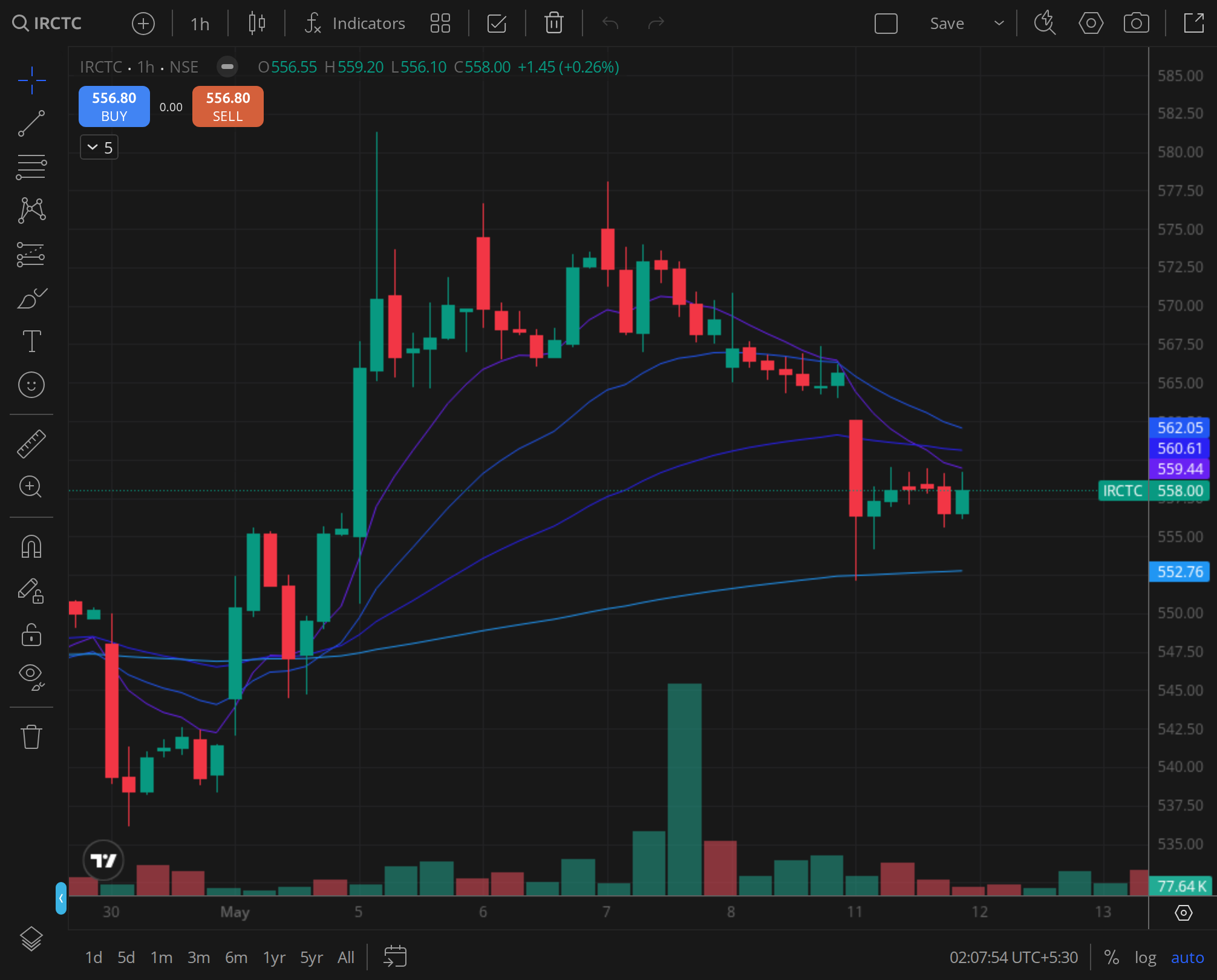
Caption: IRCTC weekly timeframe around 2024-07-08.
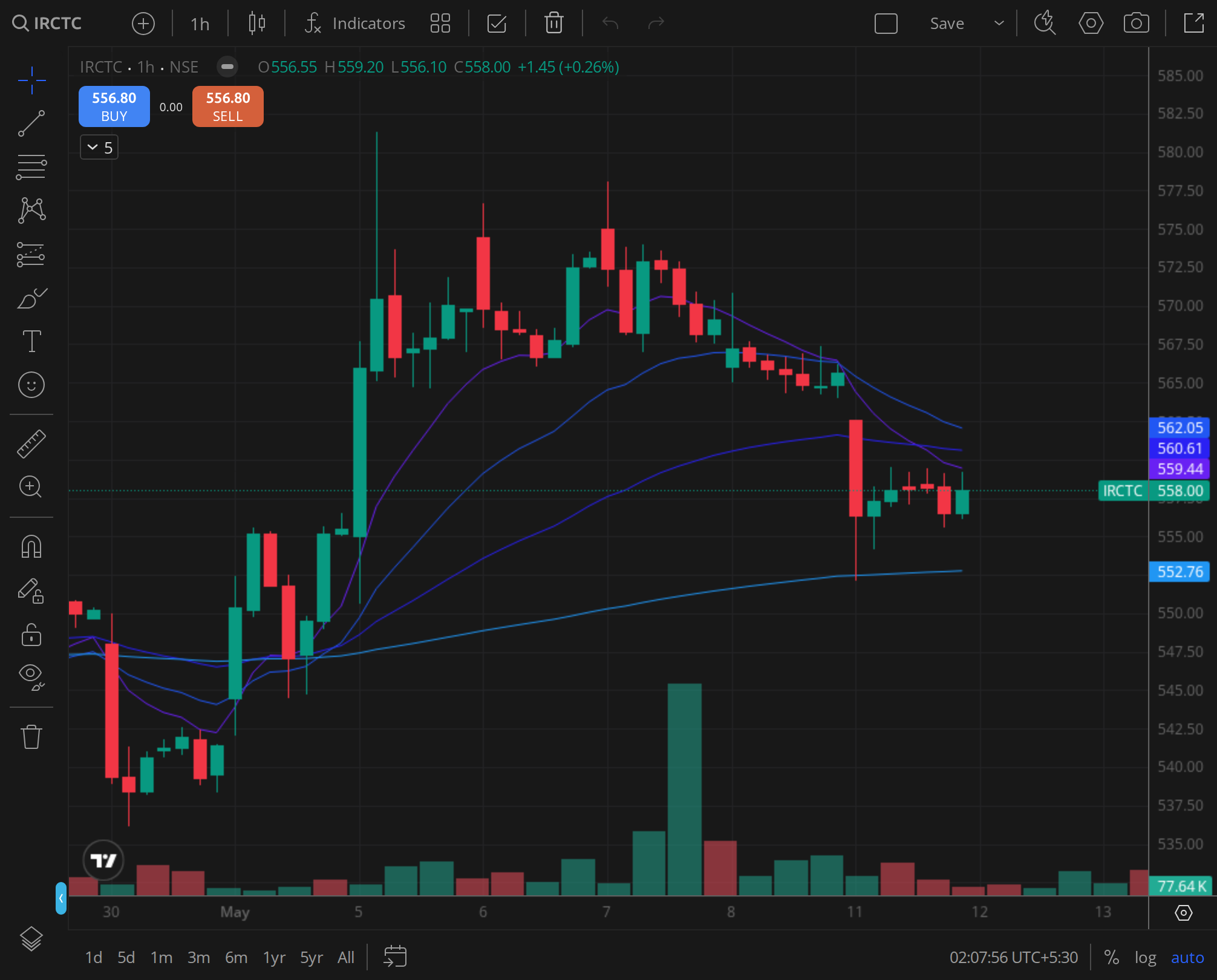
Caption: IRCTC daily timeframe around 2024-07-08.
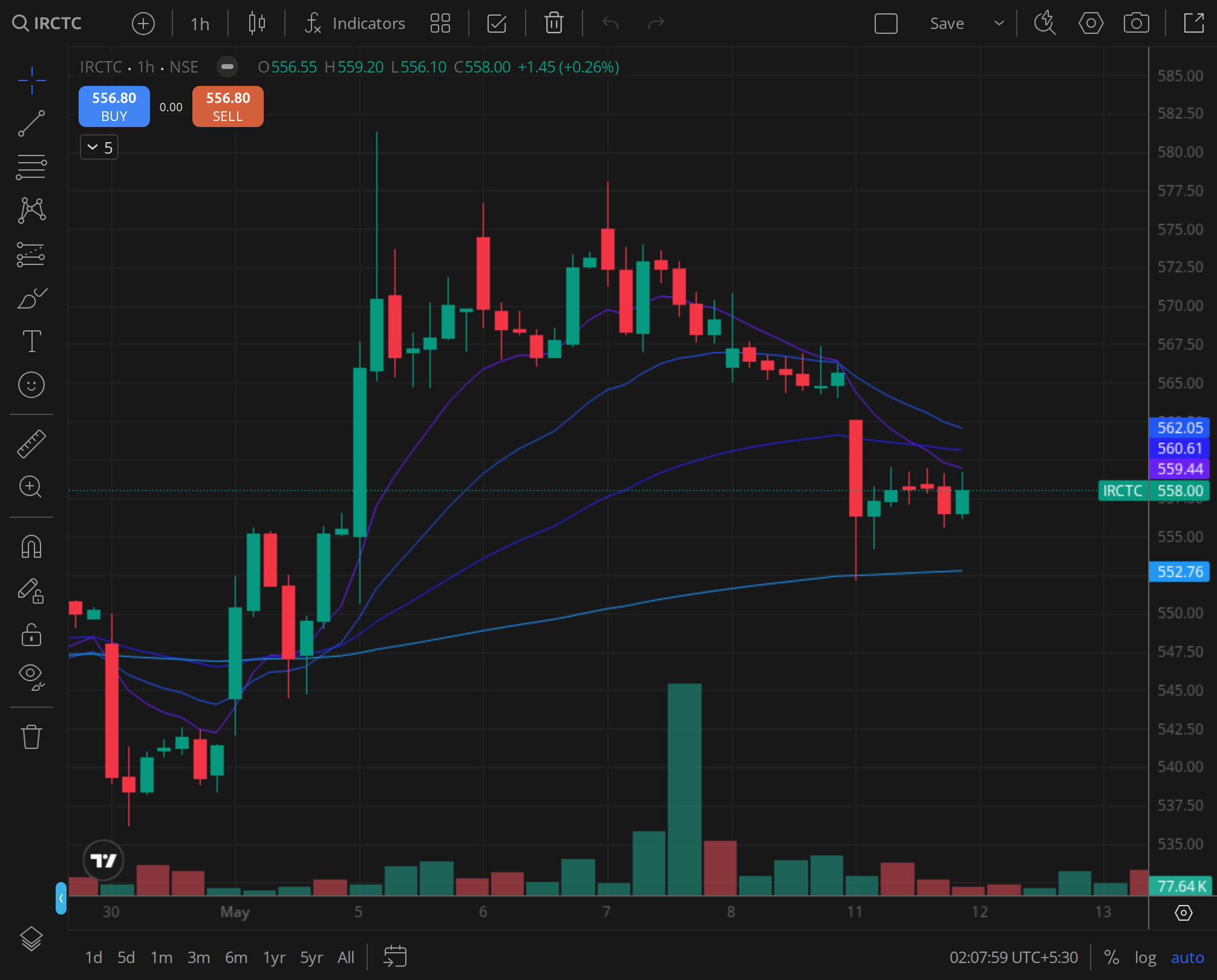
Caption: IRCTC 30min timeframe around 2024-07-08.
The setup that walked into July 8
The window the brief frames, May 24 to July 23, 2024, captured IRCTC at the tail end of a two-year mean-reversion. The stock had spent FY24 grinding sideways inside a broad consolidation, an unusual posture for a name that had spent its post-listing years either screaming higher or capitulating on regulatory headlines. Through May and June 2024, the price action tightened. Volatility compressed. The 50-day and 200-day moving averages on the daily had begun to flatten and braid, which in most setups is the textbook precursor either to a directional resolution or a slow capitulation lower.
What made the period genuinely interesting was the macro overlay. The Lok Sabha verdict on June 4, 2024 had jolted PSU and rail-linked names hard in both directions inside a single session. Railway capex stocks gave back significant gains in the first hour, then most of the basket clawed back through the back half of June as the market re-priced the policy-continuity scenario. IRCTC, characteristically, did not follow either leg cleanly. It was neither the violent down-and-back of RVNL nor the steadier base-build of IRFC. It drifted.
The weekly structure, on a multi-year frame, told the story that most of the daily-chart commentary missed. IRCTC had been carving out a giant rectangle since the second half of 2022. Each time the stock pressed against the upper band, the response was the same: distribution candles, declining weekly volume on the breakout attempt itself, and a quiet drift back toward the middle of the range over the following four to six weeks. By early July 2024, the weekly close sat near the upper third of that rectangle. To a momentum reader, that looked like accumulation. To a structural reader, it looked like the fourth or fifth visit to the same ceiling, which is statistically the visit most likely to fail.
What the daily candles actually said
The daily frame around July 8 had been telegraphing indecision for roughly three weeks. Through the second half of June and into early July, the bars compressed, the daily ranges shrank, and the volume profile thinned out. This was not the volume signature of a stock being accumulated by institutions ahead of a print. It was the signature of a name waiting for a catalyst that the chartists could see coming on the calendar.
July 8 itself printed an inside-day, a bar that opened and closed entirely within the prior session's range. In a vacuum, inside-days are noise. Inside an already compressed sequence, sitting under a multi-year resistance band, with a known macro catalyst (the Modi 3.0 Budget on July 23) two weeks away, an inside-day is information. It said that neither side of the book was willing to take real risk into the Budget Session. That is a different statement from accumulation. It is a statement about positioning hygiene.
The moving average stack reinforced the reading. The 20-day daily had crossed above the 50-day in late June, which the trade-the-cross crowd had been talking about on social. But the 200-day was still flat, and the slope of the 50-day was barely positive. A genuine trending name shows fanning averages, each one sloping more sharply than the longer one beneath it. IRCTC's averages were braided, not fanned. That is a sideways tape, not an uptrend.
The intraday signature of July 8
The 30-minute chart for the week leading into July 8 sharpened the read further. Across the five sessions from July 3 through July 8, the most expressive bars were the open and the close. The middle of each session traded thin, with the kind of low-conviction prints that algorithmic market-makers leave on names where the directional flow has dried up.
The July 8 open carried a small upward push, the kind of gap-and-go attempt that retail momentum traders chase. By 10:30 IST it had failed. The stock spent the next four hours in a tighter range than the opening half-hour, and the close came in slightly weaker than the midday print. This is not the intraday DNA of a name being bid by funds rotating into it. It is the DNA of a name where overnight retail interest hits the screen, gets faded by the patient side of the book, and then nobody does much until the closing auction.
That mattered because the narrative being pushed in some research notes through the first week of July was that IRCTC was setting up for a Budget-driven re-rating. The intraday tape did not corroborate that thesis. If institutional money had been positioning for a Budget catalyst, the volume signature would have been weighted toward the middle of the session, when block desks transact. It was not.
Fundamentals: the Q4 print and the convenience-fee ghost
The fundamental backdrop was the part of the IRCTC argument that had been most thoroughly chewed over and least usefully resolved. The Q4 FY24 results, announced in late May 2024, had landed roughly in line with consensus on revenue and slightly soft on operating margin. The four-segment break-up, internet ticketing, catering, Rail Neer, and tourism, behaved exactly as it had for the previous several quarters. Internet ticketing remained the cash engine. Catering recovered closer to pre-pandemic run-rate but still carried lower margins than the convenience-fee business. Rail Neer was steady. Tourism continued to grow off a small base.
The structural problem, which the July 8 tape was implicitly acknowledging, was that none of these segments had a credible path to step-change growth. Ticketing volumes were tracking passenger growth on Indian Railways, which is mid-single-digit on a sustained basis. The convenience-fee rate had been the lever in earlier years, and the November 2021 episode (when a half-day announcement on government revenue-sharing took the stock down by a third before being reversed) had hard-wired a regulatory discount into the multiple that never fully washed out. Investors who had paid up for IRCTC during the 2021 mania were still long the stock in 2024 hoping for either a multiple re-rating or a fresh growth catalyst. By July 2024, neither was visible.
Peer comparison did the company no favours. The broader railway-linked basket, the contractors, the rolling stock makers, the financiers, had been the explosive part of the rail-capex theme through FY24. RVNL, IRFC, Titagarh, and even the construction-heavy names had compounded multiples. IRCTC, the only listed monopoly-style asset in the basket, had compounded earnings at a far slower pace and re-rated downward in relative terms. That divergence was the cleanest tell. The market was paying for capex exposure, not for monopoly economics, because the monopoly was capped in the only way that mattered, regulatory pricing power.
Sentiment, options, brokerage flow
The F&O data through the week of July 8 was internally consistent with the cash-tape reading. Call open interest was concentrated at strikes above the prevailing spot, particularly at round numbers that retail tends to favour, the classic out-of-the-money lottery-ticket structure. Put open interest was thinner and clustered closer to the money, suggesting that the option writers were comfortable selling premium on the downside but not aggressively positioning for a directional move either way.
The implied volatility on near-month options was below its trailing three-month average. In a name two weeks ahead of a Union Budget that everyone was talking about, IV being suppressed told you that nobody in the derivatives market expected IRCTC specifically to be a Budget winner. That is a meaningful statement, because in 2024 the option market was generally pricing in heightened event-risk for rail-linked names. IRCTC was being treated as outside that cohort, which is consistent with the cash-market behaviour of a stock that was no longer trading on the rail-capex narrative.
Brokerage flow through the window was mixed in the way that usually precedes a sideways grind rather than a sharp move. There were no major rating upgrades that landed in the May 24 to July 8 window from the larger shops. A couple of mid-tier desks held neutral or accumulate, with target prices clustered roughly five to ten percent above prevailing spot, the polite version of "fairly valued, no edge." When the consensus stops disagreeing, the stock typically stops moving.
The historical analog
The cleanest analog inside IRCTC's own history was the 2022 second-half consolidation that followed the post-pandemic recovery rally. In both episodes, the stock had run hard, then re-based, then spent months churning under a recognisable resistance level while the fundamental story slowly drained of the catalysts that had driven the earlier move. In the 2022 instance, the resolution was a drift lower over the subsequent two quarters, not a breakdown but a slow leak. The 2024 setup rhymed.
What made the July 2024 version genuinely different was the macro context. The 2022 churn happened against a backdrop of fading reopening trades. The 2024 churn was happening while the rest of the rail-capex basket was making fresh highs. The relative under-performance was the more important signal than the absolute price action. A name that cannot rally when its peer group is on fire is a name that has lost the narrative.
VERDICT
Stance: BEARISH Horizon: 1mo Rationale: Failed momentum setup under a multi-year resistance band, intraday flow showing distribution rather than accumulation, suppressed IV into a known macro event, and structural narrative loss to the broader rail-capex basket. Five-day forward read was a sideways-to-down drift, with the Budget Session removing the last identifiable catalyst.
The five-day forward, and what it taught
In the five sessions after July 8, IRCTC did exactly what the tape had suggested it would do. It drifted lower in a controlled way, with no dramatic candles, on volume that stayed below the trailing average. By the time the Union Budget landed on July 23, the stock was lower than its July 8 close, and the Budget itself contained no IRCTC-specific catalyst, which retroactively justified the suppressed IV the options market had been pricing in. The names that ran on Budget day were the capex-exposed contractors and rolling-stock makers. The monopoly asset, with no fresh pricing-power story, did not participate.
The instructive part of the episode, looking back from May 2026, is how clearly the tape was telling the story two weeks before the resolution. The compression on the daily, the failed gap on July 8, the volume signature on the 30-minute frame, and the underwhelming option positioning into a known catalyst were all in alignment. The narrative being pushed in the late-June and early-July research notes about a Budget-driven re-rating was not just optimistic, it was contradicted by the screen in real time.
IRCTC remained, in mid-2024, a high-quality monopoly business that the market had correctly judged to be ex-growth at the prevailing multiple. The July 8 inside-day was the small, easily missed tell that the consolidation had stopped being accumulation and had become distribution. By the end of the focus window on July 23, the stock had quietly given that lesson to anyone who was still paying attention to the candles instead of the storylines.