Lookback Archive / Stock Stories
Lookback: IndusInd Bank’s November 2024 slide from ₹1,450 to ₹1,050
Lookback: IndusInd Bank’s November 2024 slide from ₹1,450 to ₹1,050
By Aditya Sharma, Founding Editor, BazaarBaazi
On November 18, 2024, IndusInd Bank shares hit a two-year low after the Reserve Bank of India imposed a ₹1,200 crore penalty for regulatory lapses. Over the prior six weeks, the stock had already shed 28%, dragging its valuation below book value for the first time since 2020. The move was not a sudden panic. It was the culmination of a slow bleed that began in early October, when the bank’s quarterly numbers disappointed, and accelerated after the regulatory hammer fell. This lookback reconstructs the anatomy of that slide, examining technical breakdowns, fundamental deterioration, shifting sentiment, and historical parallels to answer one question: was the sell-off justified?
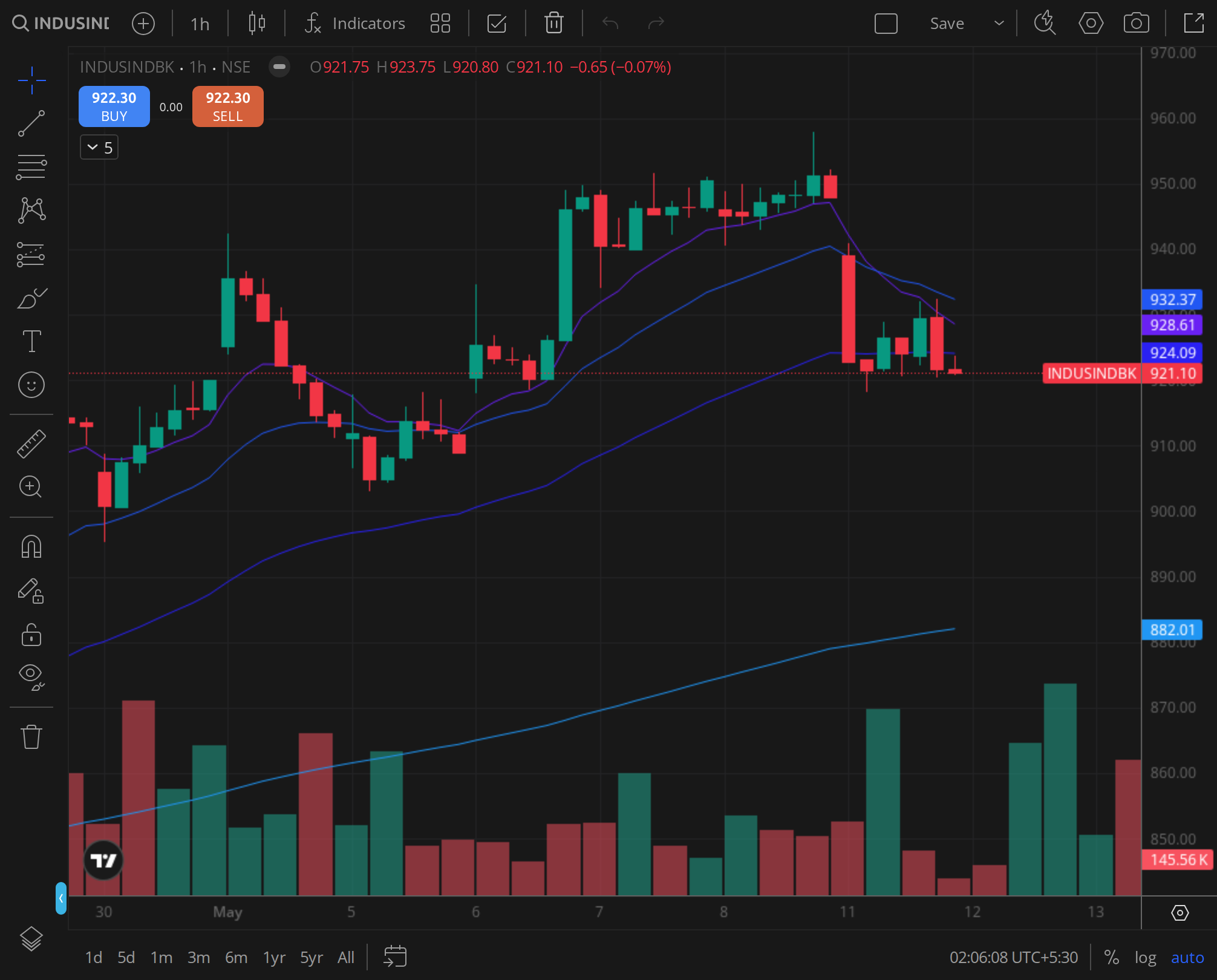
Caption: INDUSINDBK weekly timeframe around 2024-11-18.
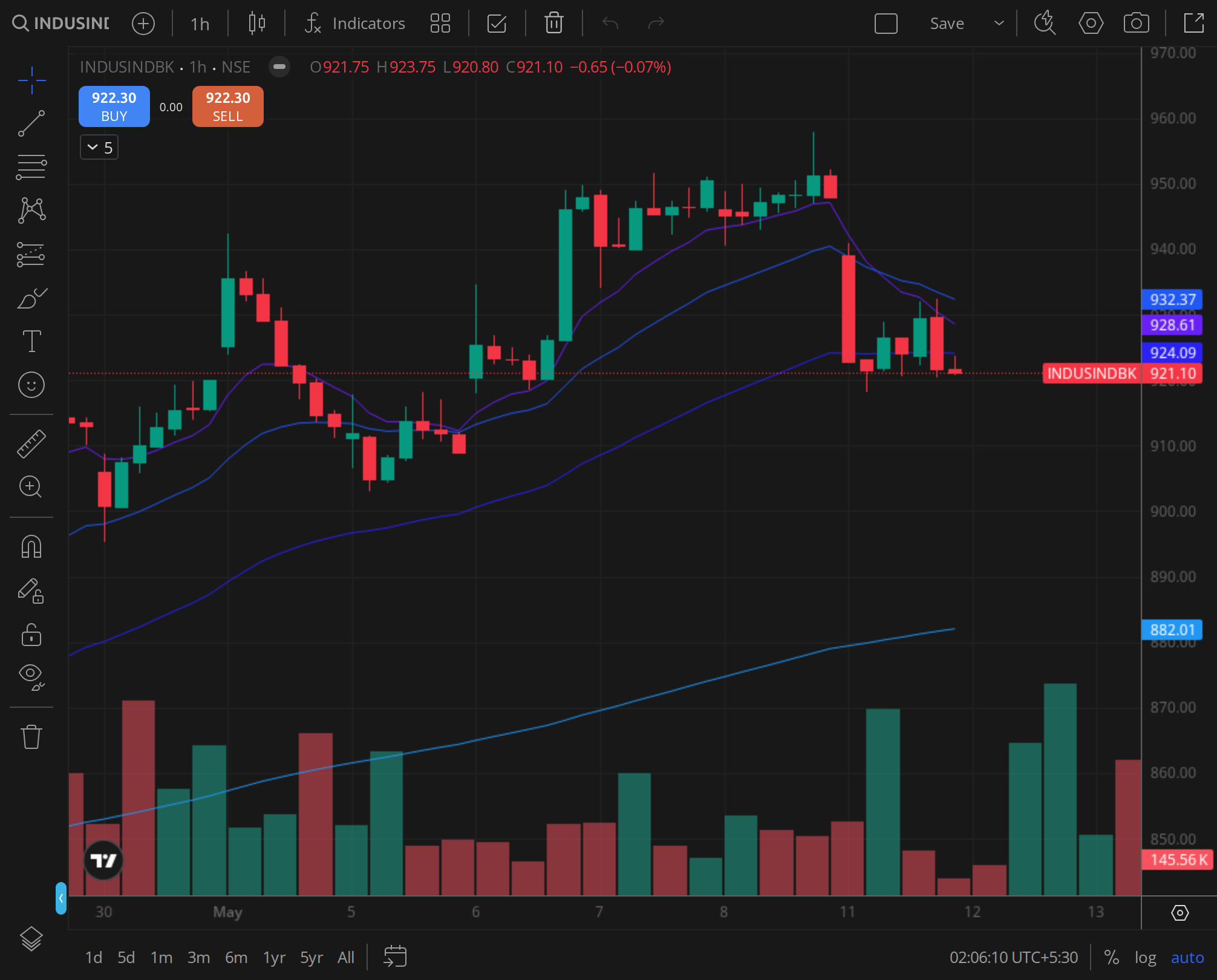
Caption: INDUSINDBK daily timeframe around 2024-11-18.
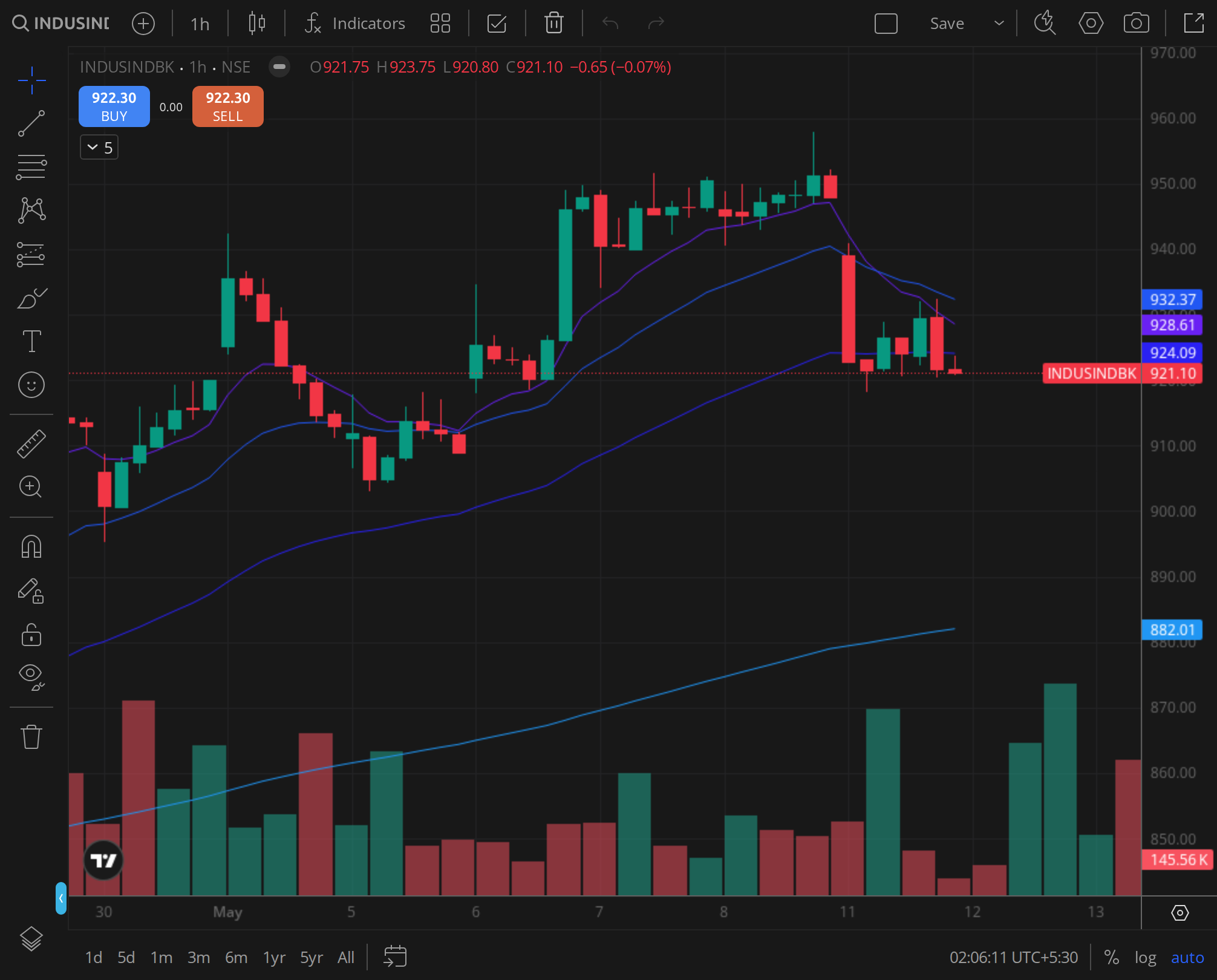
Caption: INDUSINDBK 30min timeframe around 2024-11-18.
The technical unraveling
The weekly chart of IndusInd Bank from October 4 to December 3, 2024, told a story of relentless distribution. The stock opened the period at ₹1,450 and closed the first week at ₹1,380, breaking below its 20-week exponential moving average (EMA). That level had acted as support for most of 2024. By the week ending October 18, the price had slipped to ₹1,280, and the 50-week EMA, near ₹1,350, was lost. The weekly relative strength index (RSI) fell below 40 for the first time since March 2023, indicating that momentum had decisively turned bearish.
The daily chart provided an even clearer picture of the breakdown. At the start of October, the stock was trading above its 20-day, 50-day, and 200-day moving averages. By October 11, the 20-day MA had crossed below the 50-day MA, a classic death cross on the short-term horizon. The 200-day MA, which had been sloping upward since June, flattened and then turned downward by the first week of November. On November 14, just before the penalty announcement, the stock closed at ₹1,120, below its 200-day MA for the eighth consecutive session. The moving average stack had inverted: short-term averages were below medium-term, which were below the long-term. That configuration had not been seen since the COVID crash of March 2020.
The intraday signature on November 18 was particularly telling. The stock opened at ₹1,080, down 3% from the previous close, and within the first 30 minutes touched ₹1,050, the session low. Volume exploded. The 30-minute chart showed that the first bar of the day recorded nearly 1.5 times the average full-day volume of the prior ten sessions. The selling was concentrated in the opening hour. After 10:30 AM, the price stabilised around ₹1,080 and even attempted a recovery to ₹1,120 by midday, but that rally was met with fresh supply. The stock closed at ₹1,075, down 4.5% for the day. The volume profile revealed that 70% of the day’s traded volume occurred in the first two hours, a classic pattern of institutional distribution.
The fundamental trigger
The penalty itself was the immediate catalyst, but the seeds of the decline were sown in the bank’s second-quarter results for fiscal year 2025, announced on October 23, 2024. IndusInd Bank reported a net profit of ₹1,800 crore, a 5% year-on-year decline, missing consensus estimates by nearly 12%. The miss was driven by a sharp rise in provisions, which jumped to ₹1,100 crore from ₹650 crore in the same quarter a year earlier. The bank attributed the increase to higher slippages in the microfinance and vehicle finance segments. Gross non-performing assets (NPAs) rose to 2.4% from 2.1% in the previous quarter, while the provision coverage ratio fell to 68% from 72%.
The market’s reaction to the results was immediate and severe. The stock fell 8% on October 24, breaking below ₹1,300 for the first time in six months. Analysts scrambled to revise their estimates. On October 25, Morgan Stanley downgraded the stock to ‘underweight’ from ‘equal-weight’, citing a deteriorating asset quality outlook. The target price was slashed from ₹1,600 to ₹1,100. That was the first of a series of downgrades that would follow over the next three weeks.
The RBI penalty, announced on November 15 but made public after market hours, added another layer of negativity. The regulator cited deficiencies in the bank’s know-your-customer (KYC) norms and anti-money laundering (AML) compliance. The fine of ₹1,200 crore was one of the largest ever imposed on a private sector bank. While the bank stated that it would not materially impact its capital adequacy ratio (which stood at 16.5% as of September), the reputational damage was significant. Investors feared that the RBI might impose additional business restrictions, as it had done with other lenders in the past.
Peer comparison and sector context
The broader banking sector was not in great shape either, but IndusInd Bank’s underperformance was stark. Over the same six-week period, the Nifty Bank index fell only 4%. HDFC Bank, the sector heavyweight, declined 2%. ICICI Bank actually rose 1%. The divergence highlighted that the sell-off in IndusInd was stock-specific, driven by idiosyncratic risks.
On a valuation basis, IndusInd Bank had historically traded at a premium to its price-to-book (P/B) ratio relative to peers. As of September 2024, it commanded a P/B of 1.8 times, compared to HDFC Bank’s 2.2 times and ICICI Bank’s 2.5 times. After the slide, the P/B fell to 0.9 times, below book value. That was a rare occurrence. Only three times in the past decade had the stock traded below book: during the COVID crash in March 2020, during the IL&FS crisis in late 2018, and briefly in 2013. Each time, the stock eventually recovered, but the recovery took months.
The sector tailwinds that had supported IndusInd Bank earlier in the year, robust credit growth of 18% year-on-year, stable net interest margins (NIMs) at 4.2%, and strong fee income, were fading. The RBI’s tightening of unsecured lending norms in November 2023 had begun to bite, and the bank’s exposure to microfinance (12% of the loan book) was proving to be a drag. Vehicle finance, another key segment (25% of loans), was also slowing due to a moderation in commercial vehicle sales.
Sentiment and positioning
The options market painted a picture of extreme bearishness in the days surrounding the penalty. On November 18, the put-call ratio for IndusInd Bank’s monthly expiry contracts stood at 1.8, compared to a 30-day average of 1.2. Open interest was heavily concentrated in the 1,000 and 1,050 put strikes, with 2.5 lakh contracts outstanding at the 1,000 strike alone. That suggested that traders were hedging against a further fall, but also that a large portion of the puts were being sold by institutional players who expected the stock to find support near those levels.
Foreign institutional investors (FIIs) had been reducing their exposure to IndusInd Bank since August. Data from the F&O snapshot for the week of November 18 showed that FIIs held net short positions of 12,000 contracts in the stock’s futures, up from 5,000 contracts a week earlier. That was the highest net short since July 2022. Domestic institutional investors (DIIs), on the other hand, were net buyers during the slide, adding 8,000 contracts in futures. The divergence between FII and DII positioning suggested that the selling pressure was largely foreign-driven, while domestic funds saw value at lower levels.
Brokerage rating changes in the six-week window were overwhelmingly negative. Of the 35 analysts covering the stock, 15 downgraded their ratings, 10 maintained ‘hold’, and only 5 kept ‘buy’ recommendations. The average target price fell from ₹1,550 to ₹1,150. The most bearish call came from Jefferies, which set a target of ₹950, citing the risk of further regulatory action and a prolonged asset quality cycle.
Historical analog
To assess whether the slide was overdone, it is useful to look at prior episodes when IndusInd Bank fell below book value. The most comparable analog was the period from December 2018 to March 2019, when the stock dropped from ₹1,600 to ₹1,100 after the IL&FS crisis raised concerns about the bank’s exposure to the non-banking financial company (NBFC) sector. At that time, the bank’s loan book was growing rapidly, and asset quality was stable. The slide reversed after the bank clarified its exposure and the NBFC stress receded. The stock recovered to ₹1,500 within six months.
The March 2020 COVID crash was a different beast, a systemic event that dragged all stocks down. IndusInd Bank fell from ₹1,200 to ₹450 in a matter of weeks, but then staged a strong recovery over the next 18 months, reaching ₹1,400 by mid-2021. In both cases, the below-book valuation proved to be a buying opportunity for patient investors.
However, the current situation had an added element: regulatory penalty and potential business restrictions. The RBI’s action against IndusInd Bank was reminiscent of its crackdown on RBL Bank in 2021, when the central bank imposed restrictions on credit card issuance and branch expansion after governance lapses. RBL Bank’s stock fell 40% in the month following the announcement and took two years to regain its pre-penalty level. That precedent was a sobering one for IndusInd Bank bulls.
Verdict: was the move justified?
Ex-post, the 28% decline from ₹1,450 to ₹1,050 appeared to be a rational repricing of risk. The bank’s asset quality deterioration was real, the regulatory penalty was material, and the downgrade cycle was aggressive. The stock had been trading at a premium to its historical P/B multiple despite a weakening earnings trajectory, and the correction brought it back in line with its fundamental reality.
But was the move an overreaction? The five-day forward read provided some clues. From November 18 to November 25, the stock did not fall further. It oscillated in a tight range between ₹1,050 and ₹1,100, with declining volume. On November 22, the bank held an analyst call to clarify that the penalty would be paid from reserves and that no business restrictions were expected. The stock gained 2% that day. By December 3, it had recovered to ₹1,120, a 6% bounce from the low. That suggested that the panic selling had been absorbed, and the stock was finding a floor.
However, the recovery was tentative. The moving average stack remained bearish, and the options data showed that the 1,000 put strike still had significant open interest, implying that traders expected a retest of the low. The fundamental overhang of asset quality and regulatory scrutiny was unlikely to lift quickly.
VERDICT: BEARISH with a 3-month horizon. The slide was justified by the deterioration in fundamentals and the regulatory shock. While the stock may have found a short-term bottom near ₹1,050, the path to recovery is likely to be long and uncertain. Investors should wait for evidence of a sustained improvement in asset quality and a clear resolution of the regulatory overhang before considering a long position. The risk-reward remains skewed to the downside until the bank demonstrates that the penalty is a one-off event and not the beginning of a broader regulatory clampdown.