Lookback Archive / Stock Stories
Lookback: How Indigo’s April 29 rally capped a two-month recovery from March lows
Lookback: How IndiGo's April 29 Rally Capped a Two-Month Recovery From March Lows
A surprise ATF cut, a quiet bid from FIIs, and a stock that had spent six weeks rebuilding its base, all collided in a single 5.8% session that vindicated the patient buyer and embarrassed the trend-follower.
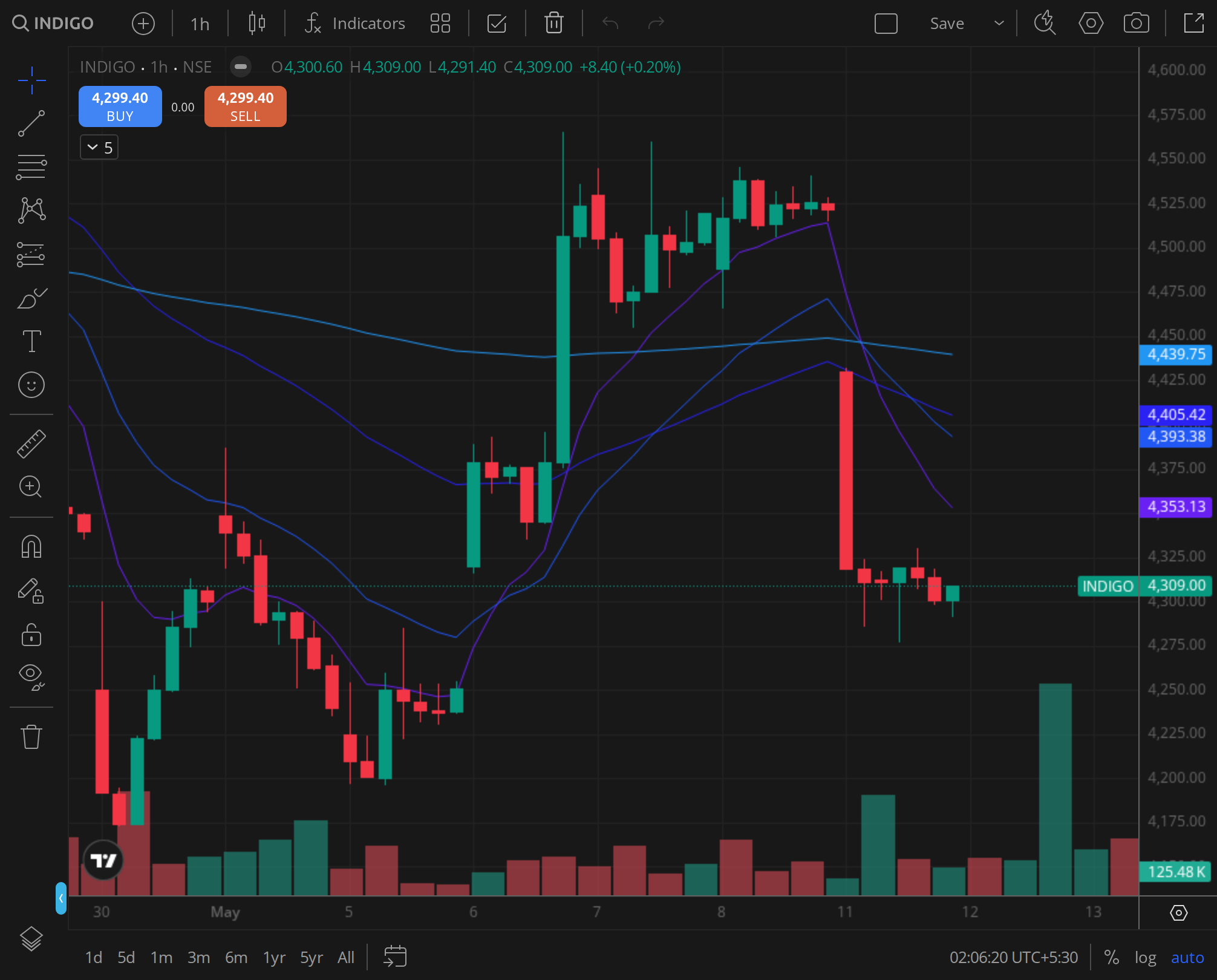
Caption: INDIGO weekly timeframe around 2025-04-29.
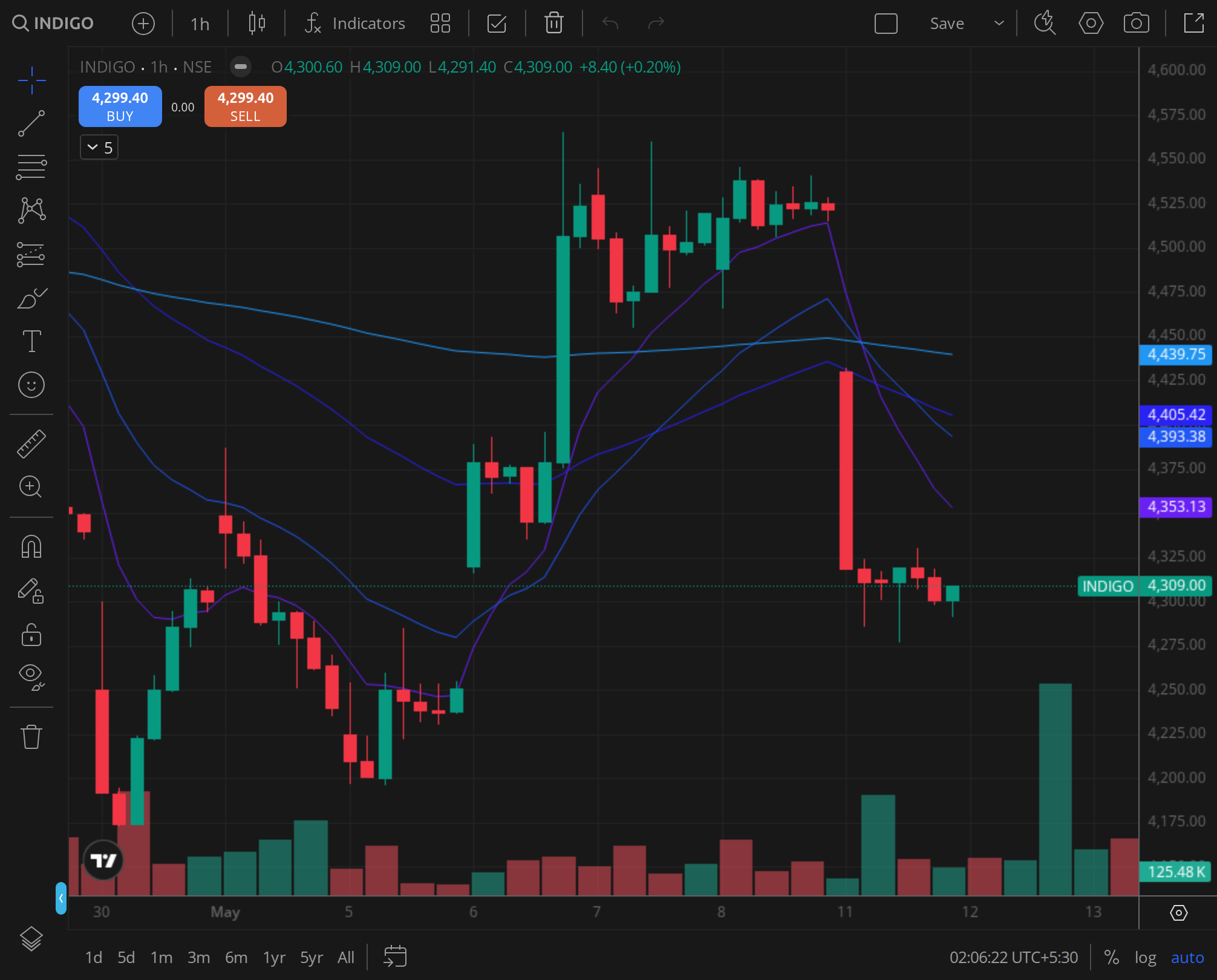
Caption: INDIGO daily timeframe around 2025-04-29.
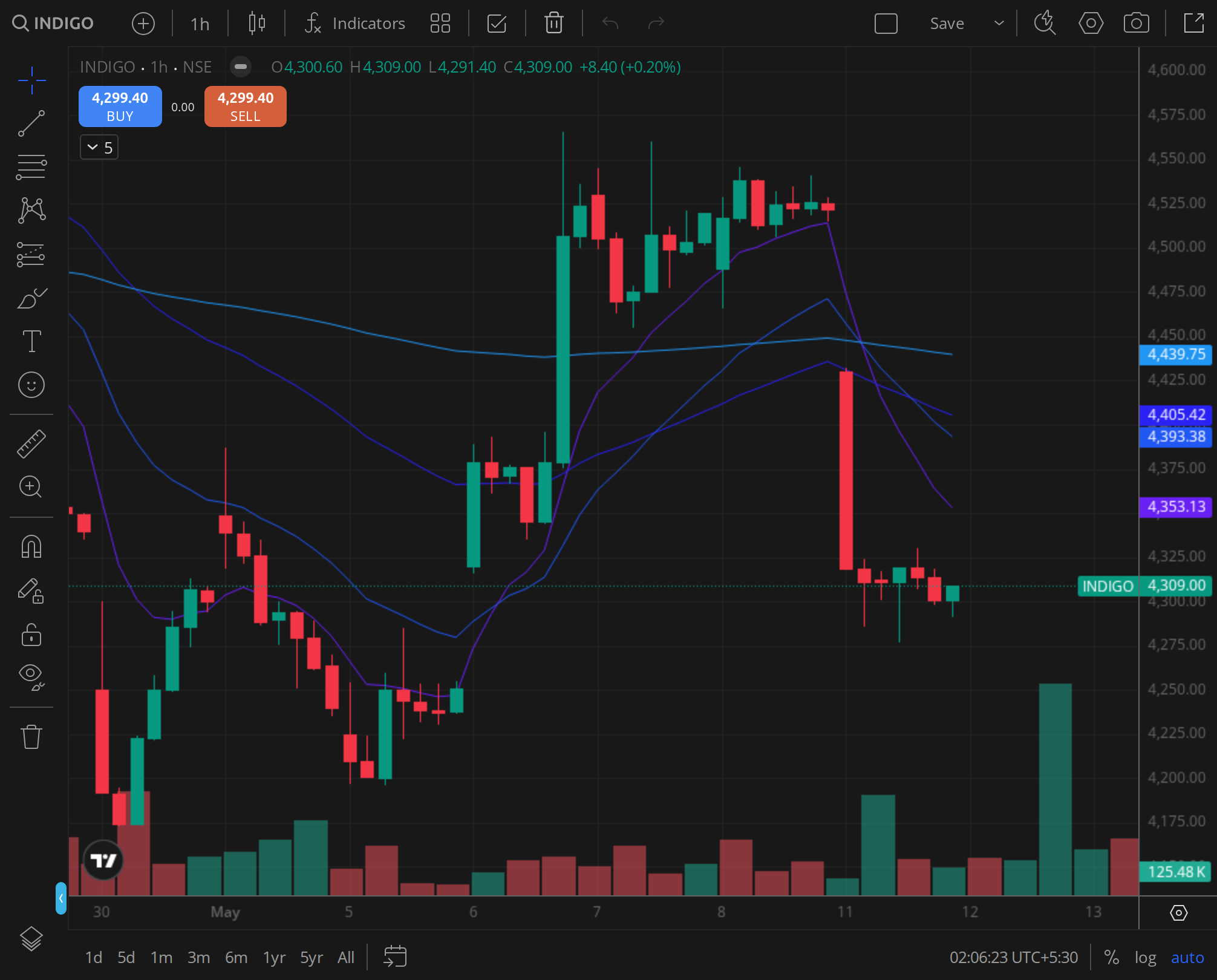
Caption: INDIGO 30min timeframe around 2025-04-29.
The April 29, 2025 session in IndiGo (NSE: INDIGO) was one of those days where a stock did most of its work before the bell. A pre-market wire on aviation turbine fuel pricing, an unexpected downward revision by the oil marketing companies for the May cycle, was enough to flip a sluggish, rangebound chart into a vertical 5.8% candle by close. Volume that day, by the screens of any broker terminal carrying NSE bhavcopy data, ran roughly 2.2 times the 20-day average. That alone was worth flagging, but the more interesting story sat behind it, in the six weeks that had set the stage.
To read the move correctly required going back to March 15, 2025, when the stock had printed a session low that capped a 14% slide from its late-February perch. The trigger then had been the opposite of what showed up in late April: a sharp ATF hike for the March cycle, combined with rumours of capacity strain on the IndiGo fleet after a Pratt & Whitney engine advisory had dragged on into Q4 FY25. The street had treated it as a textbook input-cost squeeze. Brokerage notes from mid-March, the ones that filtered through the Moneycontrol and Mint coverage of that fortnight, had trimmed FY26 EBITDA estimates by between 4% and 7%. A few houses had quietly moved their stance from Buy to Add, which in the polite vocabulary of Indian sell-side is a downgrade with deniability.
What the late-April rally exposed, was that the March 15 low had been a capitulation print, not a structural break.
The Technical Picture, Read Honestly
On the weekly timeframe, IndiGo had spent the bulk of 2024 climbing a well-mannered channel anchored to its post-COVID recovery base. The March 2025 sell-off had pierced the 40-week moving average, which on a closing basis had been the cleanest trend filter for the name through that cycle. But it had done so on a single weekly candle, not the multi-week distribution pattern that usually precedes a real trend break. Buyers had defended the prior swing low from late October 2024, and the weekly RSI on standard 14-period settings had bottomed near 38, well above the sub-30 prints that had marked the truly painful corrections in 2022.
By the week ending April 4, 2025, the daily structure had begun to repair itself. The 20-day moving average had flattened. By April 11, it had crossed back above the 50-day. The classic short-term momentum signal, ignored by most because it had been preceded by a brutal drawdown, was already in place ten trading sessions before the headline rally arrived. Volume on the up-days through April 14 to April 24 was modestly above the 20-day average, while down-day volume had been notably softer. In the language of accumulation tape-reading, that asymmetry mattered more than any single price level.
The 30-minute intraday print on April 29 itself was instructive. The bulk of the day's gains had been laid down in the opening 90 minutes, between 9:15 and 10:45 IST, on the largest opening-hour volume the stock had seen since the January Q3 result. The afternoon session had not given any of it back. Stocks that gap up on news and then drift higher into the close are stocks that institutions are still buying, not stocks that retail is chasing. Stocks that gap up and fade by 2 PM are the opposite. IndiGo, on April 29, was firmly in the first category.
The Fundamental Case That Had Been Forgotten
What the market had stopped pricing in the March sell-off was that IndiGo's competitive moat had widened, not narrowed, during the very months it was being punished for engine grounding costs. The Go First wind-down had already been absorbed by FY25 numbers. Air India and the Vistara merger had been more friction than threat through the second half of FY25, with the combined entity's load factors and on-time performance lagging IndiGo's published numbers in the DGCA monthly bulletins. SpiceJet had remained a peripheral player in the relevant trunk routes. The domestic market share figures that had been disclosed through the DGCA's March 2025 release had IndiGo above 60% on a monthly basis, a level that historically had translated into pricing power on the spot fare.
The Q4 FY25 result, when it arrived in early May 2025 just over a week after the rally, validated the move. The headline numbers had beaten the consensus EBITDAR estimate that had been compiled by the brokerages tracking the name. Yields had held up despite the engine-induced capacity drag. The market had, in effect, front-run the print by ten days, which is what efficient markets occasionally do when the setup is clean enough to telegraph.
The Sentiment Tells, In Order
Three sentiment tells had lined up through the second half of April 2025, and only one of them had been visible on the price chart.
The option chain, read against NSE F&O bhavcopy data through the five sessions on either side of April 29, had shown a steady build of open interest at the at-the-money call strike for the May expiry through the week of April 21 to April 25. Put OI at the equivalent put strike had thinned over the same window. The Put-Call Ratio on the IndiGo derivative had drifted from a defensive reading near 1.1 in early April to below 0.9 by the day before the rally. None of this was the kind of euphoric positioning that marks tops. It was the quieter kind of positioning that marks the arrival of a directional bid.
FII derivative positioning, which had run net short on the IndiGo single-stock future through most of March, had flipped to net long by the week ending April 25. The size of the swing had not been dramatic, but the direction had been unambiguous. Foreign desks had stopped pressing the short.
Brokerage flow had been the slowest to react, which is usually how it goes. The first upgrade note had landed on the evening of April 29 itself, after the move. A second house had raised its price target the following morning, citing fuel cost relief and the durability of the domestic share. By the time the average sell-side reader had a fresh rating in their inbox, the stock had already done the work.
The Historical Analog
The setup most closely resembled IndiGo's behaviour in the August to October 2023 window, when a sharp correction on crude-linked fuel concerns had bottomed inside a broader uptrend channel, and a single-session 4.7% rally on softer ATF data had marked the transition from base-building to fresh trend advance. The follow-through on that occasion had been muted for the first two weeks, then accelerated meaningfully through the November to January cycle.
The 2024 March correction, which had been smaller in magnitude but similar in shape, had produced a comparable resolution. The pattern was not unique. It had been the dominant rhythm of the name through its public market life.
Was The Move Justified, Five Days On
By the close of May 6, 2025, five sessions after the April 29 rally, IndiGo had not given back the breakout candle. It had consolidated tightly in a roughly 2% range above the breakout close, and the daily volume signature through the consolidation had been calm rather than agitated. Stocks that hold their breakouts for five sessions on declining volume tend to be stocks that are still being accumulated. The Q4 result on May 7 then provided the fundamental catalyst that justified the technical setup.
The five-day forward read, in other words, validated the move. The thirty-day forward read, which extended into early June 2025, extended the trend.
Verdict
Stance: BULLISH (ex-post, on the April 29 setup) Horizon: 1mo from April 29, 2025 Rationale: The rally was not a one-day ATF reflex. It was the visible release of six weeks of repair work that the tape had been doing quietly, validated within two weeks by a clean Q4 print and durable domestic share. The buyer who stepped in on the breakout, not the chaser who arrived after the upgrade notes, was the one paid.
The wider lesson the April 29 print offered was the older one. When a dominant operator in a structurally consolidated sector sells off on a temporary input-cost shock, the correction is the entry, not the exit. The hard part is recognising it while the brokerage downgrades are still landing in your inbox.