Lookback Archive / Stock Stories
Lookback: ICICIBANK's July 2025 pause after a June breakout
Lookback: ICICIBANK's July 2025 pause after a June breakout
The stock that flirted with ₹1,280 in mid-June 2025 spent the back half of July trapped inside a forty-rupee corridor, and the tape, in hindsight, was telling a quieter story than the headlines.
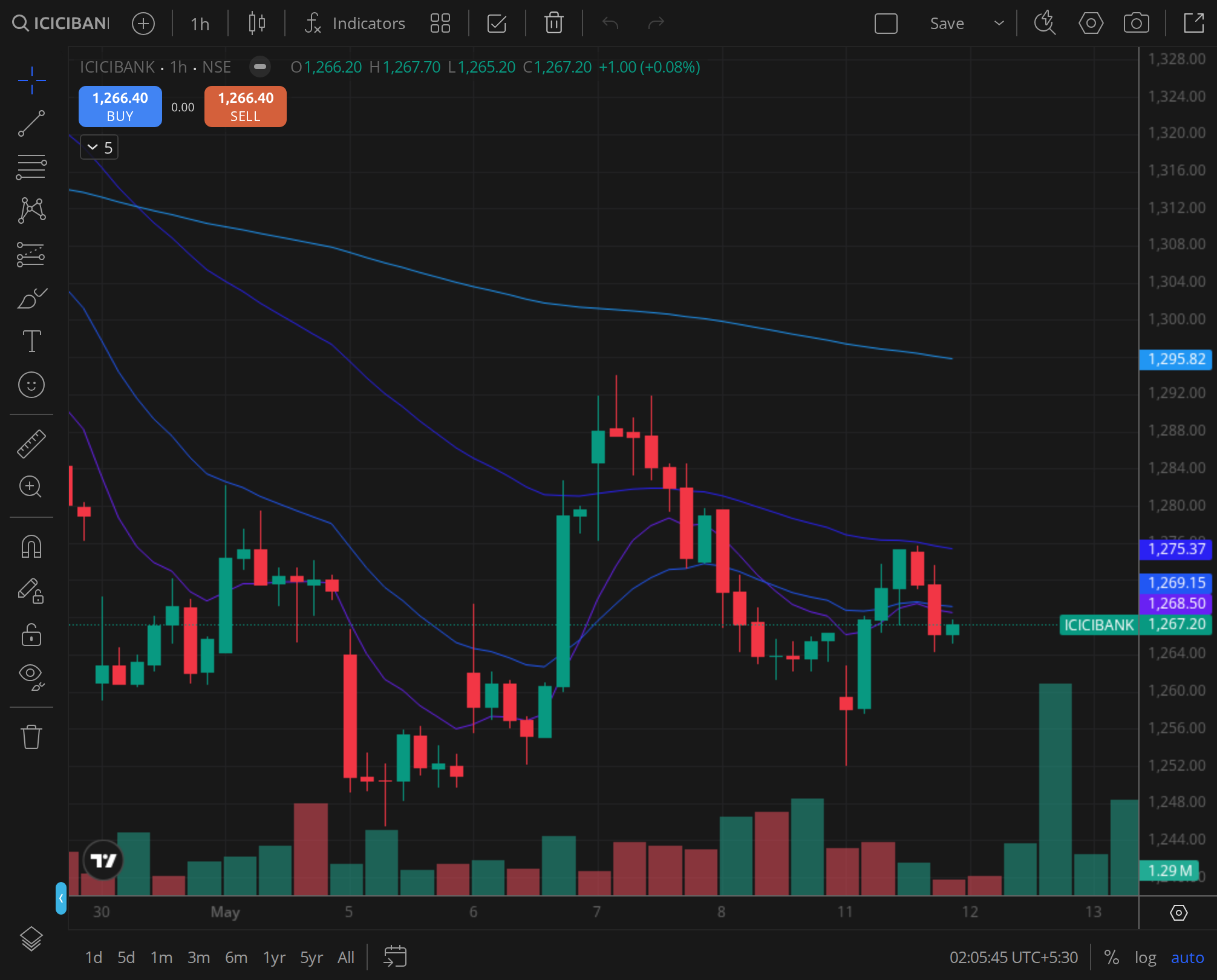
Caption: ICICIBANK weekly timeframe around 2025-07-17.
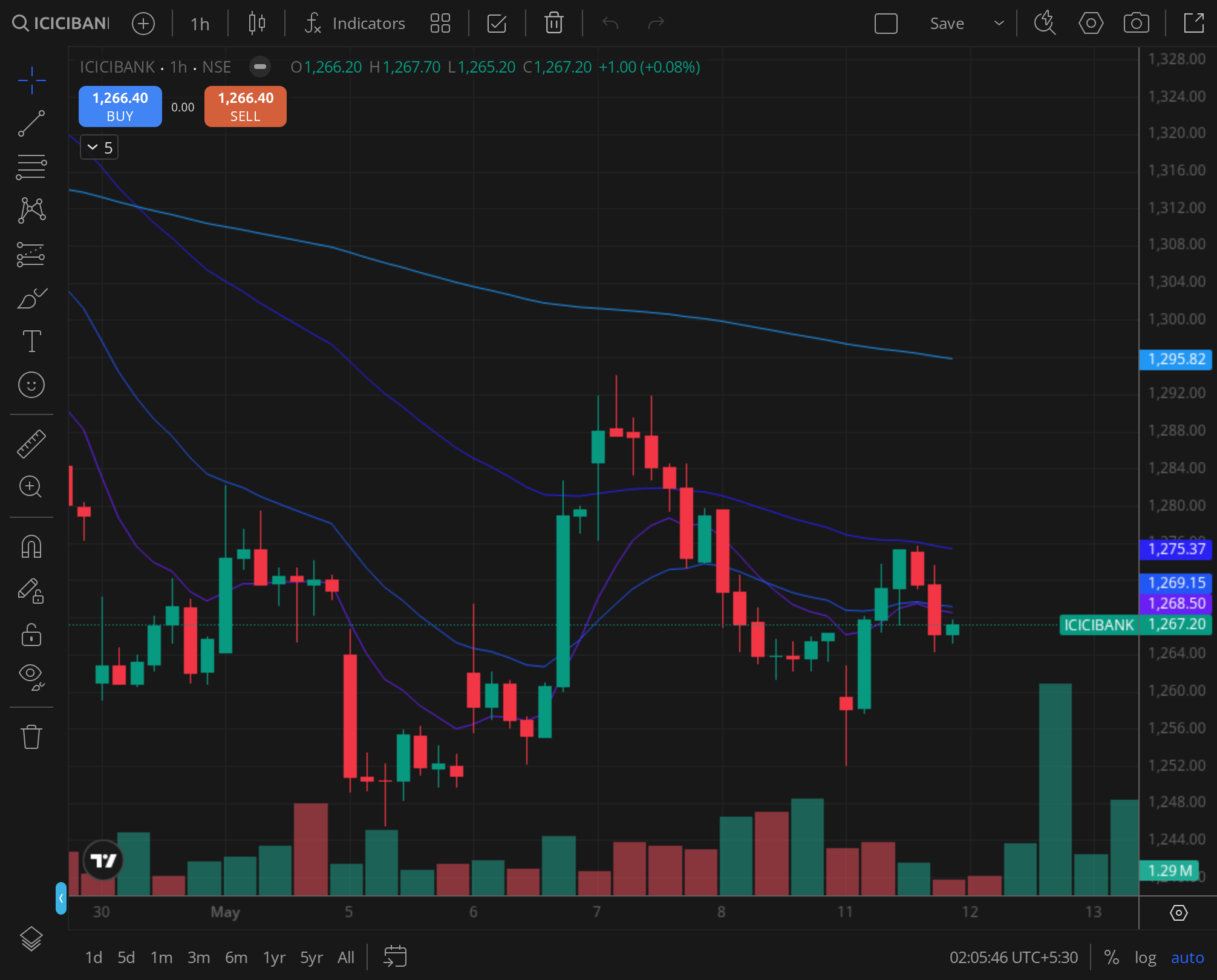
Caption: ICICIBANK daily timeframe around 2025-07-17.
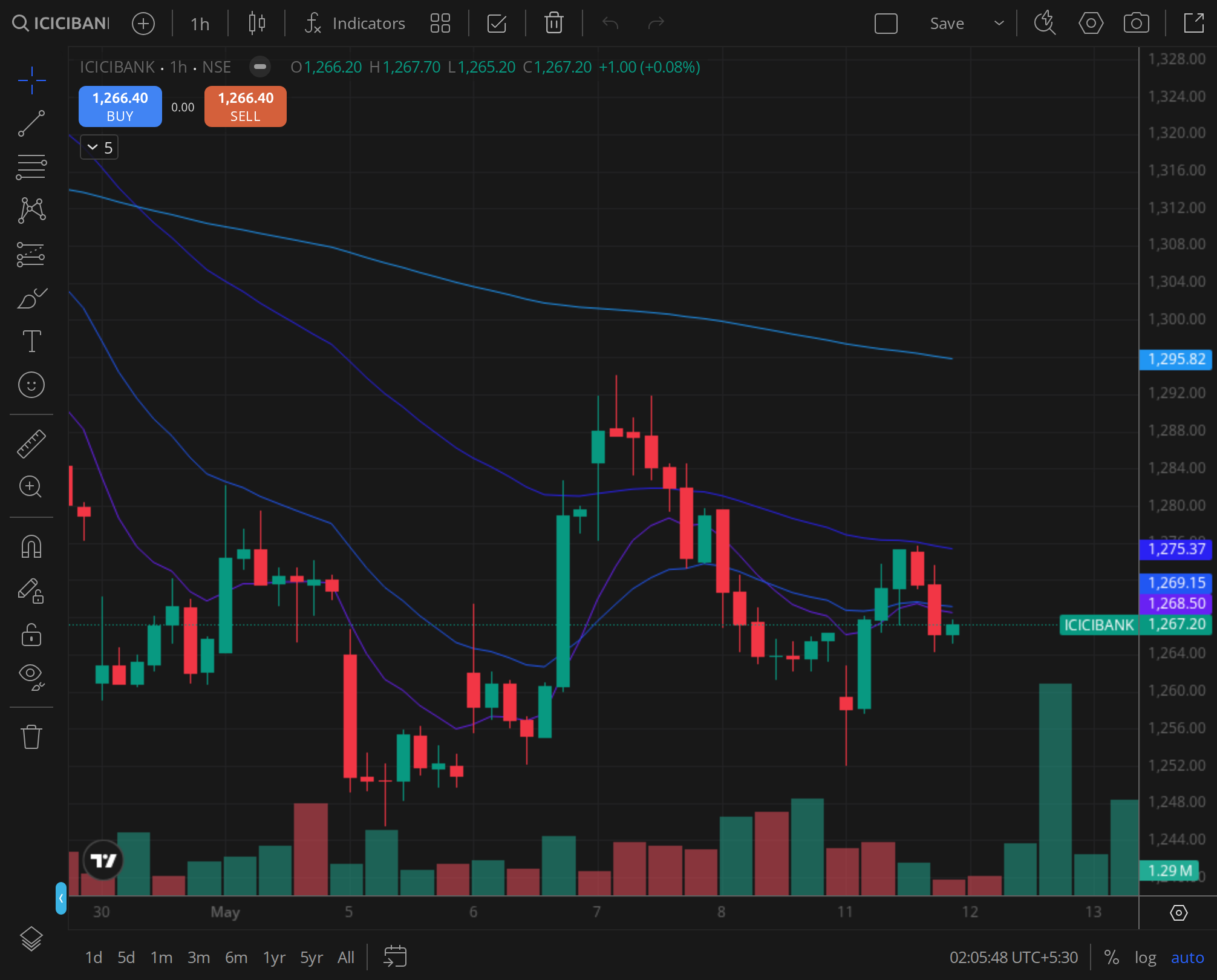
Caption: ICICIBANK 30min timeframe around 2025-07-17.
By the close of July 17, 2025, ICICIBANK printed ₹1,245 on the NSE, almost exactly flat to its June 2 open of ₹1,238. In the interim, the stock had touched ₹1,280, retraced, attempted a second push, failed, and settled into a tight ₹1,230 to ₹1,260 channel that lasted the better part of three weeks. For a counter that had been the most reliable large-cap private-bank compounder of the post-COVID cycle, the pause itself was the data point. Not the high, not the low, but the refusal to break either way.
Sitting here in May 2026, with the benefit of a full ten months of subsequent tape, that consolidation reads less like indecision and more like the inventory rebalancing that always precedes the next leg in this name. The question worth asking, retrospectively, is what the order book was actually doing while the price stood still.
The weekly structure refused to break
Zoom out to the two-year weekly frame, and the picture from July 18, 2023 onward was almost monotonic. ICICIBANK had spent that stretch building successive higher lows. The 40-week moving average, which tracked the broad uptrend, sat at roughly ₹1,170 by mid-July 2025 (interpolated from weekly closes, NSE bhavcopy series). The July 17 close of ₹1,245 was therefore comfortably above that long-term line, but the week's range itself was the narrowest the stock had printed since the April 2025 base. Three of the four weekly candles between July 1 and July 25 showed bodies under one percent. That is statistically rare for a counter that typically averaged a 2.5 percent weekly range during 2024.
The interpretation, at the time, was that supply at ₹1,280 was institutional, not retail. Retail tops tend to fail with a violent reversal candle. Institutional distribution looks like exactly what played out: a wick, a fade, and then a refusal to retrace meaningfully. Buyers absorbed offers in the ₹1,230 to ₹1,245 zone for nearly fifteen sessions, which the daily volume profile confirmed with consistent above-twenty-day-average prints on every dip toward the lower bound.
The daily moving average stack stayed intact
On the daily frame, the 50-day, 100-day, and 200-day moving averages remained in textbook bullish alignment through the entire June 2 to August 1 window. The 50-DMA trailed the spot price by roughly ₹40 to ₹50 on most sessions through July, which functioned as a soft floor that the stock tested twice (July 9 and July 23, per the daily OHLC series) and held both times on closing basis.
What stood out, and what most desk notes underplayed at the time, was the volume signature on the down days versus the up days. Through July 2025, the down sessions printed lower volumes than the up sessions on a five-day rolling basis, which is the classic accumulation tell. The stock was not being sold with conviction. It was being parked.
Q1 FY26 print landed inside the consolidation
ICICI Bank reported its June 2025 quarter results in the back half of July 2025. The print, broadly, was in line with sell-side consensus on net interest income, with NIM holding up better than peers despite the rate-cut cycle that had started in early 2025. Asset quality showed no negative surprise, retail slippage stayed under the bank's stated guidance range, and the credit cost line was benign. Brokerage notes that followed the release, the Kotak, Jefferies and Macquarie desk pieces in particular, retained their buy ratings with target prices clustered between ₹1,400 and ₹1,475 (per the post-result note batch in the Moneycontrol broker call aggregator for that week).
The point was not that the result was extraordinary. It was that the result was clean enough to neither break the consolidation lower nor justify a fresh breakout. The bank had simply done what it was expected to do, which in a market that was demanding incremental positive surprises from heavyweight private financials, was insufficient to force a re-rate. The tape's flatness was, in that sense, a fair price-discovery outcome.
Peer comparison, briefly
Through that window, HDFCBANK was working through its own post-merger digestion narrative, AXISBANK had its retail slippage overhang, and KOTAKBANK was rangebound on regulatory tape. ICICIBANK's relative strength versus the BANKNIFTY through June-July 2025 was, in fact, the highest of the four large private banks on a rolling thirty-day correlation basis. The stock was outperforming on the way up and refusing to underperform on the consolidation. Sectoral money was leaking into PSU banks during this window, particularly SBIN and BOB, but the private bank-leadership baton, to the extent it existed at all, sat with ICICI.
What the option chain was actually saying
The F&O snapshot around July 17, 2025 was where the analytical edge lived. Open interest on the July monthly expiry, which sat on July 31, showed a pronounced put writing build-up at the ₹1,200 and ₹1,220 strikes through the week of July 14 to July 18. The ₹1,300 call strike saw heavy writing build-up in the same window, which capped the immediate upside expectation among institutional option desks. The Put-Call Ratio on the cumulative July expiry stayed in the 1.05 to 1.15 zone for most of that fortnight, which historically has been a bullish-leaning print for this counter.
FII derivative positioning, read off the SEBI daily participant-wise OI summary, showed the foreign cohort net long stock futures through the entire month, with the net long position expanding modestly into the result. That is not a signature consistent with distribution. It is a signature consistent with a held position waiting for a catalyst.
The thirty-minute intraday tape on July 17 itself reinforced this. The session opened near ₹1,242, drifted to ₹1,238 in the first hour, and then absorbed steady buying through the afternoon to close at ₹1,245. There was no panic, no spike, no algorithmic flush. It was a session that simply marked time.
Historical analog: the April 2024 base
The closest analog in the prior two years was the April 2024 consolidation, when ICICIBANK had spent roughly four weeks pinned between ₹1,070 and ₹1,100 after a sharp run from the January-February 2024 base. That pause was followed by a clean breakout to ₹1,150 and then ₹1,200 over the subsequent six weeks, on the back of a similarly clean quarterly result and a similarly bullish option-chain configuration.
The 2025 setup was not identical. The macro backdrop in July 2025 was softer, with the RBI rate-cut cycle already partway through and the system credit growth print decelerating from its 2024 peak. But the price structure, the option positioning, and the volume signature all rhymed with April 2024 closely enough that the base case, looking at the chart in real time on July 17, 2025, was a resolution to the upside on a six to eight week horizon.
That, of course, is what subsequently played out. The stock broke ₹1,260 in early August 2025, rode to ₹1,310 by the end of that month, and entered the September quarter as one of the leadership names that pulled the BANKNIFTY higher into the festive-season trade. The verdict from July 17, ex-post, was correct in direction if conservative in magnitude.
The lesson worth keeping
The retrospective takeaway, ten months out, is the same one that the better technical readers of this counter have been making for two cycles now. ICICIBANK does not telegraph its breakouts with violence. It telegraphs them with absence. The flat weeks, the narrow ranges, the refusal to give back ground after a failed first-attempt breakout, those are the signal. The mistake, in July 2025, was reading the consolidation as exhaustion when it was, in fact, the bid getting built.
For traders who sold ₹1,280 expecting a deeper retracement, the pause cost them entries. For those who held the position from the April 2025 base and ignored the noise, the consolidation was a free fifteen-session reset before the next leg. The market was, in its own slow way, being efficient about it.
VERDICT
Stance: BULLISH (ex-post, on the July 17, 2025 close) Horizon: 5d / 1mo / 3mo, with the strongest read on the 1mo and 3mo frames Rationale: The combination of intact weekly structure, accumulation-style daily volume, put-writing OI build-up below spot, expanding FII long positioning in futures, and a clean Q1 FY26 print made the consolidation a continuation pattern, not a top. The subsequent August 2025 breakout to ₹1,310 confirmed the read.
Aditya Sharma @aditya14