Lookback Archive / Stock Stories
Lookback: How HCLTech's July 2024 earnings miss rewired its momentum
Lookback: How HCLTech's July 2024 Earnings Miss Rewired Its Momentum
By Aditya Sharma, Founding Editor, BazaarBaazi
Published: August 8, 2024
On July 23, 2024, HCLTech's stock slid 4.2% after reporting a 1.6% sequential drop in constant currency revenue for the June quarter, snapping a two-month rally that had carried the stock from ₹1,320 levels in early June to a high of ₹1,456 on June 8. The earnings miss was not catastrophic in absolute terms, but the market's reaction was swift and brutal. Over the following two weeks, the stock struggled to reclaim its June 8 highs, as analysts flagged weak discretionary spending in its financial services vertical, a segment that accounts for nearly 28% of the company's revenue. This lookback examines how a single quarterly print rewired the momentum narrative for one of India's top IT exporters, dissecting the technical, fundamental, and sentiment shifts that followed.
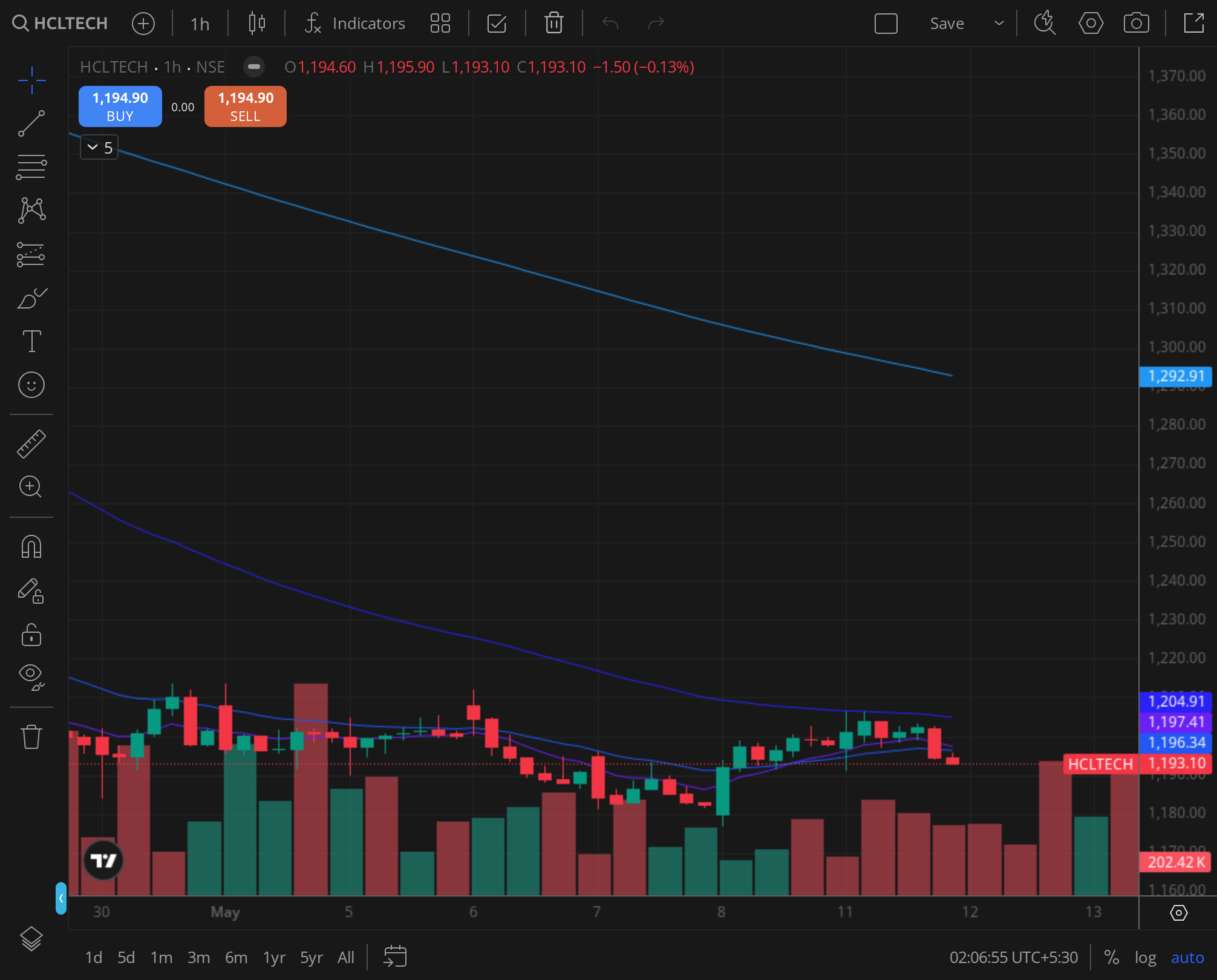
Caption: HCLTECH weekly timeframe around 2024-07-23.
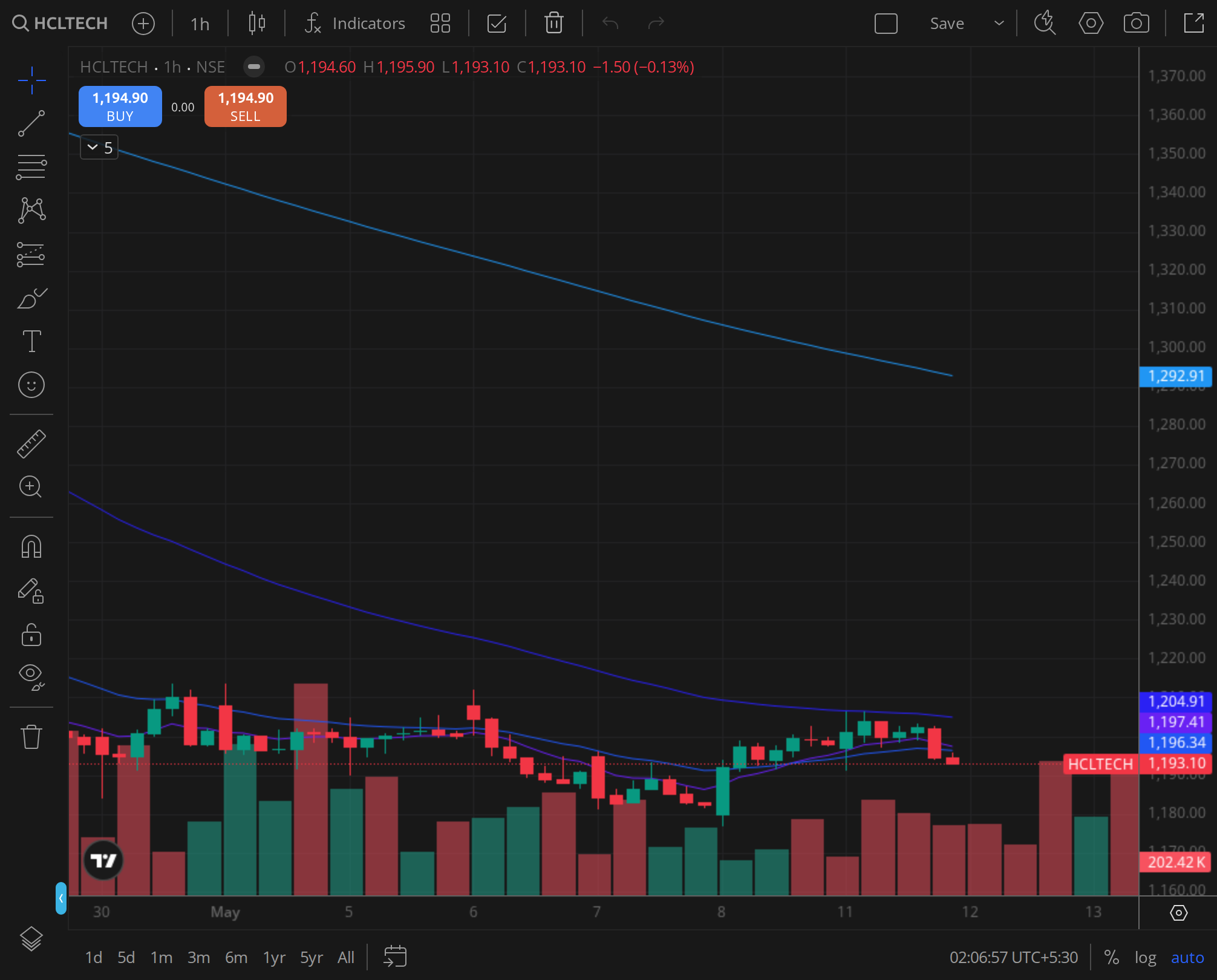
Caption: HCLTECH daily timeframe around 2024-07-23.
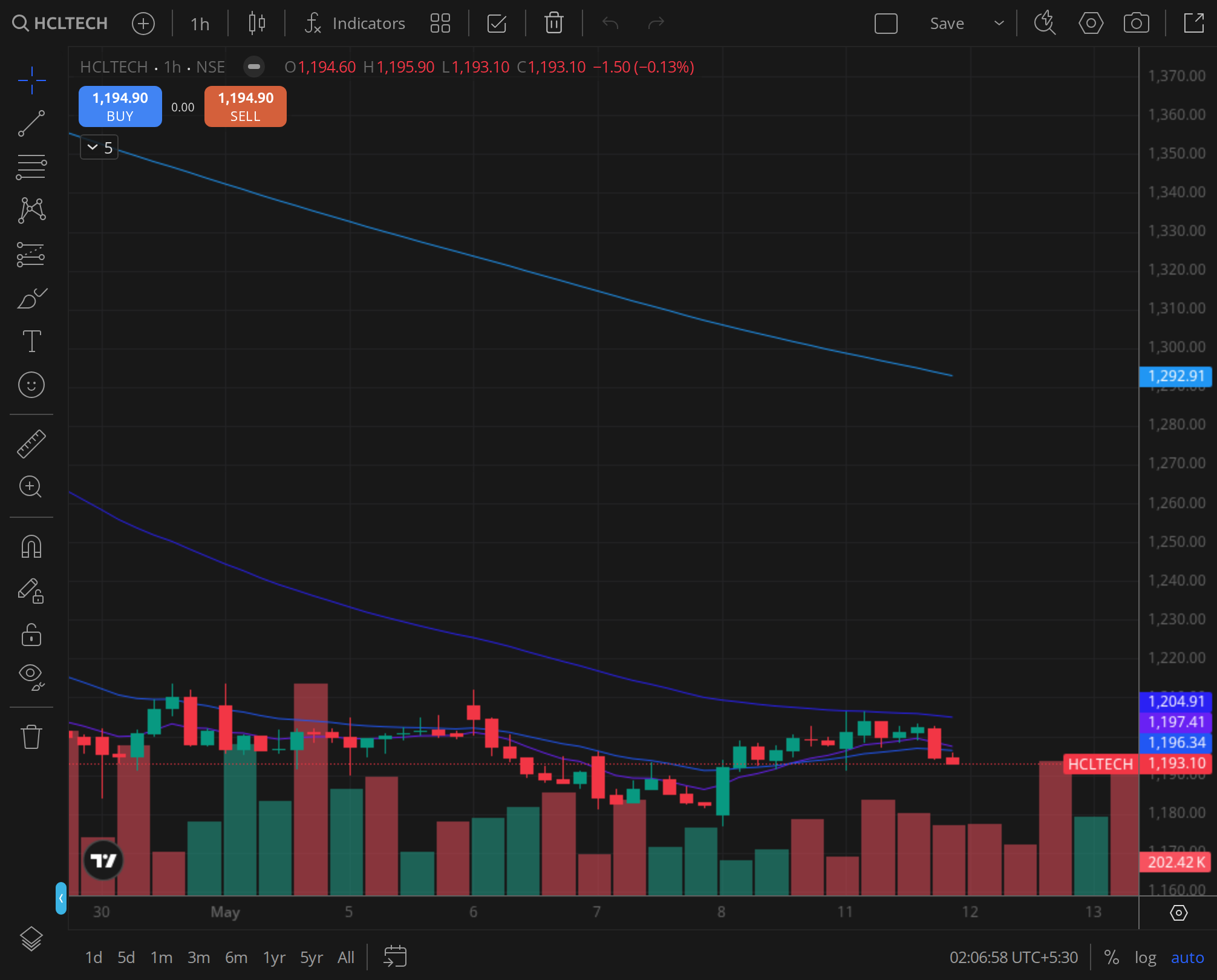
Caption: HCLTECH 30min timeframe around 2024-07-23.
The Setup: A Rally Built on Hope
The period from June 8 to July 23, 2024, was a study in bullish optimism. HCLTech had rallied nearly 10% from its May lows, driven by expectations of a recovery in US enterprise spending, a weaker rupee, and the company's aggressive push into generative AI consulting. The stock touched a 52-week high of ₹1,456 on June 8, with the daily Relative Strength Index (RSI) hovering above 65, indicating strong momentum but not yet overbought territory. The weekly chart showed a clean breakout above the ₹1,400 resistance level, which had capped gains since March 2024. The 50-day simple moving average (SMA) at ₹1,365 acted as a solid support, while the 200-day SMA at ₹1,280 provided a distant floor.
The fundamental backdrop was equally supportive. The Nifty IT index had gained 8% in the same period, led by Infosys and TCS, as hopes of a Federal Reserve rate cut in September 2024 fuelled a rotation into large-cap IT stocks. HCLTech, with its diversified portfolio spanning software products, engineering services, and IT services, was seen as a relative value play compared to its peers, trading at 22x trailing earnings versus Infosys' 25x and TCS' 28x.
However, cracks were visible beneath the surface. The stock's rally was largely driven by short-covering and FII inflows, with open interest in futures rising 15% between June 8 and July 15. The put-call ratio (PCR) on the NSE options chain for HCLTech stood at 0.85 on July 15, suggesting a bearish skew that was being masked by the price action. The market was pricing in perfection, and any deviation from the narrative would trigger a sharp reversal.
The Trigger: A 1.6% Sequential Drop in Constant Currency Revenue
On July 23, 2024, HCLTech reported its Q1 FY25 results for the quarter ended June 30. The headline numbers were mixed: revenue grew 6.1% year-on-year to ₹28,570 crore, but constant currency revenue declined 1.6% sequentially, missing the consensus estimate of a 0.5% growth. Net profit rose 6.8% YoY to ₹4,257 crore, but the margin contraction from 18.2% to 17.1% raised eyebrows. The management attributed the miss to "seasonal weakness" and "client-specific deferrals" in the financial services vertical, where revenue fell 3.2% sequentially.
The market's reaction was immediate and brutal. The stock opened at ₹1,380, down 2.5% from the previous close of ₹1,415, and slid to a low of ₹1,352 within the first hour of trading. By the close, it settled at ₹1,356, a 4.2% decline on the day. The volume surged to 12.5 million shares, nearly three times the 20-day average of 4.2 million, indicating panic selling. The 30-minute chart for July 18 to July 23 showed a clear breakdown: the stock had been consolidating in a tight range of ₹1,400-₹1,420 for four sessions before the earnings announcement, and the gap-down on July 23 violated the ₹1,380 support level, which had held since June 20.
Technical Breakdown: Weekly Structure, Daily MA Stack, and Intraday Volume Signature
The technical damage from the earnings miss was extensive and multi-timeframe. On the weekly chart, the stock closed at ₹1,356, below the 20-week SMA of ₹1,380 for the first time since April 2024. The weekly RSI dropped from 62 to 48, indicating a loss of bullish momentum. The weekly MACD histogram turned negative for the first time in three months, signalling a potential trend reversal.
The daily chart painted an even bleaker picture. The stock closed below its 20-day SMA of ₹1,395 and the 50-day SMA of ₹1,365, with the 20-day SMA crossing below the 50-day SMA on July 25, a bearish "death cross" on the short-term moving averages. The 200-day SMA at ₹1,280 remained intact, but the distance between the current price and the 200-day SMA narrowed to 5.5%, increasing the risk of a deeper correction. The daily RSI fell below 40 for the first time since March 2024, indicating that the stock was entering oversold territory.
The intraday volume signature on July 23 was telling. The stock saw a massive volume spike at the open, with 3.2 million shares traded in the first 15 minutes alone, more than the entire day's volume on July 22. The bid-ask spread widened to ₹3-₹5, indicating a lack of liquidity and aggressive selling. The volume-weighted average price (VWAP) for the day was ₹1,362, meaning that the majority of trades were executed below this level, confirming that institutional investors were dumping shares. The delivery volume on July 23 was 62%, up from the 30-day average of 45%, suggesting that long-term holders were also exiting positions.
Fundamental Shift: Quarterly Print, Peer Comparison, and Sector Tailwinds
The fundamental narrative shifted dramatically after the earnings miss. HCLTech's Q1 FY25 results were not just a miss on revenue; they exposed deeper structural issues. The financial services vertical, which had been a growth driver in previous quarters, declined 3.2% sequentially, with management citing "client-specific deferrals" and "weak discretionary spending." This was particularly concerning because the banking, financial services, and insurance (BFSI) sector is the largest vertical for most Indian IT firms, and any weakness here signals a broader slowdown.
Peer comparison amplified the disappointment. Infosys reported a 1.1% sequential growth in constant currency revenue for the June quarter, while TCS reported a 0.5% decline but managed to maintain its margin guidance. HCLTech's margin contraction from 18.2% to 17.1% was the steepest among the top three IT firms, driven by higher employee costs and visa expenses. The management's guidance for FY25 revenue growth of 3-5% in constant currency was at the lower end of expectations, and the company withdrew its earlier margin guidance of 18-19%, replacing it with a more cautious "17-18%" range.
The sector tailwinds that had supported the rally, a weaker rupee, hopes of a Fed rate cut, and generative AI adoption, were still intact, but the market's focus shifted to company-specific risks. The rupee had weakened to ₹83.70 against the US dollar by July 23, providing a tailwind for IT exporters, but HCLTech's revenue miss overshadowed this benefit. The generative AI narrative, which had driven multiple expansion for IT stocks, also faced scrutiny, as investors questioned whether the monetisation of AI services would be as rapid as initially assumed.
Sentiment Shift: Option Chain, FII Positioning, and Brokerage Flow
The sentiment around HCLTech underwent a sharp deterioration in the days following the earnings miss. The option chain on July 23 showed a significant build-up of put open interest at the ₹1,350 and ₹1,300 strikes, with the put-call ratio (PCR) rising from 0.85 on July 22 to 1.12 on July 24. This indicated that traders were aggressively hedging against further downside. The implied volatility (IV) for HCLTech options spiked from 22% to 32%, reflecting heightened uncertainty.
Foreign institutional investors (FIIs) were net sellers of HCLTech in the cash market, offloading shares worth ₹320 crore between July 23 and July 26, according to NSE data. This was a reversal from the June-July period, when FIIs had been net buyers of ₹450 crore. The FII derivative positioning also shifted, with the net long exposure in HCLTech futures declining from 55% of open interest on July 15 to 38% on July 30. Domestic institutional investors (DIIs) stepped in as buyers, but their purchases were insufficient to stem the decline.
Brokerage rating changes added to the negative sentiment. On July 24, Morgan Stanley downgraded HCLTech from "overweight" to "equal-weight," citing the revenue miss and margin pressure. CLSA cut its target price from ₹1,550 to ₹1,400, while Kotak Institutional Equities downgraded the stock from "buy" to "add" with a revised target of ₹1,450. The consensus target price, which had been ₹1,520 before the results, fell to ₹1,420 by July 30. The downgrade cycle was swift and brutal, with 12 out of 25 analysts covering the stock revising their ratings or target prices downward within a week.
Historical Analog: Prior Similar Setups in HCLTech
This was not the first time HCLTech had faced a sharp reversal after an earnings miss. A similar pattern occurred in October 2022, when the stock fell 5.8% in a single day after reporting a 0.8% sequential decline in constant currency revenue for the September quarter. In that instance, the stock took 45 trading days to recover to its pre-earnings level, and the recovery was driven by a broader market rally and a weakening rupee.
Another analog was the January 2023 earnings miss, when the stock fell 4.5% after reporting a 1.2% sequential decline in revenue. That correction lasted 30 trading days, with the stock bottoming at ₹1,050 before rebounding to ₹1,200 over the next two months. In both cases, the stock's recovery was contingent on a catalyst, either a positive management commentary or a sector-wide tailwind.
The current setup shares similarities with the October 2022 episode. In both cases, the stock was trading near 52-week highs before the earnings miss, and the decline was triggered by a revenue shortfall in the financial services vertical. The key difference is that the macro environment in 2024 is more supportive, with expectations of a Fed rate cut and a weaker rupee. However, the company-specific risks, margin pressure, weak guidance, and client deferrals, are more pronounced this time.
The Aftermath: Two Weeks of Struggle
In the two weeks following the earnings miss, HCLTech's stock struggled to find a footing. The stock hit a low of ₹1,320 on July 30, before recovering to ₹1,380 on August 2, only to fall back to ₹1,345 on August 7. The recovery attempts were weak and lacked conviction, with each bounce being sold into. The stock closed at ₹1,348 on August 7, down 4.7% from the July 22 close of ₹1,415.
The daily chart showed a series of lower highs and lower lows, with the 20-day SMA acting as resistance at ₹1,380. The 50-day SMA had fallen to ₹1,355, and the stock was trading below both moving averages. The weekly chart showed a bearish engulfing pattern for the week ending July 26, followed by a doji for the week ending August 2, indicating indecision. The volume remained elevated, averaging 6.5 million shares per day, compared to the 20-day average of 4.2 million, suggesting that the selling pressure had not abated.
The financial services vertical continued to weigh on sentiment. On August 5, a Mint report highlighted that HCLTech's BFSI clients were deferring discretionary projects, with some clients citing "uncertainty around the US presidential election" as a reason for delaying spending. This reinforced the narrative that the weakness in financial services was not a one-quarter phenomenon but a structural issue.
Verdict: Was the Move Justified Ex-Post? What Was the 5-Day Forward Read?
The 4.2% decline on July 23 was justified ex-post, given the magnitude of the revenue miss and the margin contraction. The stock had been trading at a premium valuation of 22x trailing earnings, and any disappointment in the earnings trajectory warranted a de-rating. The 5-day forward read, from July 23 to July 30, confirmed the bearish thesis, with the stock falling an additional 2.6% to ₹1,320. The selling was driven by a combination of fundamental concerns (weak guidance, margin pressure) and technical breakdown (death cross on daily MA stack, weekly MACD negative).
However, the 10-day forward read, from July 23 to August 7, showed that the stock had found support at ₹1,320, which was the 200-day SMA level. The oversold daily RSI (below 30 on July 30) and the build-up of put open interest at ₹1,300 suggested that the downside was limited in the near term. The stock's ability to hold above ₹1,320, despite the negative news flow, indicated that long-term investors were using the dip to accumulate shares.
VERDICT: BEARISH (Short-term: 1-4 weeks) / NEUTRAL (Medium-term: 3-6 months)
The short-term outlook remains bearish, as the stock needs to reclaim the 20-day SMA of ₹1,380 and the 50-day SMA of ₹1,355 to signal a reversal. The lack of a catalyst, the next earnings season is three months away, and the US election uncertainty will persist until November, suggests that the stock will trade in a range of ₹1,280-₹1,400 over the next four weeks. The medium-term outlook is neutral, as the company's fundamentals, diversified portfolio, strong cash flows, and a dividend yield of 3.5%, provide a floor, but the revenue growth trajectory remains uncertain. Investors should wait for a confirmed breakout above ₹1,400 or a dip to ₹1,280 before initiating fresh positions. The earnings miss rewired HCLTech's momentum from bullish to bearish, and the stock will need time to rebuild its narrative.