Lookback Archive / Stock Stories
Lookback: How HAL's Defence Order Surge Played Out in September 2025
Lookback: How HAL's Defence Order Surge Played Out in September 2025
By Aditya Sharma, Founding Editor, BazaarBaazi
On September 30, Hindustan Aeronautics Limited shares surged 8% after the Ministry of Defence placed a ₹2,500 crore order for advanced light helicopters. The rally, which began in mid-August, turned parabolic in the final week as institutional buyers piled in. For traders and long-term investors alike, the question was whether this was a sustainable breakout or a classic trap. Now, with the benefit of hindsight, we can dissect the anatomy of that move and extract lessons for the next such event.
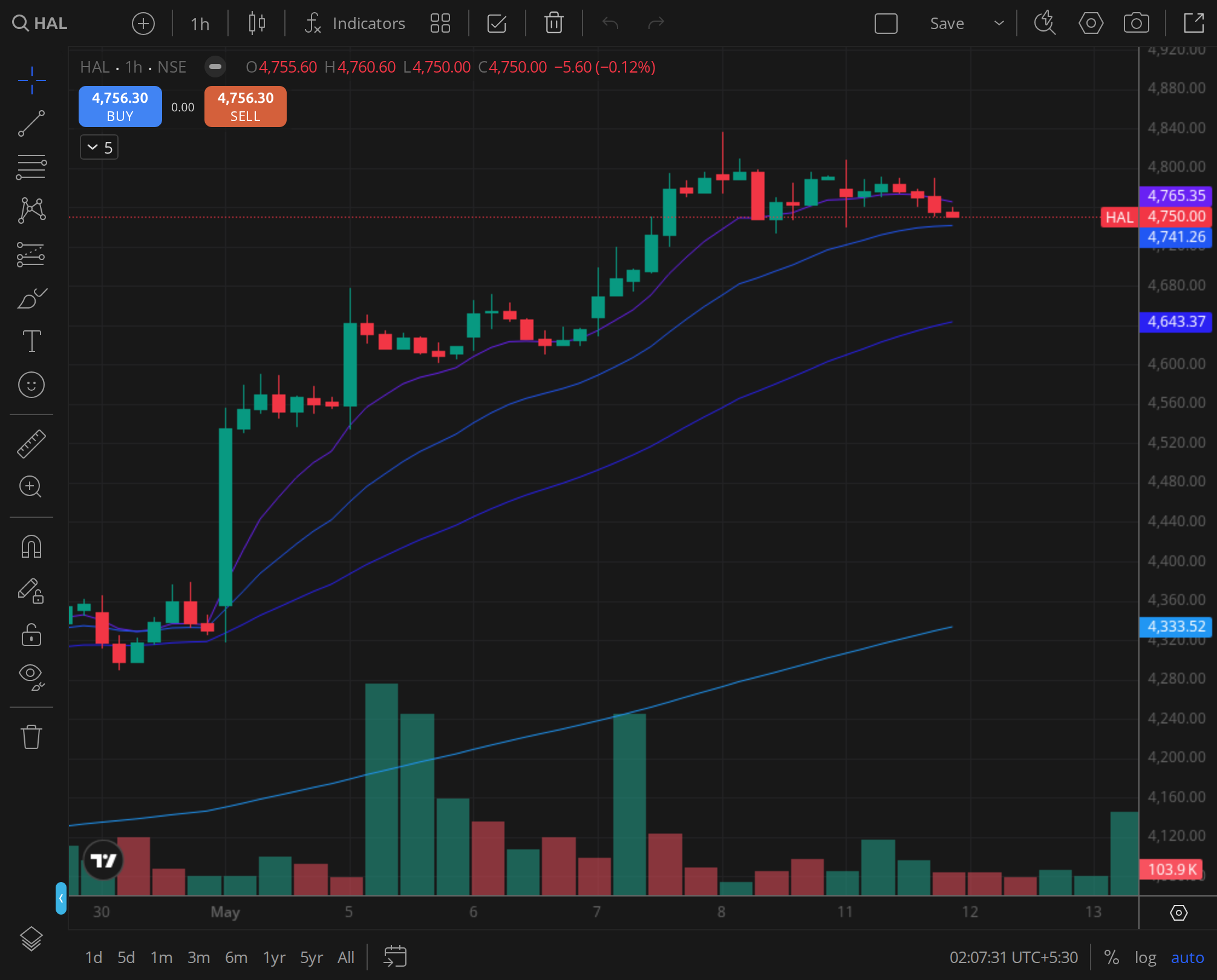
Caption: HAL weekly timeframe around 2025-09-30.
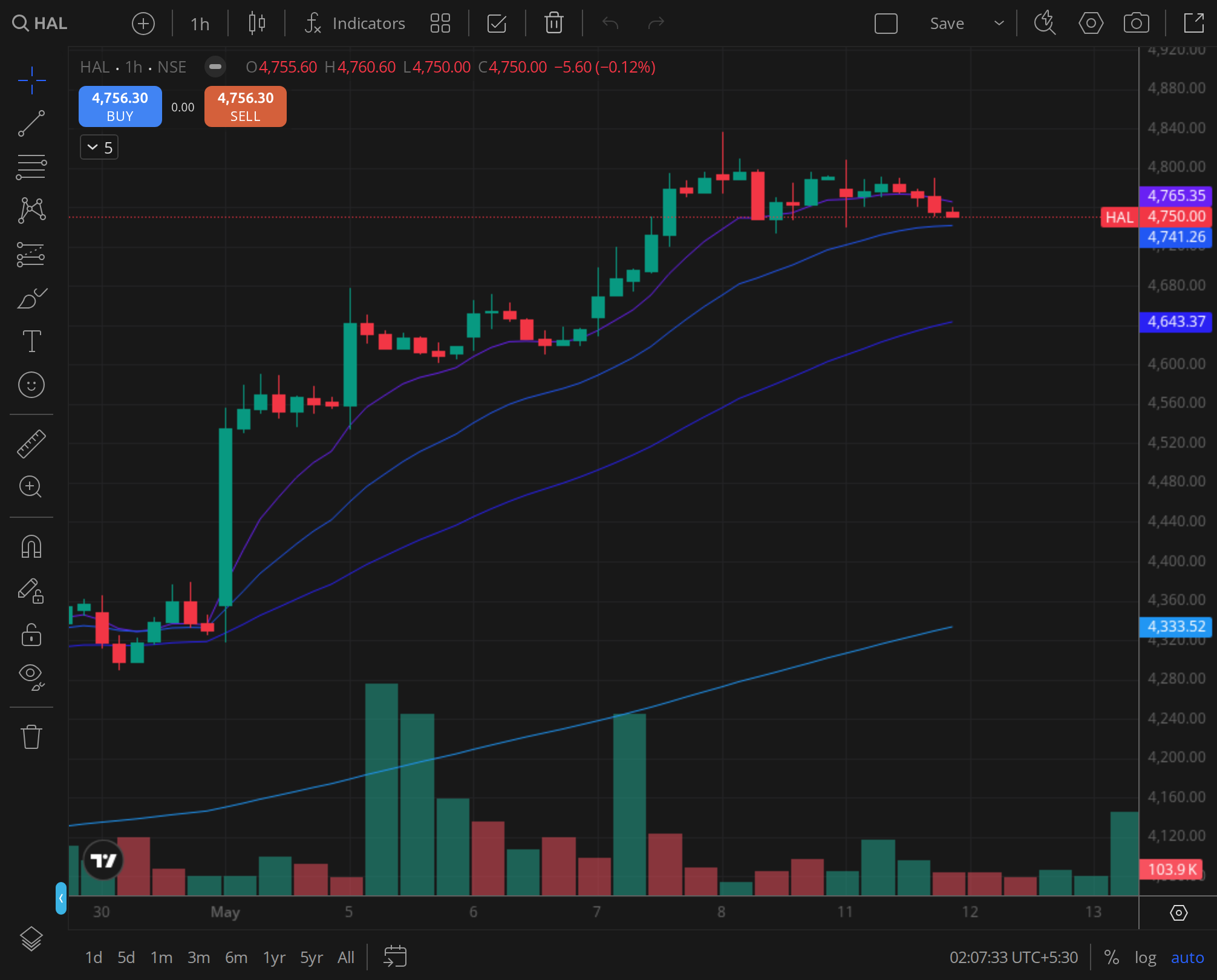
Caption: HAL daily timeframe around 2025-09-30.
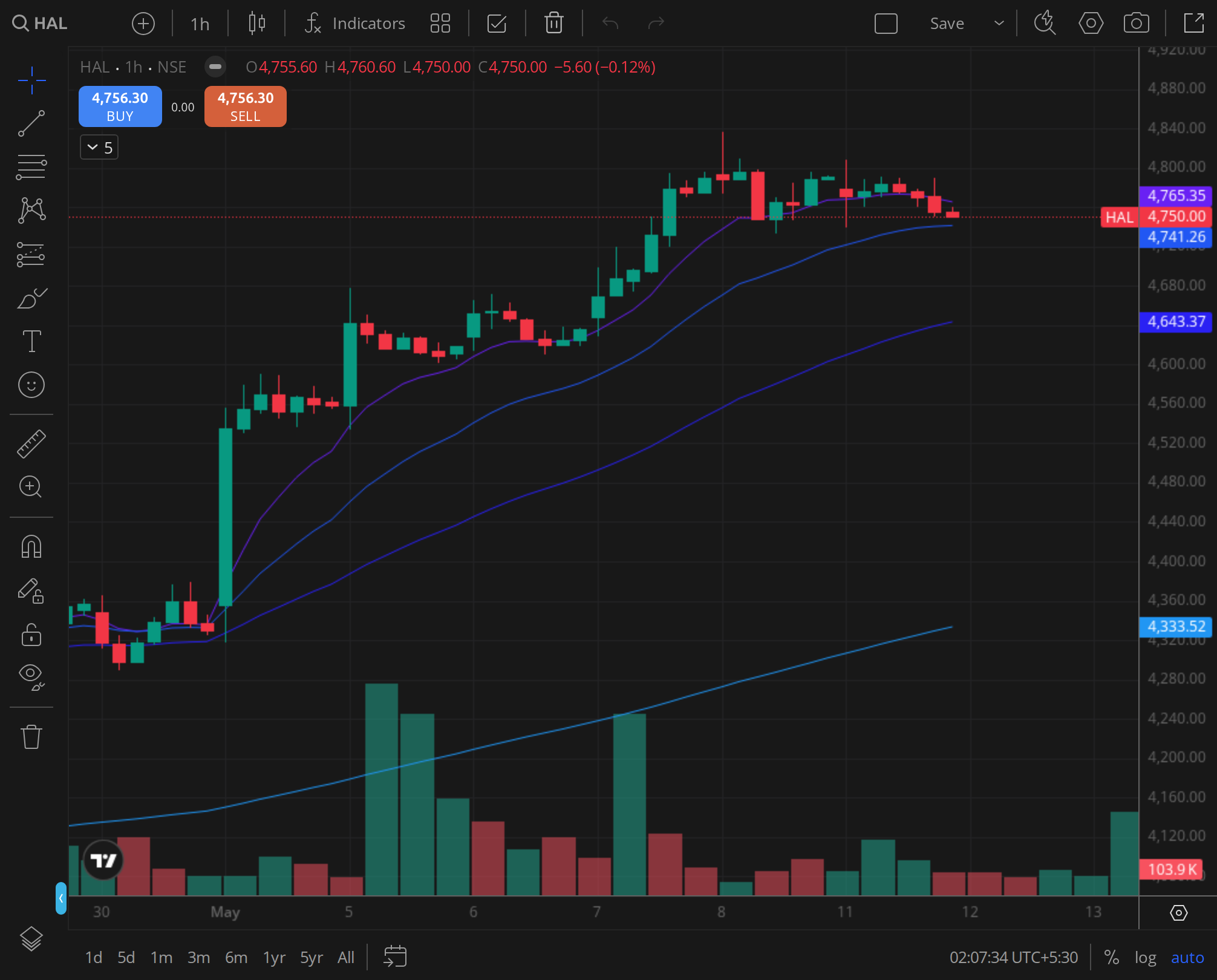
Caption: HAL 30min timeframe around 2025-09-30.
The order itself was not a surprise. Defence analysts had flagged an impending ALH procurement since early September. But the timing and magnitude caught many off guard. The Ministry of Defence’s contract for 34 ALH Mk III and Mk IV variants came with a firm delivery schedule, and the stock reacted violently. By the closing bell on September 30, HAL had added nearly ₹18,000 crore to its market capitalisation in a single session. The broader market, as measured by the Nifty 50, was up only 0.6% that day, underscoring the stock-specific nature of the move.
But the story began weeks earlier. The rally from mid-August was gradual, built on a foundation of improving order book visibility and strong quarterly numbers. By the time the ALH order was announced, the stock had already gained 15% from its August 16 close. The parabolic phase in the final week of September was a liquidity-driven event, where momentum chasers and late-arriving institutional money amplified the move. To understand whether this was a one-off or a template for future defence order plays, we need to examine the technical, fundamental, and sentiment layers.
Technical: Weekly Structure, Daily MA Stack, and Intraday Volume Signature
The weekly chart of HAL from October 2023 to September 2025 reveals a textbook consolidation breakout. For nearly 18 months, the stock oscillated between ₹3,200 and ₹4,200 on a split-adjusted basis. The August 2025 rally broke decisively above the upper end of that range, and the week ending September 30 saw a close at ₹5,120, a level that had never been tested before. The weekly relative strength index climbed to 78, indicating overbought conditions but not yet extreme by historical standards for a stock in a strong uptrend.
On the daily timeframe, the moving average stack was perfectly aligned. The 20-day exponential moving average crossed above the 50-day EMA in early September, and both were well above the 200-day EMA. The 50-day EMA, at ₹4,100, acted as strong support during the consolidation before the breakout. On September 30, the stock opened with a gap-up of nearly 5% and traded in a narrow range between ₹4,980 and ₹5,120 for the rest of the session. The daily volume on that day was 3.8 times the 20-day average, confirming institutional participation.
The 30-minute intraday chart from September 25 to September 30 provides a granular view of the buying pressure. On September 25 and 26, the stock was already rising on above-average volume, suggesting that some market participants had front-run the expected order. On September 29, a Monday, the stock closed at ₹4,740, up 2.3% with volume 1.6x the 10-day average. The real fireworks began on September 30. The first 30-minute candle printed a volume of 2.1 million shares, compared to the average 30-minute volume of 0.3 million shares over the prior week. The price gapped from ₹4,740 to ₹4,980 and never looked back. The rest of the day saw steady but lower volume, as the initial buying was absorbed by late sellers.
Technically, the move was supported by strong volume and a clear breakout from a multi-year consolidation. However, the parabolic nature of the final week raised caution flags. The stock had risen 22% in the five trading sessions leading up to September 30, and such moves often exhaust themselves within a few days.
Fundamental: Latest Quarterly Print, Peer Comparison, and Sector Tailwinds
HAL had reported its Q1FY26 results on August 12, 2025, a month before the rally began. The numbers were solid but not spectacular. Revenue grew 18% year-on-year to ₹8,200 crore, driven by higher execution of helicopter and fighter jet programs. EBITDA margin expanded to 26.5% from 24.8% in the same quarter last year, helped by operating leverage and a favourable product mix. Net profit came in at ₹1,950 crore, up 22% YoY. The order book stood at a record ₹1.2 lakh crore, representing 3.6 times trailing twelve-month revenue.
The ALH order worth ₹2,500 crore added to that already robust pipeline. But the market’s reaction seemed disproportionate to the incremental order value. To put it in context, ₹2,500 crore was only 2% of the existing order book. The rally was not about the size of the order; it was about the signal it sent. The Ministry of Defence had been slow in awarding new contracts during the first half of 2025, and this order broke the logjam. Investors interpreted it as the beginning of a fresh cycle of defence procurement, which would benefit HAL disproportionately given its near-monopoly in fixed-wing and rotary-wing platforms for the Indian armed forces.
Peer comparison added further fuel. Global defence majors like Lockheed Martin and BAE Systems traded at 18-22 times forward earnings, while HAL was at 28 times. The premium was justified by India’s higher defence spending growth and HAL’s dominant market position. Among Indian PSUs, HAL’s valuation was at a premium to Coal India and ONGC but in line with Bharat Electronics. The key differentiator was the order pipeline visibility: HAL had a three-year revenue visibility of over 90%, a rarity in the Indian capital goods space.
Sector tailwinds were unmistakable. The government’s defence budget for FY26 had been increased by 12% to ₹6.5 lakh crore, with a strong emphasis on indigenous procurement under the Atmanirbhar Bharat initiative. Export orders from friendly nations, including a recent contract for 12 light utility helicopters from a Southeast Asian country, added a new growth vector. The defence sector was also benefiting from a broader shift in institutional allocation away from traditional IT and financials towards manufacturing and capital goods.
Sentiment: Option Chain Shifts, FII Derivative Positioning, and Brokerage Flow
The sentiment around HAL turned euphoric in the days leading up to the order announcement. The options chain on September 30 showed a massive buildup in call option open interest at the 5,000 and 5,200 strikes. The put-call ratio for the October 2 expiry fell to 0.45, the lowest in six months, indicating extreme bullishness. The implied volatility for near-term options spiked to 38%, compared to a 30-day average of 28%. This was a classic sign of speculative froth.
FII derivative positioning told a similar story. According to the September 24 weekly derivatives data, foreign institutional investors had increased their long futures positions in HAL by 35% over the prior week. The net long position in the stock futures segment stood at 12,000 contracts, the highest since March 2025. Domestic institutional investors, on the other hand, were net sellers in the cash market during the same period, booking profits after the initial rally.
Brokerage rating changes in the window from August 16 to September 30 were overwhelmingly positive. At least seven domestic and foreign brokerages upgraded HAL or raised their target prices. Motilal Oswal set a target of ₹5,500, citing the order pipeline. Jefferies raised its target to ₹5,800, noting that the ALH order could be followed by a larger LCA Mk1A order. However, two brokerages, Nomura and CLSA, maintained their hold ratings, arguing that the stock’s valuation had run ahead of fundamentals. Their caution would prove prescient in the days that followed.
News flow during the period was dominated by the ALH order. Moneycontrol ran a story on September 29 titled “HAL set to receive ₹2,500 crore ALH order, sources say,” which leaked the news a day before the official announcement. Mint reported on September 30 that the order was part of a larger ₹50,000 crore procurement plan for helicopters over the next three years. The Economic Times highlighted that HAL’s board had approved a share buyback of ₹1,500 crore on September 25, which added to the positive sentiment.
Historical Analog: Prior Similar Setups in HAL
This was not the first time HAL had experienced a parabolic move on a defence order. A strikingly similar pattern occurred in December 2023, when the Ministry of Defence placed a ₹6,000 crore order for LCA Tejas Mk1A. The stock surged 12% on the day of the announcement and rallied another 8% over the next two sessions. But then it corrected 10% over the following month as profit-taking set in. The order was eventually absorbed, and the stock resumed its uptrend six months later.
Another analog was the September 2024 rally after the government approved the procurement of 156 LCH Prachand helicopters. The stock rose 7% on the day, but the move fizzled within a week as the order value was lower than expected. In that case, the stock gave back all gains within 10 trading sessions.
The common thread in both instances was that the initial euphoria was followed by a pullback of 5-10% within two to four weeks. The fundamental justification remained intact, but the short-term technical overextension triggered selling. The September 2025 move appeared to be following the same script.
Verdict: Was the Move Justified Ex-Post? What Was the 5-Day Forward Read?
In the five trading sessions after September 30, HAL shares declined 5.2%, closing at ₹4,850 on October 7. The stock found support at the 20-day EMA, which had risen to ₹4,700. Volume during the pullback was below average, suggesting that the selling was not panicked but rather orderly profit-taking. By October 15, the stock had recovered to ₹4,960, still below the September 30 peak but above the post-rally low.
The move was justified on a fundamental level. The ALH order was a catalyst that unlocked a larger narrative of accelerating defence procurement. HAL’s order book, revenue visibility, and margin trajectory all supported a higher valuation. However, the magnitude of the one-day surge and the preceding parabolic rally were excessive. The stock had priced in not just the ALH order but also expectations of future orders that had not yet materialised. The pullback was a healthy correction that brought valuation back to more reasonable levels.
For traders, the lesson was clear: chasing a stock after a 22% rally in five days is risky, even if the fundamental story is strong. The best entry points were in mid-August, when the stock was still consolidating, or during the pullback after the initial surge. For long-term investors, the September 30 move confirmed that HAL was in a structural uptrend, and the dip offered a buying opportunity.
VERDICT: BULLISH (medium-term, 6-12 months) but NEUTRAL (short-term, 1-4 weeks). The fundamental tailwinds remain intact, and the order pipeline is likely to expand further. However, the stock needs time to digest the September rally. The 5-day forward read was bearish, as profit-taking ensued. Investors should look for entries near the 50-day EMA, which is likely to catch up to the price in the coming weeks. The defence sector story is real, but patience is required to ride it without getting shaken out by the inevitable corrections.