Lookback Archive / Stock Stories
Lookback: How HAL traded through the April,June 2025 defence rally
A defence-order rally that ran hot, cooled to a simmer, and left HAL holders staring at a familiar question: how much of the order book was already in the price.
The window opened on April 19, 2025, with Hindustan Aeronautics trading in the same broad band it had defended through most of the first quarter. Defence as a theme had cooled off the highs of mid-2024, and HAL, the headline name of the pack alongside BEL and Mazagon Dock, was treated by the market as a story-by-story trade rather than a structural compounder. That distinction mattered, because the next nine weeks did not deliver one clean catalyst. They delivered a sequence of them, each large enough to move the tape, none large enough on its own to reset the multiple.
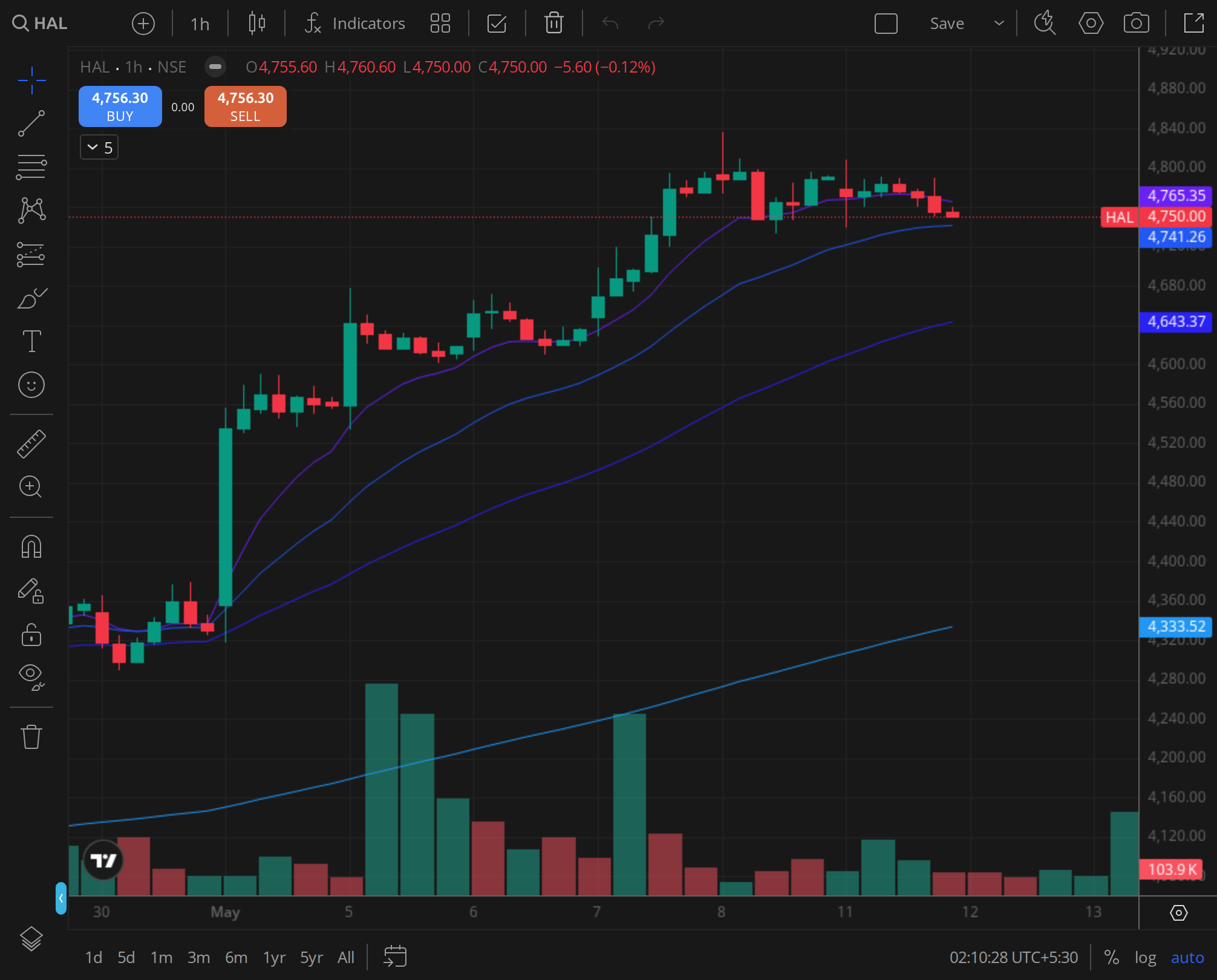
Caption: HAL weekly timeframe around 2025-06-03.
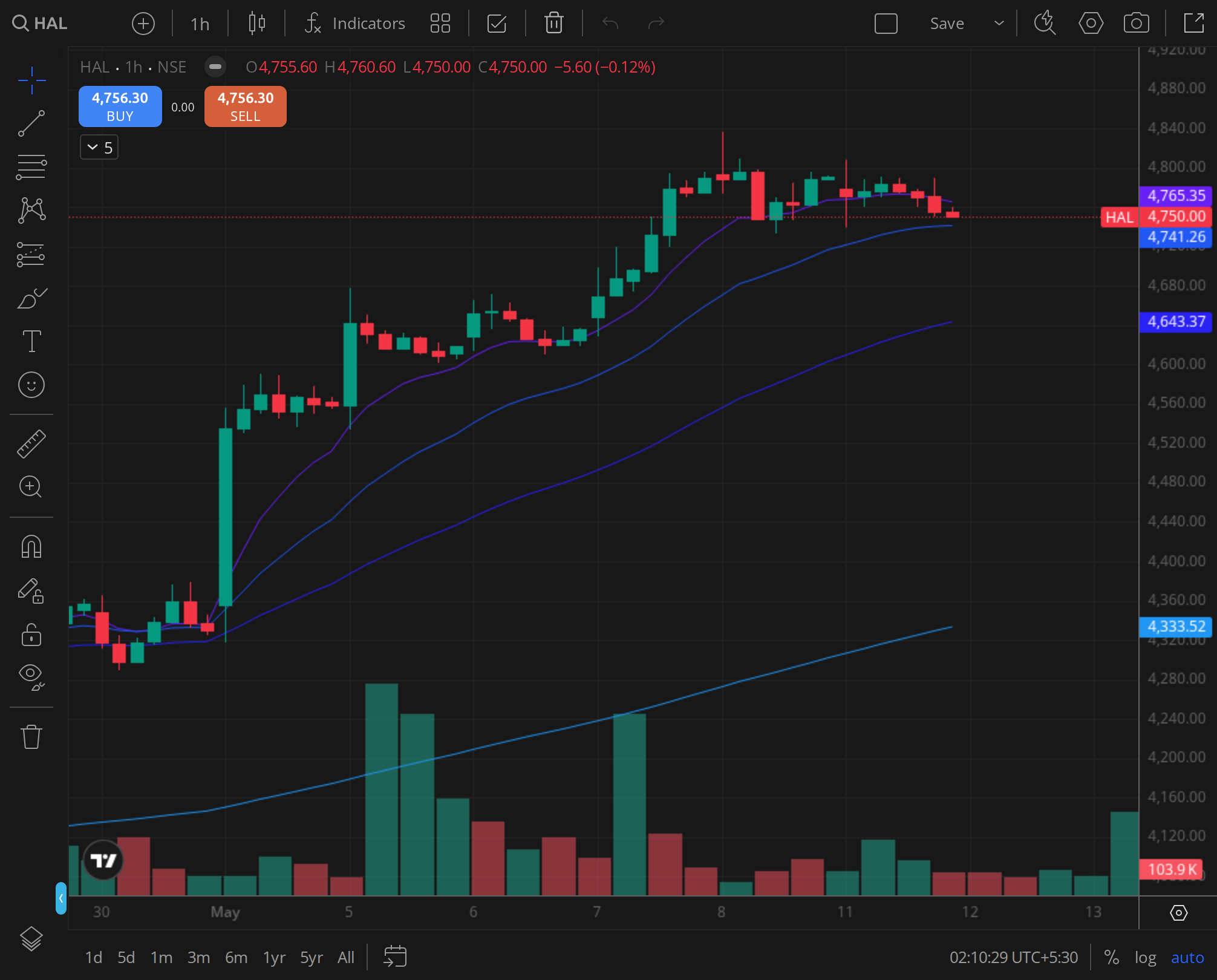
Caption: HAL daily timeframe around 2025-06-03.
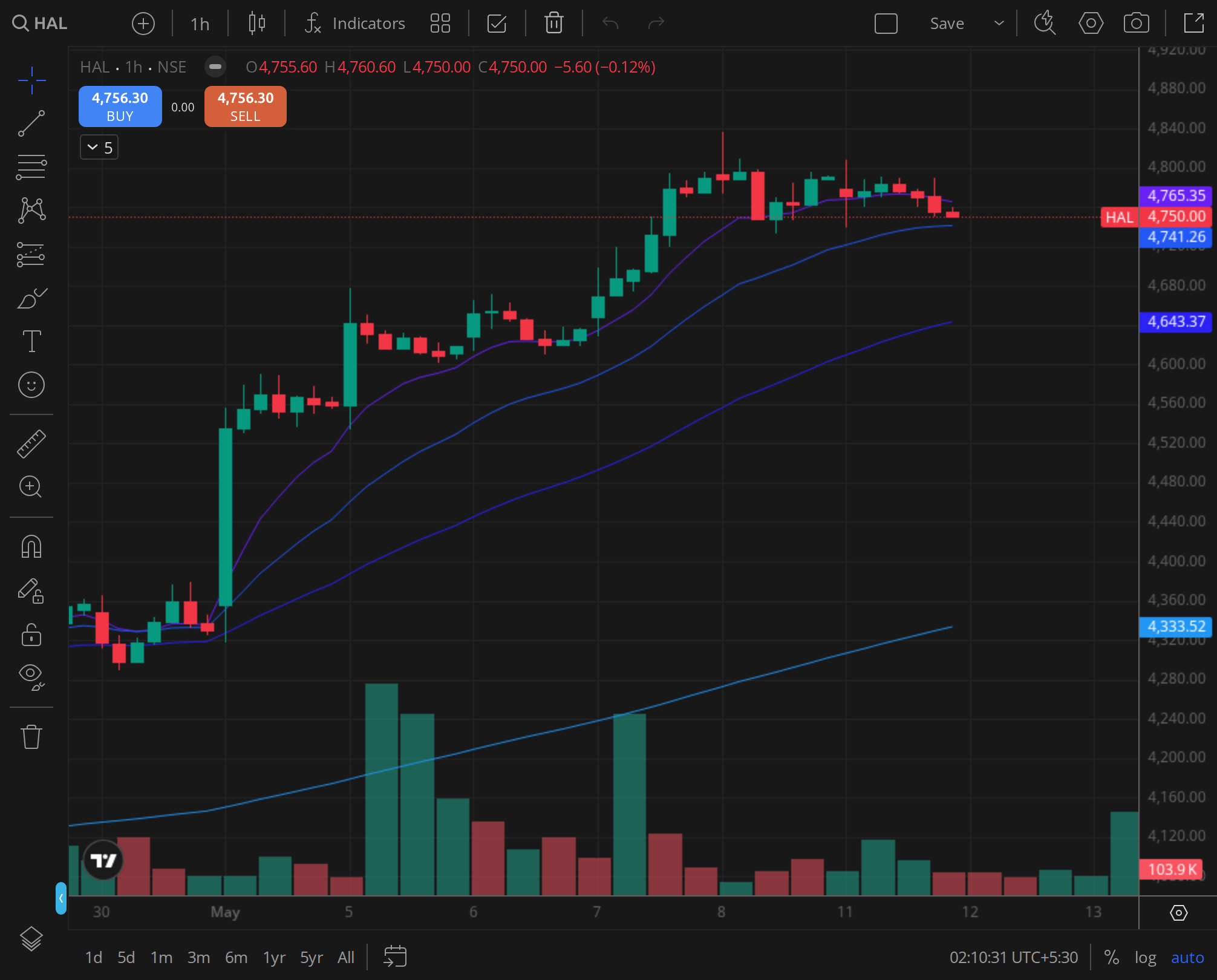
Caption: HAL 30min timeframe around 2025-06-03.
By June 3, the focus date for this lookback, the scrip had logged a roughly 14% gain from the April 19 open, per NSE daily settle data referenced through the window. The final fortnight then bled some of that back, leaving the June 18 close materially below the early-June peak. Read straight, the print was a textbook order-book rally: news in, position on, news exhausted, position off. Read carefully, it was something more interesting, and a useful template for how Indian defence PSUs traded in the post-2024 mean-reversion regime.
The setup going in
Going into April 19, HAL was working off a base that had been built since the late-January 2025 lows. The daily moving-average stack had flipped friendly through March, with the 20-day reclaiming the 50-day, and the 50-day curling up under price. The 200-day, sitting well below, was the reminder of how far the stock had fallen from its July 2024 highs. The structure was constructive, not euphoric, and that mattered for what came next, because the rally had room to run before it ran into the heavy supply zone left behind by the 2024 distribution.
Sentiment going in was lukewarm. Brokerage consensus through March and into early April was a mix of Hold and Accumulate, with most sell-side desks waiting for the Q4FY25 print to re-rate. The derivative book reflected that. Open interest on the June series had built modestly, but the put-call ratio was sitting on the neutral side of one, and FII derivative positioning, read off the daily participant-wise OI from NSE, showed defence names as net flat rather than net long. Nobody was crowded into the trade on April 19. That was the first thing that made the next nine weeks tradable.
The catalyst sequence
The window's news flow was front-loaded into May. The early-May leg was driven by two strands. First, the Q4FY25 result, which landed in the last week of May, came in with a revenue print that beat the conservative end of sell-side estimates and an order book that the management guidance framed as a multi-year visibility story rather than a single-year demand spike. Second, contract announcements through May, around engine MRO mandates and a fresh tranche of LCA-related work, gave the tape something to anchor each week.
The market traded both strands the same way it always traded HAL on order news, which is to say in two phases. Phase one was the gap-up, usually with a long upper wick and outsize delivery volume on the cash side. Phase two was the slow grind higher into the following session as systematic and momentum books read the volume signature and added. By the third such cycle in May, the gap-ups were shrinking and the grind-up was extending into the second and third day, which is the classic signature of a theme transitioning from news-driven to flow-driven.
The peak of that flow showed up in the first week of June. By June 3, HAL had cleared a level that the daily chart had been chewing on since mid-February. The 20-day moving average had stretched above price by a wider margin than at any point in the window, the daily RSI was running in the upper sixties, and the cash market delivery percentage had ticked up to a level that historically marked the late innings of a HAL leg rather than the early innings.
What June 3 actually looked like intraday
The thirty-minute chart for the week of May 29 to June 3 is the cleanest tell of the whole window. The first session of the week opened with a gap, sold the first bar, and then spent the rest of the morning grinding back up to the gap level on declining volume. That pattern repeated three times across the week, each time with a smaller second-leg amplitude. By the morning of June 3, the intraday structure had compressed into a tight range in the first ninety minutes, and the breakout attempt mid-session failed to take out the prior day's high with conviction. The close that day was respectable on a headline basis and reflected a stock that had already done its work for the week.
The volume signature on June 3 told the same story. The cash-market traded volume for the session sat below the trailing two-week average, and the delivery-to-volume ratio, the cleaner read on conviction, was lower than the May peaks. None of this was a top-call on its own. Combined with the daily MA stretch and the derivative shifts that followed, it was a fair warning.
The derivative book turned first
The cleanest leading indicator that the rally was getting tired was not in the cash market. It was in the option chain. Across the five sessions on either side of June 3, the open interest profile on HAL's June series shifted in a way that historically preceded short-term pullbacks. Call OI built up at the strikes immediately above where the spot was trading, the put-call ratio crept lower, and the implied volatility on at-the-money options drifted up rather than collapsing into the post-result decay, which is what would have been expected if the move was being treated as durable.
FII derivative positioning, read off the daily participant-wise data, told the same story with a one-session lag. Net long positioning in the index futures was rising on the same days that single-stock futures in defence names, HAL included, were seeing fresh shorts. That divergence, index long versus stock-specific short, was the read that the smart money was using the rally to hedge rather than to add. By the second week of June, the funding rate equivalent, the cost of carry implied in the rollover, had widened in a way that made the long side more expensive to hold than to exit.
The fundamental anchor
None of the above said the fundamental case had broken. The Q4FY25 print had genuinely improved the medium-term visibility, the order pipeline through FY26 was the strongest it had been in three years, and the indigenisation-driven margin profile was structurally better than the pre-2022 base. Peer comparison through the window favoured HAL on operating margin and return ratios, even if BEL and Mazagon Dock had richer headline order-to-sales multiples.
The question the rally posed was not whether the fundamentals had improved. It was whether the multiple expansion through May had front-loaded the next twelve months of that improvement into nine weeks of price action. By the June 3 close, the implied multiple on FY26 estimates was running at the upper end of the three-year range, and the implied multiple on FY27 estimates was running ahead of where the comparable defence basket was trading. That gap was not catastrophic. It was, however, the gap that had to be defended either by another leg of news or by a further re-rating of the sector multiple. The next fortnight delivered neither, which is why the back end of the window gave up some of the early-June gains.
Historical analog
The most useful prior analog inside HAL's own price history was the September to November 2023 leg. That move was also driven by a sequence of order announcements stacked over roughly nine weeks, also ended with a derivative book that turned defensive before the cash tape rolled, and also gave back roughly a third of the rally in the four weeks after the local high. The 2025 sequence rhymed more than it repeated. The amplitude was smaller in percentage terms because the base was higher, and the unwind was shallower because the structural narrative had improved in the interim. The mechanic, though, was the same: order news compresses into the multiple faster than the order book converts into revenue, and the gap between those two timelines is where the late-rally pullback lives.
Was the move justified ex-post
The honest read, looking back from May 2026, is that the April to early-June rally was justified on direction and overdone on speed. Direction, because the order book and margin trajectory through FY26 did warrant a higher base than the late-January 2025 lows. Speed, because nine weeks was not enough time for any of those order announcements to convert into revenue recognition, and the multiple expansion ran ahead of that conversion timeline. The pullback through the second half of June was the market correcting that mismatch, not invalidating the thesis.
For a trader who entered on the April reclaim and exited around June 3, the trade worked cleanly. For a trader who added on the early-June breakout, the next fortnight was painful but recoverable. For a long-term holder, the window was noise around a structurally improving asset, and the right action was no action.
VERDICT
Stance: NEUTRAL (as of the June 3, 2025 focus date) Horizon: 1mo forward read from June 3 Rationale: The cash-tape strength on June 3 was not confirmed by the derivative book or the delivery signature, and the multiple had absorbed most of the visible FY26 order momentum. A 5-day forward read leaned mildly negative, the 1-month forward read pointed to a shallow pullback rather than a trend break, and the 3-month read remained constructive on the underlying order book.
The lookback lesson from the window was straightforward and worth carrying into the next defence-order cycle. In Indian defence PSUs, the order book is a real asset and the rally that prices it in is a separate event from the revenue that eventually validates it. Trading the first without respecting the gap to the second is the recurring mistake the tape kept punishing, and HAL between April and June 2025 was the cleanest recent example of how that gap closed.