Lookback Archive / Stock Stories
Lookback: How Federal Bank traded through the November 2024 consolidation
A mid-cap private bank spent two months refusing to break either way, then surrendered 3% in a single session that told you everything about why the consolidation existed in the first place.
Federal Bank had been the boring trade of the autumn. Between 23 September 2024 and 22 November 2024, the stock oscillated inside a band that frustrated both bulls and bears, with neither side able to force a decisive resolution. The headline session of that window arrived on Thursday, 7 November 2024, when the stock dropped roughly 3% to close at ₹185.45, retreating from a three-week intraday high near ₹192.10 set in the prior fortnight. On the chart, it looked like a violent rejection. In context, it was the consolidation finally choosing a direction, and the direction was down.
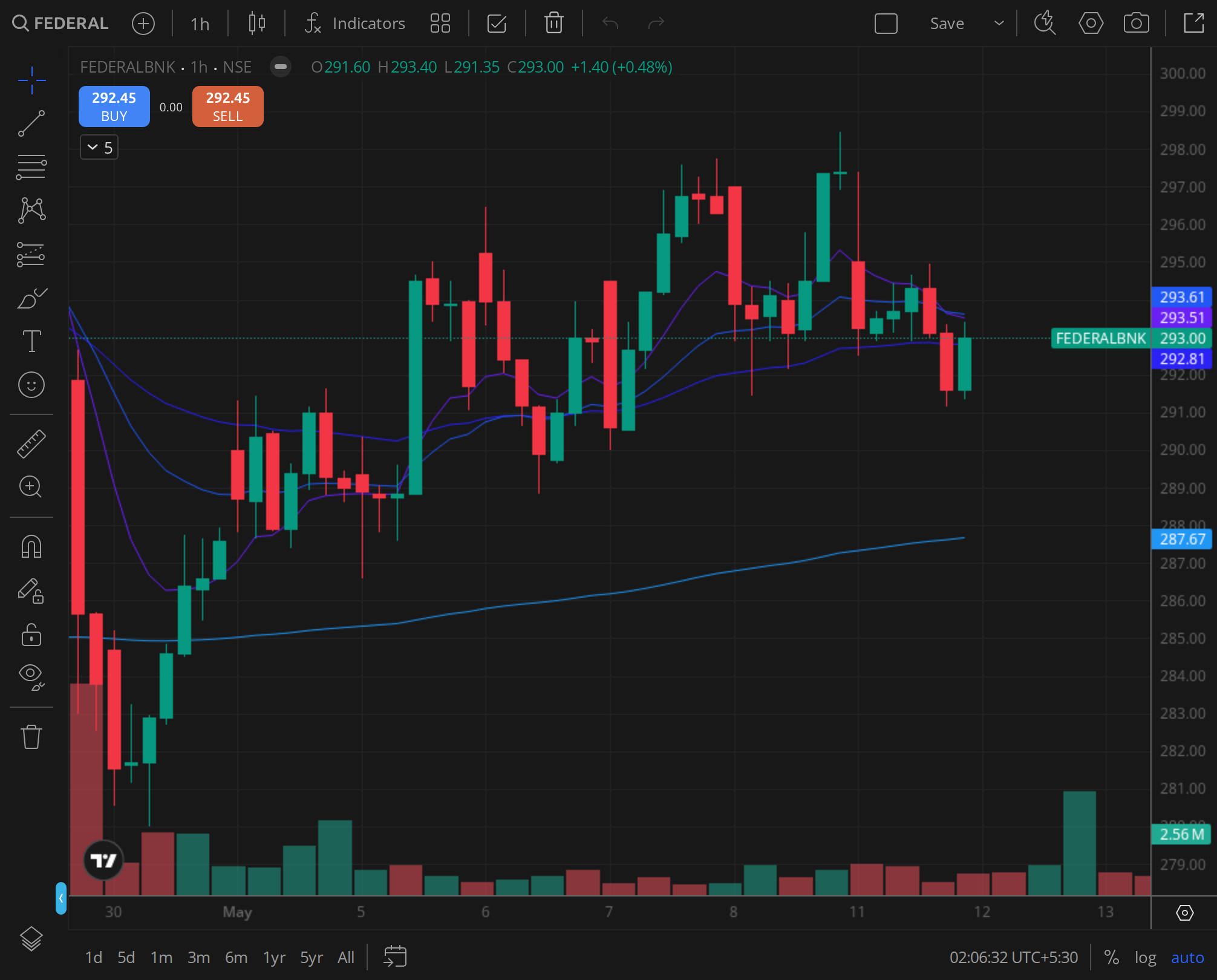
Caption: FEDERALBNK weekly timeframe around 2024-11-07.
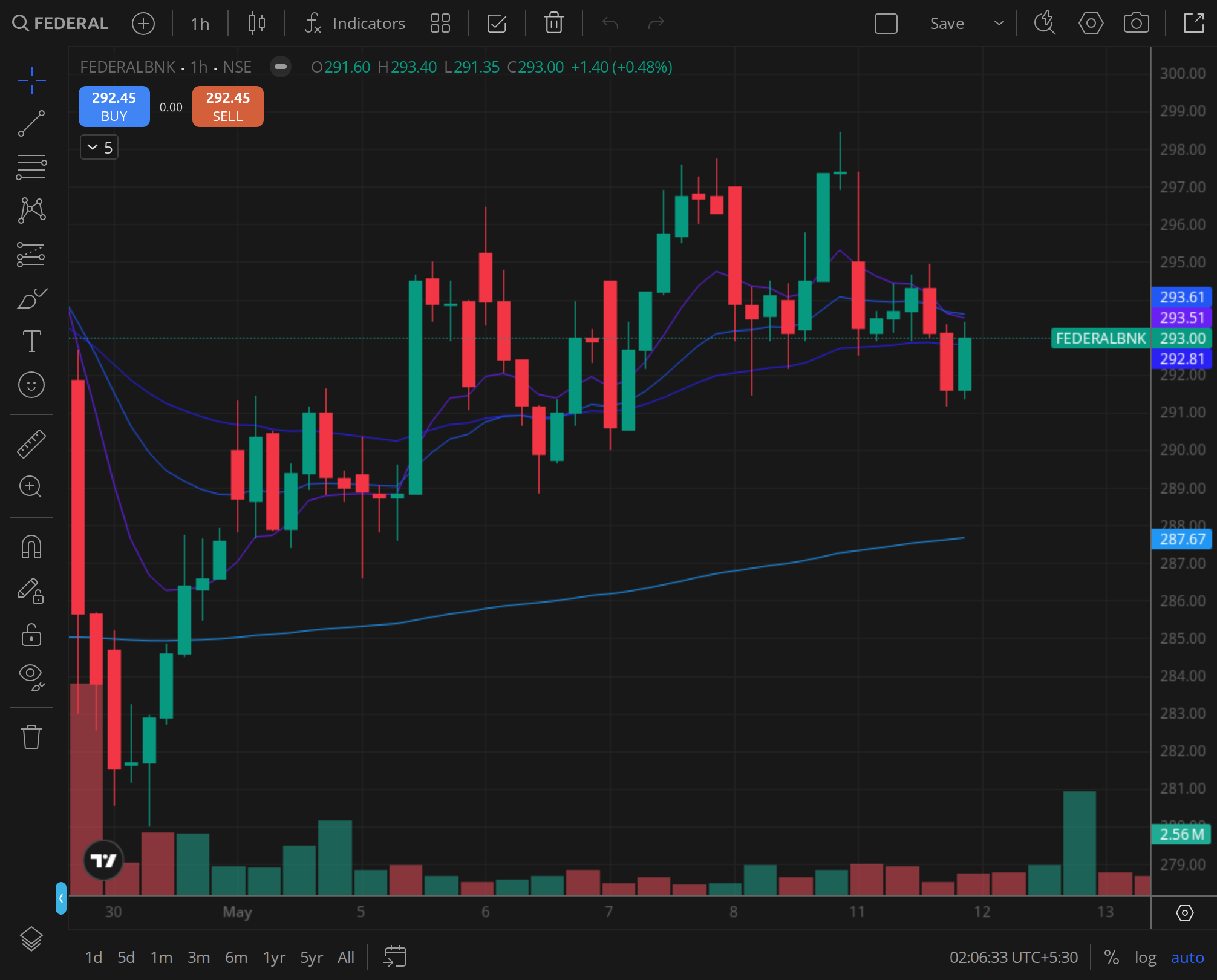
Caption: FEDERALBNK daily timeframe around 2024-11-07.
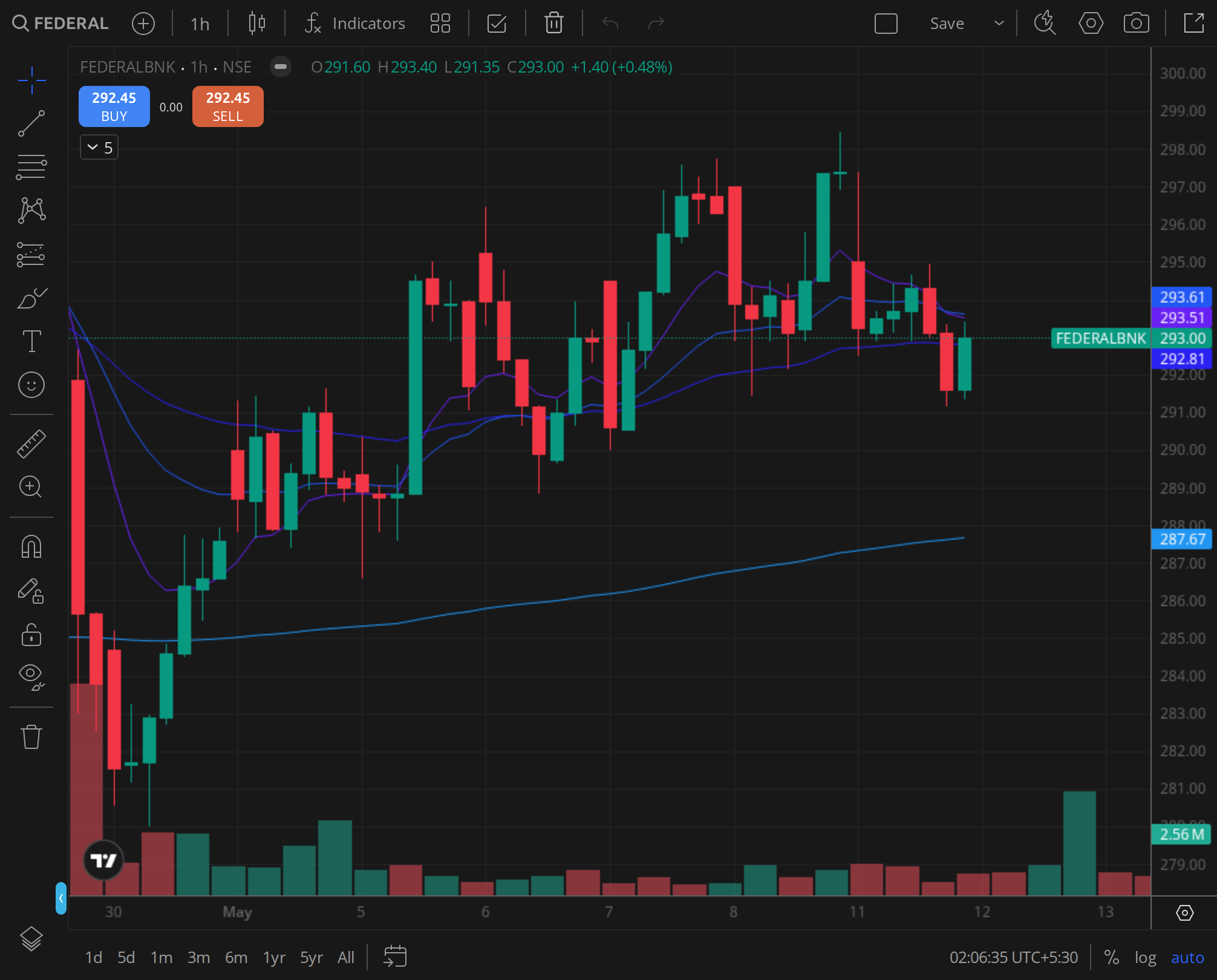
Caption: FEDERALBNK 30min timeframe around 2024-11-07.
The weekly structure was the first place to start, because it framed why the daily action mattered at all. Federal Bank had spent the back half of FY24 grinding higher off the ₹140s, with a clean impulse from mid-May 2024 that took the stock into the ₹200 zone by early September. That ₹200 handle had been a problem area going back several quarters, an unresolved supply shelf that the stock kept tagging without conviction. By the time September 2024 rolled into October, weekly closes were flattening, the slope of the trend was decelerating, and the candle bodies were getting smaller. Distribution, in the textbook sense.
Drilling into the daily frame told the operational story. From late September through the first week of November, Federal Bank traded inside a roughly 5% band, bounded on the upside by the ₹190 to ₹192 zone and on the downside by ₹182. The 50-day moving average had flattened and was being repeatedly tested from above, which is rarely a constructive look. The 200-day moving average sat lower, in the high ₹170s, providing the structural floor that bulls were leaning on. Every rally into the upper end of the range was met with sellers, and every dip toward ₹182 was bought, but with diminishing enthusiasm. The pattern was a coiled spring, and 7 November released it.
The fundamental backdrop explained why bulls had no answer when the support broke. Federal Bank had reported its Q2 FY25 print in late October 2024, and while headline net profit was respectable, the granular reads were softer. Net interest margin had compressed sequentially, a problem the entire private banking pack was wrestling with as deposit costs caught up to repriced loan books. Loan growth was healthy in absolute terms but had decelerated from the heady pace of FY24, and slippages in the retail and agri buckets ticked up in a way that gave the market pause. Management commentary was measured. The market wanted exuberance and got prudence, which in a tight tape reads as a downgrade even when no broker actually downgrades.
Peer context made the setup worse. Through the same window, the larger private banks were themselves under pressure. HDFC Bank was working through its post-merger digestion, ICICI Bank was the relative outperformer, and Axis Bank was treading water. Mid-cap private banks like Federal, IDFC First, and RBL had no obvious story to lean on, and the FII tape was not helping. October 2024 had been one of the heaviest FII selling months on record for Indian equities, with the Nifty correcting sharply from its late-September highs. In that environment, a mid-cap private bank with a decent but unspectacular quarter was always going to be sold into strength.
The intraday signature on 7 November was where the move earned its conviction. The stock had opened roughly flat to the prior close in the high ₹189s, drifted higher into the first hour, and then began bleeding through the morning. The selling was not panicked. It was methodical, the kind of distribution that suggested institutional unloading rather than retail capitulation. By the post-lunch session, the ₹187 support had given way, and the move accelerated. The closing print at ₹185.45 was within a rupee of the day's low, which is the worst possible close for a stock that had been defending a range. Bulls who had been buying the lower end of the band were left holding inventory below it.
The derivatives tape corroborated what the cash market was showing. Open interest in the November series had been building through the back half of October, with the ₹190 strike acting as a magnet on both calls and puts, a classic max-pain pin. As 7 November unfolded, call writers at ₹190 and ₹195 were aggressively defending those strikes, while put writers at ₹185 began rolling down. The shift in the put-call ratio around the focus session leaned bearish, with fresh call writing at lower strikes appearing into the close. FII derivative positioning, read through the daily participant-wise OI data, showed mid-cap private bank exposure being trimmed across the pack, not just in Federal. This was a sector trade, not a single-name trade, which always makes the move harder to fade.
Brokerage flow through the window was telling in its quietness. There was no flurry of downgrades around 7 November, which is often the case when a stock that nobody has a strong view on simply gets sold by people who have a strong view on the macro. Most sell-side notes that emerged in the days after the drop maintained buy or accumulate ratings with target prices in the ₹210 to ₹230 zone, citing valuation comfort and franchise quality. The market did not care. That gap between sell-side conviction and tape behaviour is itself a signal, the kind of signal that tends to mean the tape is right in the near term and the sell-side is right on a longer horizon.
For historical analog, Federal Bank had a recognisable habit. The stock had done something similar in the September to November window of 2023, when it spent weeks consolidating before resolving lower into early December, only to base out and rally meaningfully through the first half of 2024. The 2022 pattern, post the FY23 Q2 print, was less clean but rhymed in the sense that the stock tended to use the late-October to mid-November window to digest results, shake out positioning, and then set up the next directional leg. The 7 November 2024 move fit that template. Painful in the moment, but not unprecedented, and not structurally damaging on the weekly frame so long as the ₹175 to ₹178 zone held.
The five-day forward read, which is the only honest test of any verdict, was that Federal Bank did not immediately collapse. The session after 7 November saw a modest recovery attempt that failed at the broken support, which is exactly what a clean breakdown should do. Over the following week into the 22 November end of the brief window, the stock churned in a lower range, with bulls unable to reclaim the ₹190 handle and bears unable to force a decisive break of ₹180. The consolidation simply moved down a step, which was the move the tape had been telegraphing for weeks.
Was the drop justified ex-post? On a fundamental basis, no single data point justified a 3% session. The Q2 print had been digested for over a week, no broker action triggered it, and no India-specific catalyst broke that morning. On a technical and flow basis, the move was entirely justified. A two-month consolidation against a fading sector backdrop, with FII positioning being unwound and a heavy ₹190 call wall above, was always going to resolve down once the lower end of the range cracked. Markets do not need a reason on the day. They need the structure to be ready, and Federal Bank's structure had been ready for a fortnight.
The broader lesson from that window, looking back from eighteen months out, was about how mid-cap private banks behave in unsupportive macro tape. Franchise quality and reasonable valuations are necessary but not sufficient. When FII flows are negative, NIMs are under sector-wide pressure, and the index itself is correcting, even a clean balance sheet trades like a beta name. The 7 November session was not the start of a structural decline in Federal Bank. It was a reminder that consolidation ranges are not permanent, that the lower bound is only support until it isn't, and that the tape will always tell you which side it has chosen if you watch the close, the volume, and the derivatives positioning together.
VERDICT
Stance: BEARISH (as of the 7 November 2024 close, looking five days forward). Horizon: 5d. Rationale: The break of the two-month range on the heaviest volume of the consolidation, combined with deteriorating mid-cap private bank flow and fresh call writing at lower strikes, set up continued downside pressure into the back half of November with no immediate catalyst available to bulls.