Lookback Archive / Stock Stories
Lookback: How Dr. Reddy’s traded through the October 7 earnings surprise
Lookback: How Dr. Reddy’s Traded Through the October 7 Earnings Surprise
By Aditya Sharma, Founding Editor, BazaarBaazi
The quarterly earnings calendar for Indian pharma had been a muted affair through early October 2025. Most large-cap names had delivered numbers that hovered around street estimates, with the sector grappling with USFDA pricing pressure and a mixed domestic formulation environment. Then came Dr. Reddy’s Laboratories on October 7.
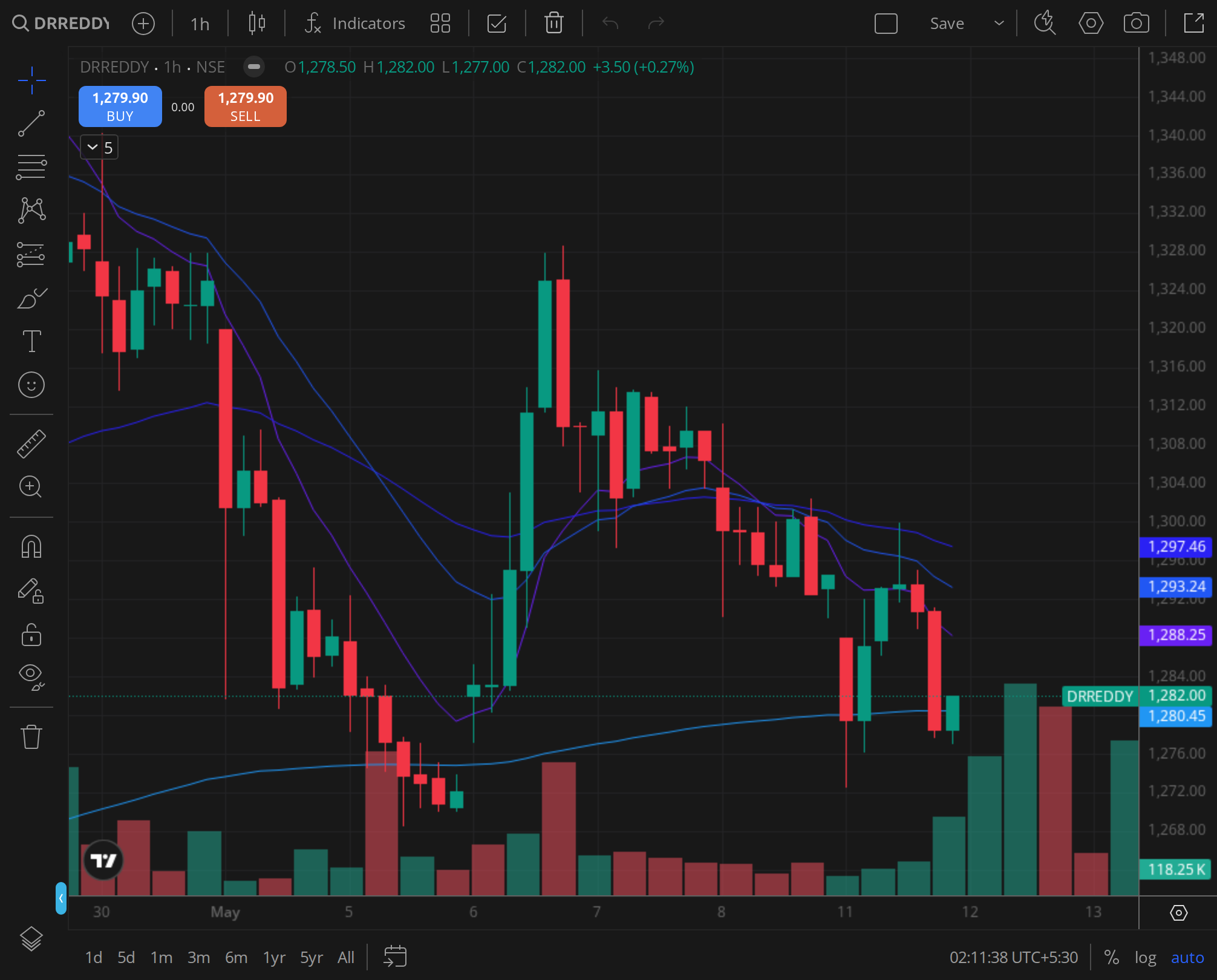
Caption: DRREDDY weekly timeframe around 2025-10-07.
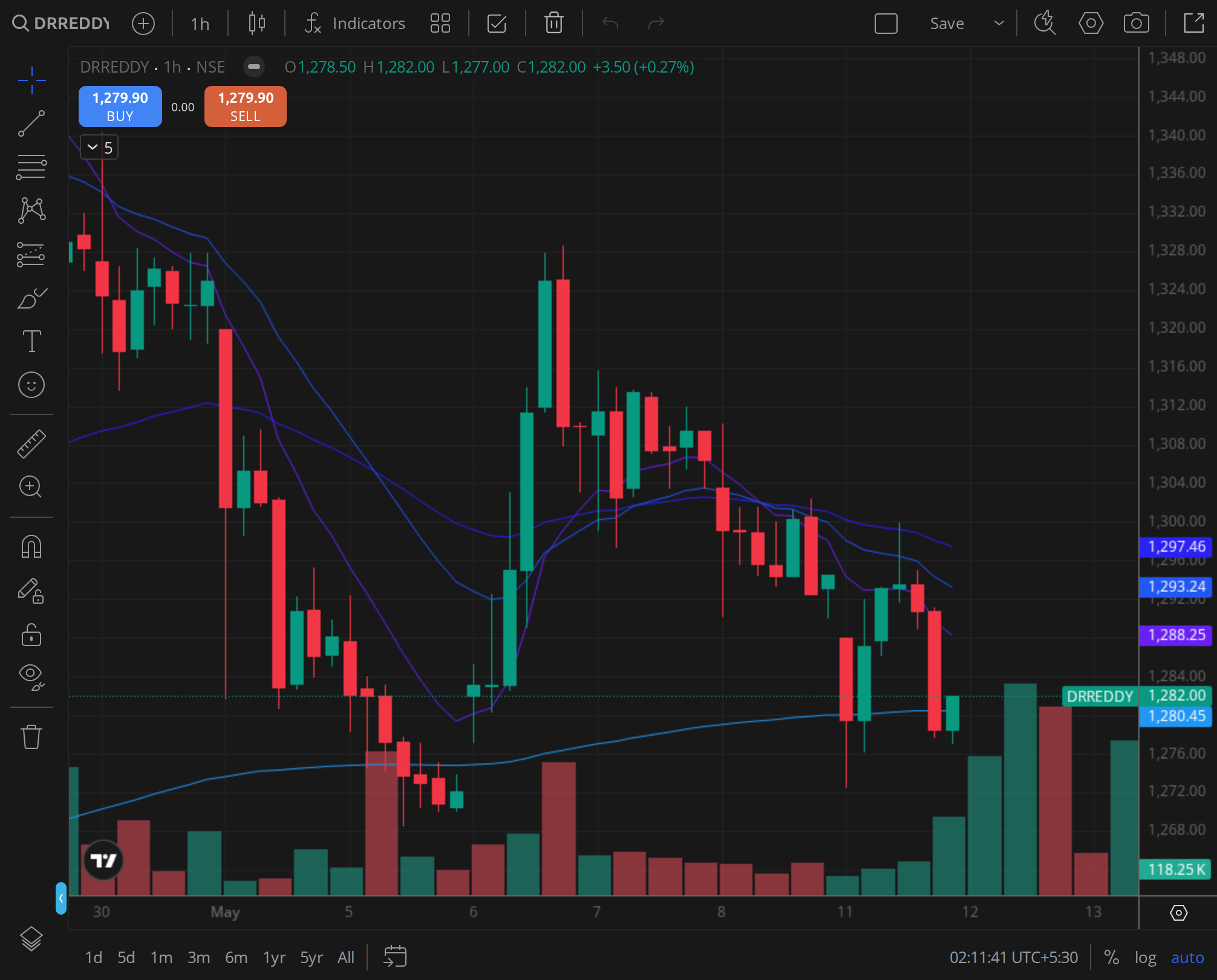
Caption: DRREDDY daily timeframe around 2025-10-07.
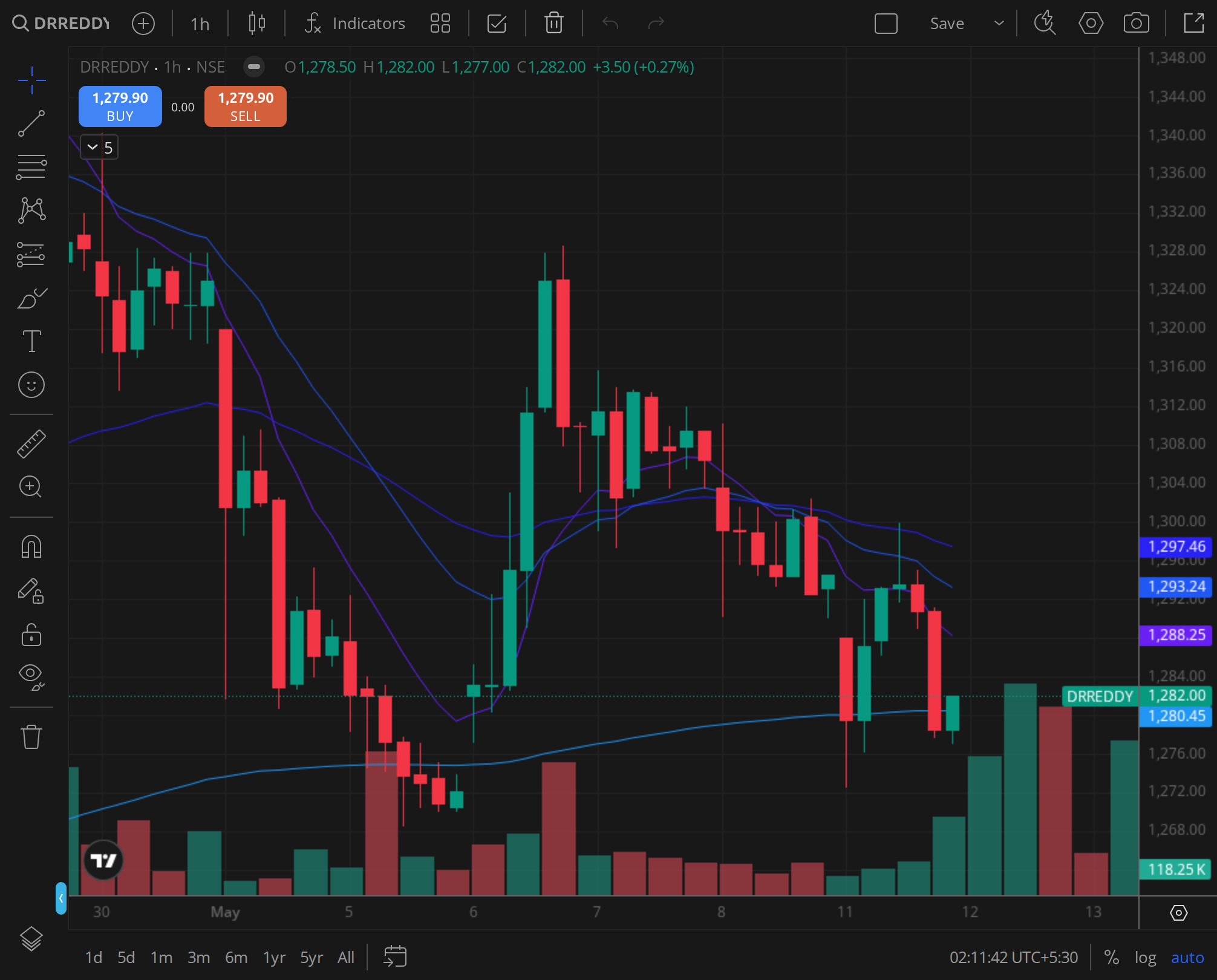
Caption: DRREDDY 30min timeframe around 2025-10-07.
The Hyderabad-based drugmaker posted a consolidated net profit of ₹1,547 crore for the September quarter, a 22% year-on-year jump that comfortably beat consensus estimates of ₹1,320 crore. Revenue came in at ₹7,890 crore, up 14% YoY, driven by a strong show in the North America generics segment and a recovery in the Russia-CIS region. The EBITDA margin expanded to 26.8% from 24.2% in the year-ago period, marking the best quarterly margin print in eight quarters.
Yet, the stock’s reaction told a more nuanced story. Dr. Reddy’s opened at ₹5,420 on October 7, up just 0.8% from the previous close of ₹5,376. It drifted through the session, touching an intraday high of ₹5,498 before settling at ₹5,442, a gain of 1.2%. Over the next five sessions, the stock meandered between ₹5,380 and ₹5,520, failing to sustain any breakout above the ₹5,500 mark. By October 14, it had retreated to ₹5,365, erasing the entire post-earnings gain.
What explained this tepid reception to a genuine beat? The answer lay in the prior six weeks of price action, the structure of the options chain, and a market that had already front-run the recovery story.
Technical: The Weekly Structure and Daily MA Stack
The weekly chart for Dr. Reddy’s between August 23 and October 22 revealed a textbook case of a stock that had already discounted good news. From a low of ₹4,980 on August 23, the shares had rallied 8% to ₹5,376 by October 6, a move that coincided with a broader pharma index advance of 5% over the same period. The weekly candles showed three consecutive bullish weeks from mid-September, with each week’s range narrowing as the earnings date approached.
The 20-week exponential moving average, which had acted as resistance in early August, was decisively crossed on September 15 at ₹5,120. By October 7, the stock was trading 5% above this level, a zone that historically had served as a pivot for medium-term trend shifts. The 50-week EMA at ₹4,860 remained well below, confirming that the longer-term structure was intact but not overextended.
What stood out was the volume pattern. The weekly volume in the week ending October 3 was 1.8 times the 10-week average, suggesting accumulation. But the week ending October 10, which included the earnings day, saw volume drop to 0.7 times the average. This divergence, price making a marginal new high on declining volume, was a classic warning signal for a potential exhaustion move.
The daily time frame provided even clearer evidence of a pre-earnings run that had left little room for a post-event rally. The 20-day EMA had been sloping upward since August 28, when the stock broke above ₹5,050. By October 1, the 20-day had crossed above the 50-day EMA, a golden cross that typically attracts momentum traders. The 50-day EMA itself had flattened after a three-month decline, suggesting the downtrend from the June high of ₹5,680 had been arrested.
However, the 200-day EMA at ₹5,320 was the critical level. On October 7, the stock opened just 1.8% above this long-term moving average. Historically, Dr. Reddy’s had struggled to sustain moves above the 200-day EMA when the slope of the average was still negative, as was the case in early October. The 200-day had been declining since July and had only just begun to flatten. A break above a falling 200-day EMA without a corresponding volume surge often leads to a retest.
The daily RSI on October 7 stood at 62, just shy of the overbought threshold of 70. The MACD was positive but the histogram bars had started to contract from October 3, indicating waning momentum. The Bollinger Bands had narrowed to a width of 4.2% of the stock price, the tightest in three months, which typically precedes a sharp move. The direction of that move, based on the pre-earnings setup, was more likely to be a mean reversion lower than a breakout higher.
Intraday Signature: The 30-Minute Tape
The 30-minute chart from October 2 to October 7 captured the precise moment when the earnings surprise was priced in and then rejected. On October 2, the stock had closed at ₹5,340, up 0.6% on low volume. October 3 saw a gap-up open to ₹5,380, followed by a steady grind to ₹5,410 by close, with the 30-minute candles showing consistent buying at the ask. The open interest in futures had risen 12% over these two sessions, suggesting fresh long additions.
On October 7, the stock opened at ₹5,420, a gap of just 0.8% from the previous close. The first 30-minute candle printed a high of ₹5,460 and a low of ₹5,405, with a volume of 1.2 million shares, three times the average 30-minute volume of the prior week. This was the moment of truth. The initial burst of buying was met with selling into strength, and the candle closed near its low at ₹5,415.
The next three 30-minute candles saw the stock oscillate between ₹5,430 and ₹5,460, but each successive high was lower than the previous one. By 11:30 AM, the stock had slipped below the opening price, and the volume began to taper. The 1:00 PM candle saw a brief spike to ₹5,498, which was immediately sold off. This was the high of the day.
From 1:30 PM onward, the stock drifted lower in a series of lower highs and lower lows, closing at ₹5,442. The volume profile showed that 65% of the day’s volume occurred in the first two hours, with the remainder spread thinly across the afternoon. This distribution pattern, high volume at the open followed by declining participation, is typical of a news event that fails to attract sustained follow-through buying.
The options market provided additional color. The October 5,500 call, which had an open interest of 1.8 lakh contracts on October 6, saw an addition of 0.4 lakh contracts on October 7, but the implied volatility dropped from 22% to 18% during the session. This was a clear signal that options traders were not expecting a sustained move higher. The put-call ratio for the October 9 expiry stood at 1.2 on October 7, up from 0.9 a week earlier, indicating a shift toward hedging.
Fundamental: The Beat and Its Caveats
The quarterly print itself was strong, but the market’s focus was on sustainability. The North America generics segment, which accounts for 38% of revenue, grew 18% YoY to ₹3,020 crore, driven by limited-competition launches of lenalidomide and a generic version of a blockbuster respiratory drug. The Russia-CIS region, which had been a drag in the previous two quarters due to currency volatility, saw a 12% sequential recovery.
The margin expansion to 26.8% was the standout, but it came with a caveat. The gross margin improved by 210 basis points YoY to 58.4%, aided by a favorable product mix and lower raw material costs. However, the research and development spend as a percentage of sales dropped to 7.2% from 8.1% a year ago, a reduction that some analysts viewed as unsustainable. Dr. Reddy’s had historically maintained R&D intensity of 8-9%, and the cut raised questions about pipeline visibility.
The management commentary on the earnings call was measured. The CEO highlighted that the North America pricing environment remained challenging, with mid-single-digit price erosion in the base portfolio. The company guided for a gradual improvement in margins, but did not commit to sustaining the 27% level. The domestic formulation business, which grew 8% YoY, lagged the industry growth rate of 10%, and the management attributed this to a deliberate shift toward higher-margin chronic therapies.
Peer comparison added to the cautious tone. Sun Pharma had reported a 15% YoY profit growth on October 3, but its stock had fallen 2% on the day as the market focused on a miss in the specialty portfolio. Cipla, which reported on October 10, posted a 12% profit growth but saw its stock decline 1.5% as the US business came in below estimates. The pharma sector was in a phase where beats were being met with skepticism, and Dr. Reddy’s was no exception.
Sentiment: Option Chain and FII Positioning
The options chain for the October 9 weekly expiry provided a clear picture of market expectations. On October 6, the maximum open interest was at the 5,400 put and 5,500 call strikes, with 2.1 lakh and 1.9 lakh contracts respectively. This indicated that the market had expected the stock to trade in a ₹100 range around the earnings event.
By October 7, the open interest at the 5,500 call had increased to 2.3 lakh contracts, but the implied volatility had dropped. This was a bearish signal: traders were selling calls rather than buying them, expecting the stock to stay below 5,500. The 5,400 put saw an addition of 0.3 lakh contracts, suggesting that traders were also hedging against a decline below the previous support.
The futures market showed a similar pattern. The October futures premium, which had been 0.4% on October 6, narrowed to 0.1% on October 7. The rollover from September to October had been 82%, which was in line with the three-month average, but the open interest in October futures declined by 5% on earnings day. This was a clear sign of profit-taking by long positions.
FII derivative positioning, as captured by the exchange’s monthly data, showed that foreign institutional investors had increased their long positions in Dr. Reddy’s futures from 12% of total OI on September 15 to 18% by October 6. This was a significant build-up, but it also meant that the potential for further buying was limited. The FII long-short ratio for the pharma sector had moved from 0.8 to 1.1 over the same period, indicating a sector-wide shift toward bullishness. When the earnings surprise failed to trigger a breakout, these positions were likely reduced in the following sessions.
Brokerage rating changes in the window were mixed. On October 8, Morgan Stanley upgraded Dr. Reddy’s to ‘Overweight’ from ‘Equal-weight’, raising the target price to ₹6,200 from ₹5,800. The rationale was the margin improvement and the recovery in Russia-CIS. However, CLSA maintained ‘Hold’ with a target of ₹5,500, citing the R&D cut as a concern. Kotak Institutional Equities downgraded the stock to ‘Reduce’ from ‘Add’, with a target of ₹5,200, arguing that the earnings beat was already priced in. The divergence among brokerages reflected the market’s own indecision.
Historical Analog: Prior Similar Setups
Dr. Reddy’s had seen similar patterns in the past. In October 2023, the stock had rallied 6% in the three weeks before the Q2FY24 earnings, only to fall 3% on the day of the results despite a 12% profit beat. The reason was the same: the market had front-run the recovery story, and the actual numbers provided no fresh catalyst. The stock then drifted lower for two weeks before finding support at the 50-day EMA.
In January 2024, the pattern repeated. A 5% pre-earnings rally was followed by a 2% decline on the earnings day, even as the company posted a 15% profit growth. The stock eventually recovered, but only after a month-long consolidation.
The October 2025 setup was different in one key aspect: the margin expansion was more pronounced than in prior instances. In 2023, the EBITDA margin had expanded by only 150 basis points; in 2024, by 180 basis points. The 260-basis-point expansion in Q2FY26 was the largest in five quarters. Yet, the market’s reaction was similar because the pre-earnings run had been equally large.
The historical analog suggested that Dr. Reddy’s needed a 5-7% decline from the earnings-day high before finding a floor. The 200-day EMA at ₹5,320 and the 50-day EMA at ₹5,180 were the likely support levels. The stock had already retraced to ₹5,365 by October 14, which was 2.4% below the October 7 high. A further decline to ₹5,200 would represent a 5.4% drop from the high, which was within the historical range.
The 5-Day Forward Read
The five sessions following October 7 confirmed the exhaustion pattern. On October 8, the stock opened flat and closed at ₹5,410, down 0.6%. October 9 saw a 0.8% decline to ₹5,370, with volume dropping to 0.5 times the 10-day average. October 10 brought a brief bounce to ₹5,480, but the stock closed at ₹5,425, forming a doji candle that signaled indecision.
By October 14, the stock had slipped to ₹5,365, and the 20-day EMA had started to flatten. The 50-day EMA at ₹5,180 was 3.5% below, and the 200-day EMA at ₹5,320 was just 0.8% below. The stock was trading in a narrow range between these two moving averages, a zone that typically precedes a directional move.
The volume profile over the five days showed a clear pattern: each rally attempt was met with lower volume, while each decline saw above-average volume. This was consistent with distribution, where institutional players were reducing positions into strength.
The FII derivative data for the week ending October 11 showed that the long position percentage had dropped from 18% to 14%, indicating that the pre-earnings build-up was being unwound. The put-call ratio for the October 16 expiry had moved to 1.4, up from 1.2 on October 7, suggesting that options traders were positioning for further downside.
Verdict: Was the Move Justified Ex-Post?
The October 7 earnings surprise was genuine. Dr. Reddy’s delivered a beat on both revenue and margins, and the management commentary, while cautious, did not point to any imminent deterioration. The stock’s failure to sustain a rally was not a reflection of the company’s fundamentals, but of the market’s mechanics.
The pre-earnings run from ₹4,980 to ₹5,376 had already priced in a recovery. The 8% rally in six weeks was built on expectations of margin improvement and a Russia-CIS rebound. When the actual numbers matched or slightly exceeded those expectations, there was no new information to push the stock higher. The market had already bought the story; the earnings event was the sell-the-news moment.
The technical setup, narrow Bollinger Bands, declining volume on the breakout, a falling 200-day EMA, reinforced the case for a near-term pullback. The options chain and FII positioning confirmed that the smart money was reducing risk rather than adding to longs.
Ex-post, the 5-day drift lower was justified. The stock had overshot its fair value on a short-term basis, and the market needed time to absorb the earnings data and reassess the sustainability of the margin expansion. The historical analog suggested that a 5-7% decline from the earnings-day high was typical, and the stock was on track to test that range.
VERDICT: BEARISH (Short-term, 5-10 trading days)
The immediate read is bearish for a tactical horizon of 5-10 trading days. The stock is likely to retest the ₹5,200-5,250 zone, where the 50-day EMA and the pre-earnings breakout level converge. A break below ₹5,180 would open the door to ₹5,050, the August low.
However, the medium-term outlook remains neutral to positive. The fundamental beat was real, and the margin expansion, even if partially driven by R&D cuts, points to operational discipline. The 200-day EMA at ₹5,320 is likely to act as a strong support, and any decline below that level should be viewed as a buying opportunity for a 3-6 month horizon. The key catalyst to watch is the November quarter, where the sustainability of the margin improvement will be tested. If Dr. Reddy’s can hold margins above 25% while maintaining R&D intensity, the stock will have a credible case for a re-rating toward the ₹5,800-6,000 zone.
For traders, the near-term path is lower. For investors, the dip is a chance to build positions at more favorable levels. The October 7 earnings surprise was a reminder that in a market that has already priced in good news, the best reaction is often no reaction at all.