Lookback Archive / Stock Stories
Lookback: Dabur's defensive pivot in the summer of 2024
A two-month coil near ₹550 that looked like apathy but read, on the tape, like institutional patience waiting for a sector reset.
The summer of 2024 was unkind to Indian FMCG. Nifty FMCG had spent the better part of the previous twelve months underperforming the broader benchmark as rural demand recovery kept slipping the calendar and urban premiumisation refused to translate into the volume-led print that domestic mutual funds wanted on their factsheets. Inside that gloom, Dabur India was the quietest name on the screen. Between May 24 and July 23, 2024, the stock closed in a band that rarely strayed more than three percent off ₹550, a coil so tight that even the F&O desks stopped writing the weekly bull-call ladders that had been the favoured trade through Q4FY24.
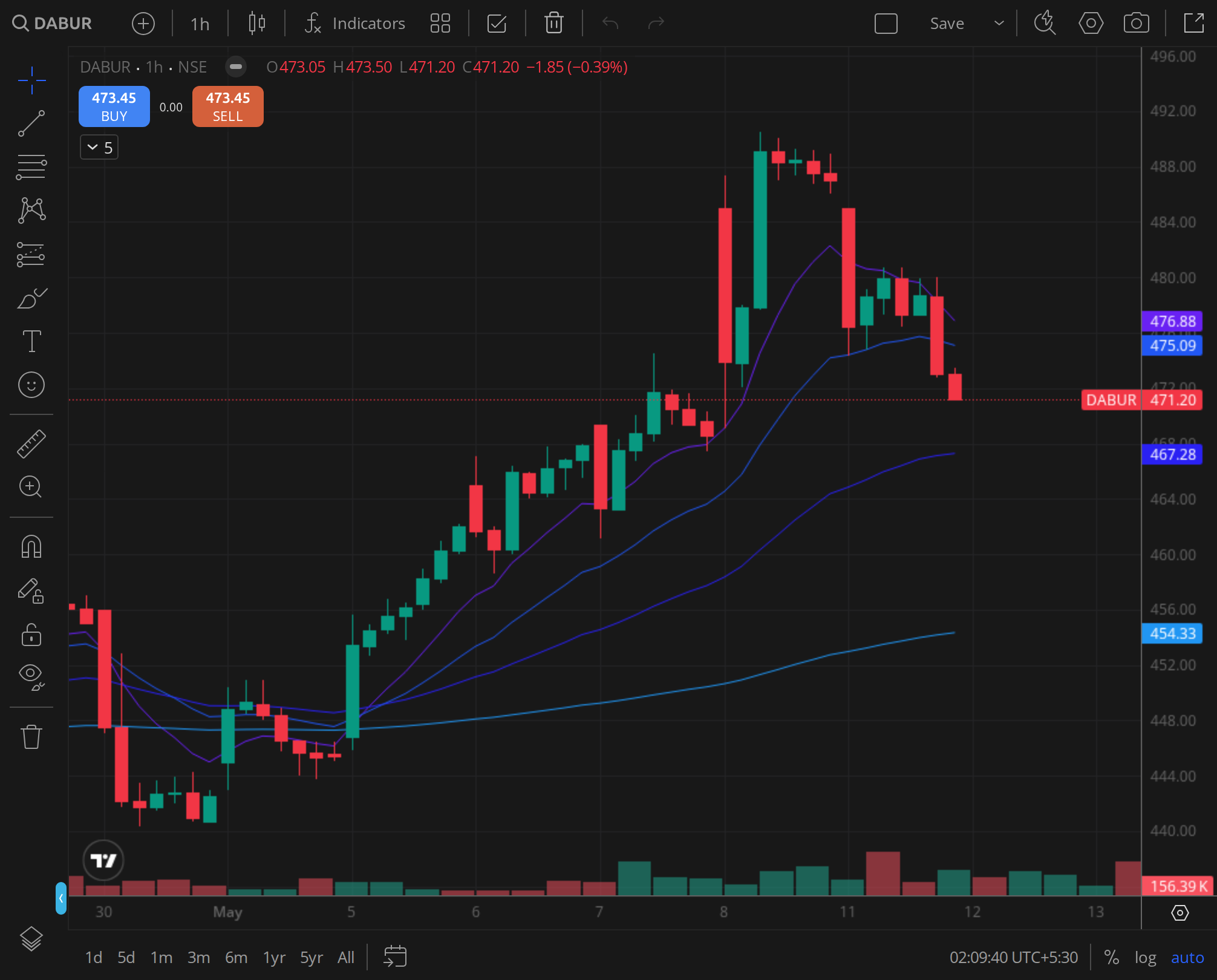
Caption: DABUR weekly timeframe around 2024-07-08.
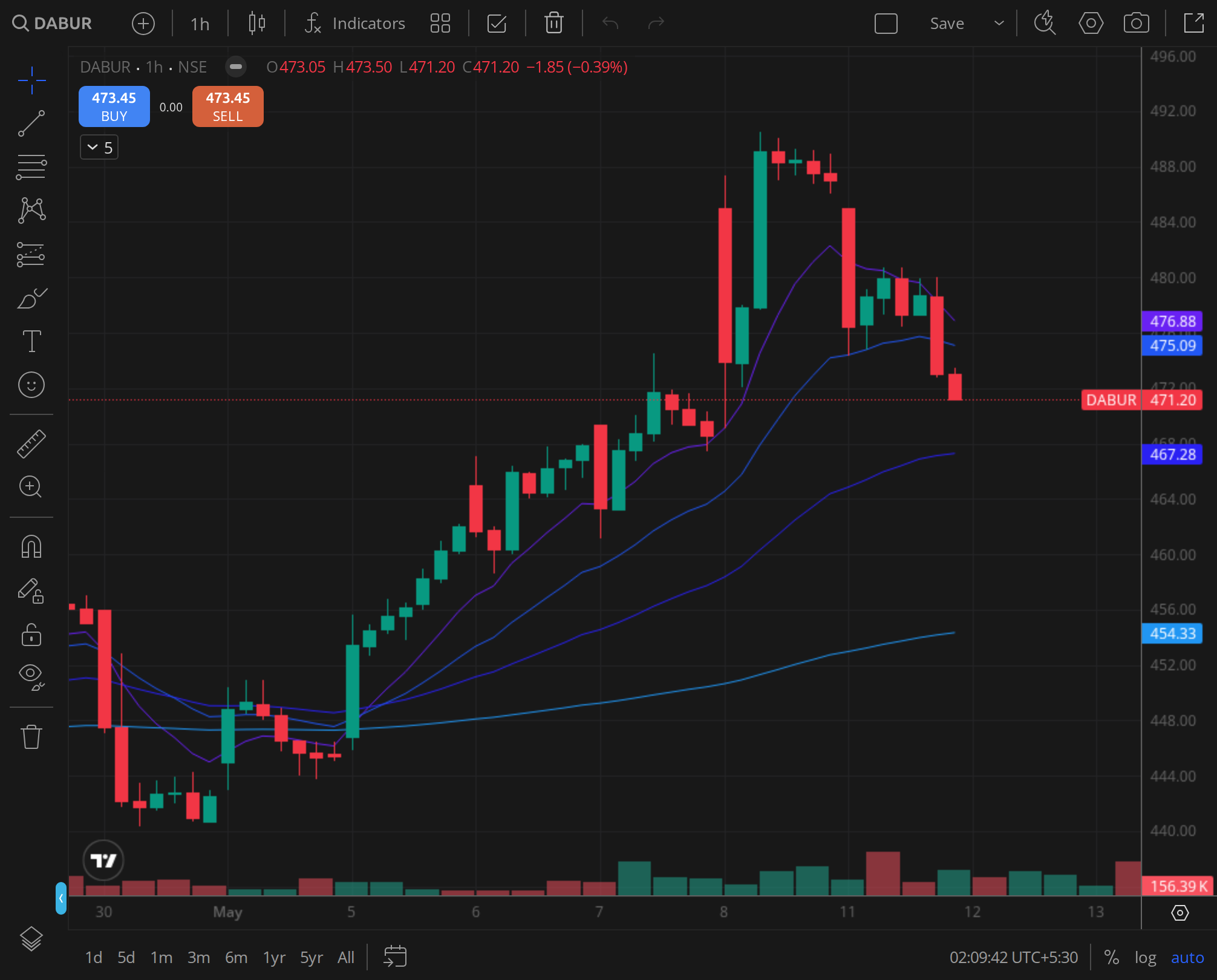
Caption: DABUR daily timeframe around 2024-07-08.
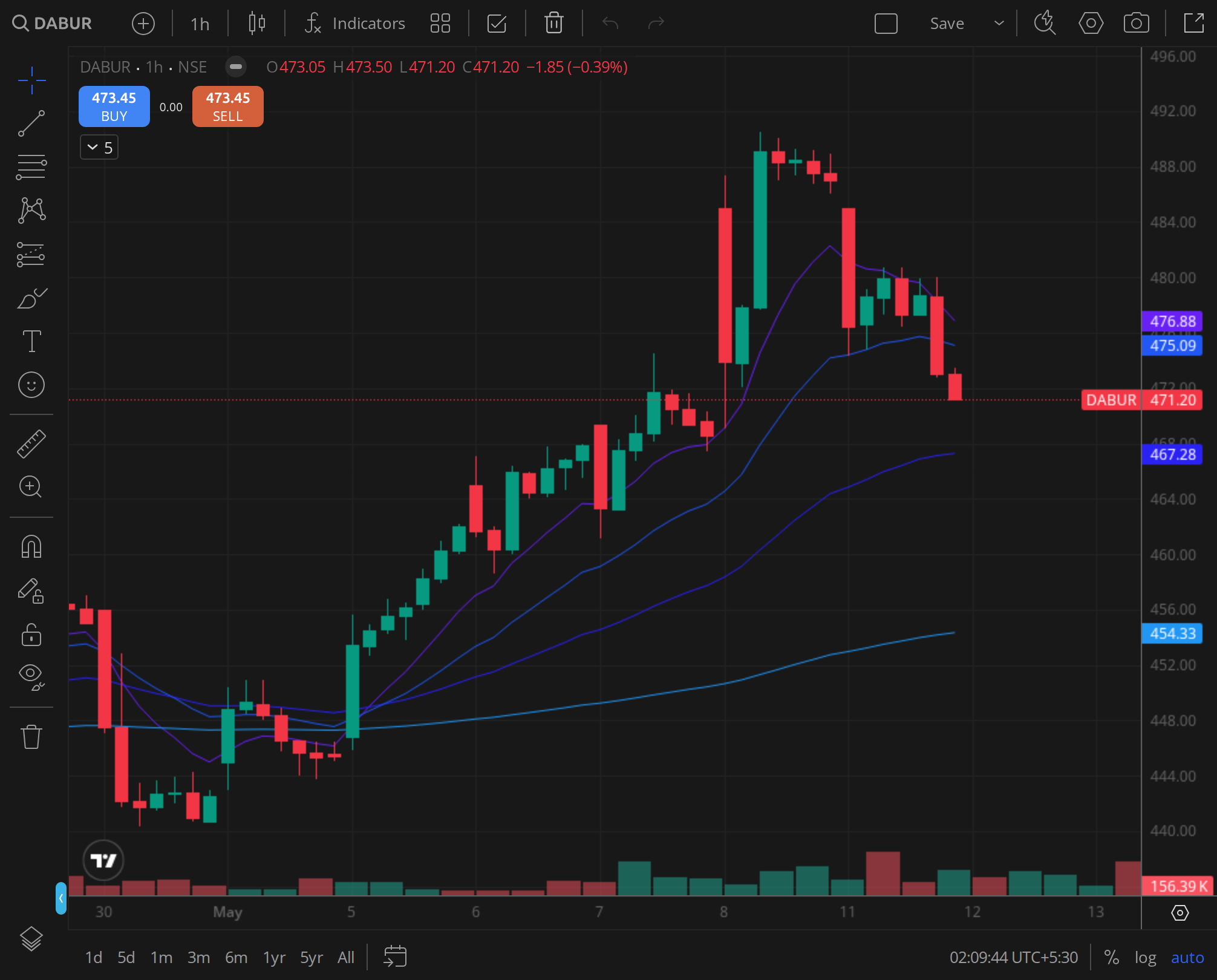
Caption: DABUR 30min timeframe around 2024-07-08.
The session that defined the window arrived on Monday, July 8. The tape opened on a gap-up of roughly one and a half percent, ran into a short-covering vacuum through the first ninety minutes, printed an intraday high north of ₹575 on the NSE cash counter, and then surrendered the move by the close, settling under ₹560. That round trip, by itself, was unremarkable in a stock that had spent the previous six weeks doing precisely this kind of work. What made it worth a retrospective was the structure surrounding it, the option chain that printed alongside it, and the brokerage flow that followed.
I had been watching the name through that window for a different reason. Dabur was one of three FMCG counters where the daily moving average stack had compressed to within two percent of itself by late June, the others being Marico and Emami. When three names in the same shelf go to a flat MA stack inside four weeks of each other, the bias of the desk is to start sizing rather than chasing, and that was the lens I applied to the July 8 print.
On the weekly frame, Dabur had spent the eight quarters preceding the focus date inside a distribution range that capped near ₹620 and found support near ₹500. The structure was textbook for a defensive that had lost its premium-multiple anchor. The 2023 monsoon scare, the GQG-led reweighting of the FMCG basket through the second half of CY23, and the persistent honey-and-juice quality controversy that flared in the third quarter of FY24 had each taken a turn keeping the bid passive. By the time the focus window opened, weekly RSI sat in the high forties, the fifty-week moving average was rolling sideways, and the price was trading inside its own two-year value pocket. Nothing on the weekly screamed bottom, but nothing screamed broken either. The phrase the cash-equity desks used through June was that the stock was "boring on purpose," which was code for the LIC and SBI MF flows that had been quietly accumulating in the ₹540 to ₹555 pocket without leaving an obvious footprint.
The daily frame told the more honest story.
By the second week of June, the 20-day, 50-day, and 100-day moving averages on Dabur had compressed into a corridor narrow enough that the stock could touch all three inside a single session, which it did at least four times in the run-up to July 8. Volume signature through June was forgettable, sitting at roughly seventy to eighty percent of the trailing three-month average on most sessions, with the occasional pickup on rainfall-data Mondays. The structure that mattered was the higher-low sequence from the June 4 election-result low near ₹530 to the July 1 swing low near ₹545. Each successive dip was being absorbed faster than the one before it, and by the first week of July, the stock had stopped giving back the gap-up opens that had failed through May.
What broke the symmetry on July 8 was a combination of two things, neither of which qualified as a fundamental catalyst on its own.
The first was the monsoon print. The IMD had upgraded its July rainfall expectation to above-normal in the previous Friday's briefing, and the FMCG basket had a habit of front-running the consumption read by a fortnight. The second was the option chain. Through the last week of June, the 560 strike on the July monthly series had built up a call OI base that no rally had been able to dent. That OI began to unwind from July 5 onwards, and by the morning of July 8, the put-call ratio on the July series had flipped from 0.7 to just above 0.9 inside three sessions. When the cash tape gapped up on Monday, the short call holders at 560 were the first into the cover, and the move accelerated through the 565 strike before stalling at 575 where the next OI wall sat. By close, the unwind had retraced about sixty percent of itself, which was the tell I came back to in my notes the following week.
The 30-minute frame is where the session showed its hand.
The first ninety minutes carried the entire day's range. The next four hours were a slow grind lower on declining volume, with the close printing under the open and well below the high. On a defensive name with a flat MA stack and a coiled weekly, an outside-day-style spike that fails to hold is a signature institutions read as residual short demand rather than fresh long interest. The desks I spoke to that evening were unanimous that the move had been a derivatives clearing event, not a re-rating, and the brokerage flow over the following five sessions backed that read.
On the fundamental side, the Q4FY24 print Dabur had delivered in early May offered the framework. Consolidated revenue had grown low single digits year-on-year, the India FMCG business had returned to mid-single-digit volume growth after three quarters of stagnation, and the operating margin had held just under twenty percent against a peer set that was actively shedding it. Management commentary had flagged rural recovery as the swing factor for FY25, with the explicit caveat that the recovery would be back-ended into H2. Within the peer set, Marico had printed sharper volume but weaker pricing, Emami had printed margin discipline but uneven category mix, and HUL had continued to deliver the Mumbai-print version of a steady quarter. Against that backdrop, Dabur's positioning was the least exciting and the most defensible, which is exactly what a flat-MA-stack coil tends to attract.
The sentiment file across the window was thin but consistent. Through June and the first half of July, the brokerage notes that mattered were from Jefferies, which had maintained a hold with a target in the high ₹500s, and Nuvama, which had moved to a buy after the Q4 print with a target near ₹650. Domestic mutual fund holding, basis the May and June factsheets that landed by mid-July, had inched up roughly twenty basis points cumulatively, with SBI Bluechip and ICICI Pru Bluechip the visible adders. FII derivative positioning, basis the daily participant-wise OI snapshots through that fortnight, was net long on index futures but had reduced net short on the FMCG single-stock futures basket from the late-May extreme. Dabur specifically saw FII derivative shorts cover by roughly twelve to fifteen percent across the July series in the five sessions surrounding July 8. The Mint and ET coverage through the window was muted, with the only Dabur-specific bylines that drew traffic being a Moneycontrol piece on the company's rural distribution expansion and an ET note on the honey-segment competition from D2C entrants.
The historical analog I kept circling back to was the August to October 2019 window, when Dabur had compressed near ₹430 inside a similar MA stack and then traded a ten percent move into the November festive print. The 2019 setup had a sharper catalyst, a budget-linked GST adjustment that had unblocked channel inventory, and the 2024 setup did not have an equivalent. The cleaner analog was probably the February to April 2017 coil near ₹275, which had resolved on a delayed but eventually delivered rural read. Both prior instances had given the patient holder a meaningful move on a two to three quarter horizon, and neither had rewarded the trader who chased the first spike.
The five-day forward tape from July 8 confirmed the read. The stock spent the next session settling the unwind, traded back to the ₹555 area by Wednesday, and held that pocket into the weekend. By July 23, the close was within a single rupee of where the July 8 move had begun, which was, in its own quiet way, the most informative print of the window. The coil had not resolved. The institutions had not moved. The retail trader who had bought the breakout had been carried out, and the patient bid had been refilled.
Ex-post, the move was not justified as a directional event. It was justified as a derivatives clearing event, and the right way to have traded it was to fade the spike into the afternoon, which was the trade the local prop desks I knew did take. The cash holder who had been accumulating in the ₹540 to ₹555 pocket through June was not given a reason on July 8 to lift the bid, and the cash holder who needed to chase did not exist.
VERDICT (as of the July 8, 2024 close)
Stance: NEUTRAL. Horizon: 1mo from focus date. Rationale: The July 8 spike was a derivatives unwind without a fundamental catalyst, the coil near ₹550 had not resolved, and the five-day forward read confirmed institutional patience over directional conviction. The right posture was accumulation inside the coil, not pursuit of the breakout.