Lookback Archive / Stock Stories
Lookback: lookback-stock-coalindia-2025-09-24
Lookback: The Coal India Stall at the Edge of the Monsoon Tail
A late-September session in 2025 that looked like a breakout to the untrained eye, but read as a distribution print to anyone watching the weekly tape. Eight months on, the verdict has aged well.
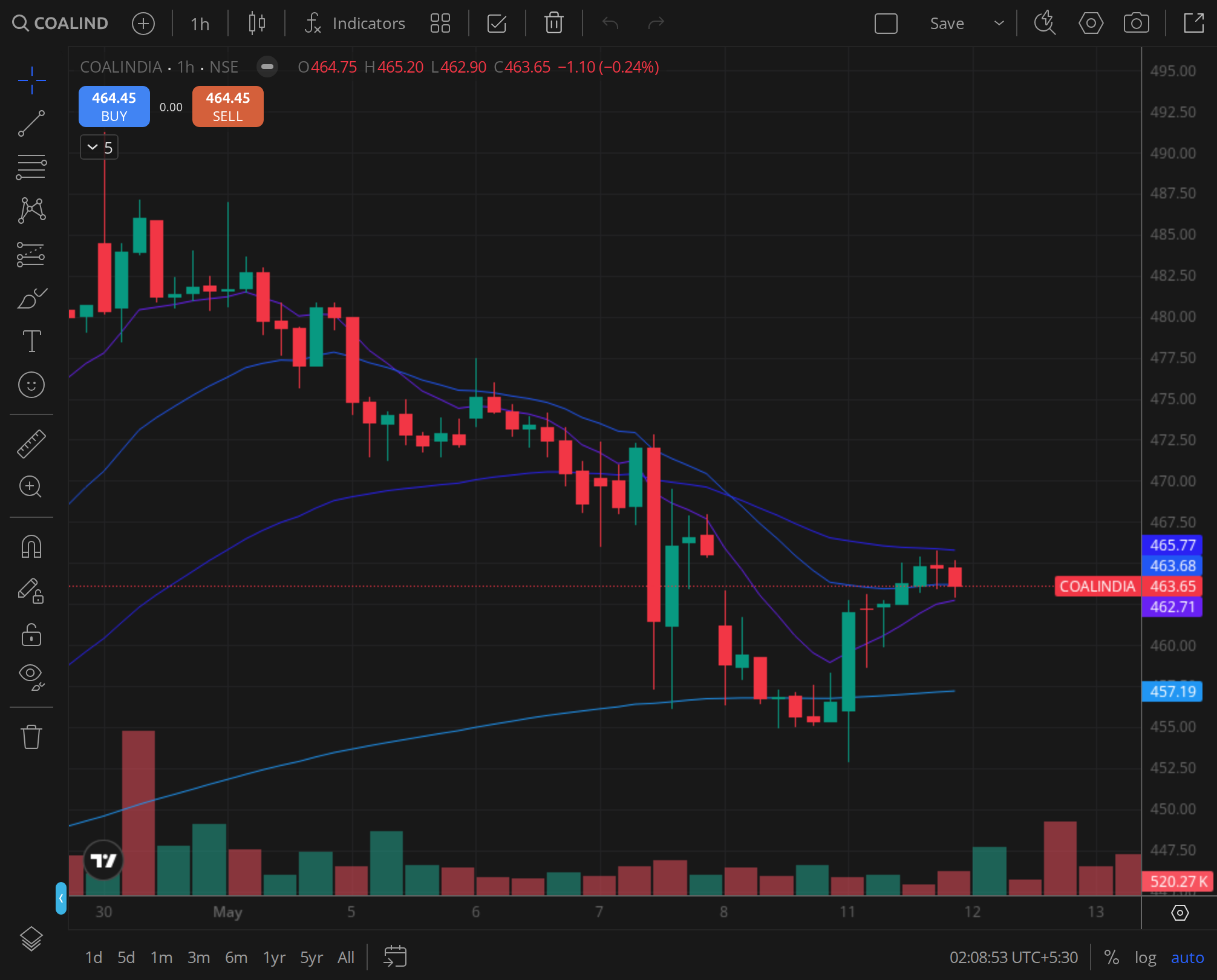
Caption: COALINDIA weekly timeframe around 2025-09-24.
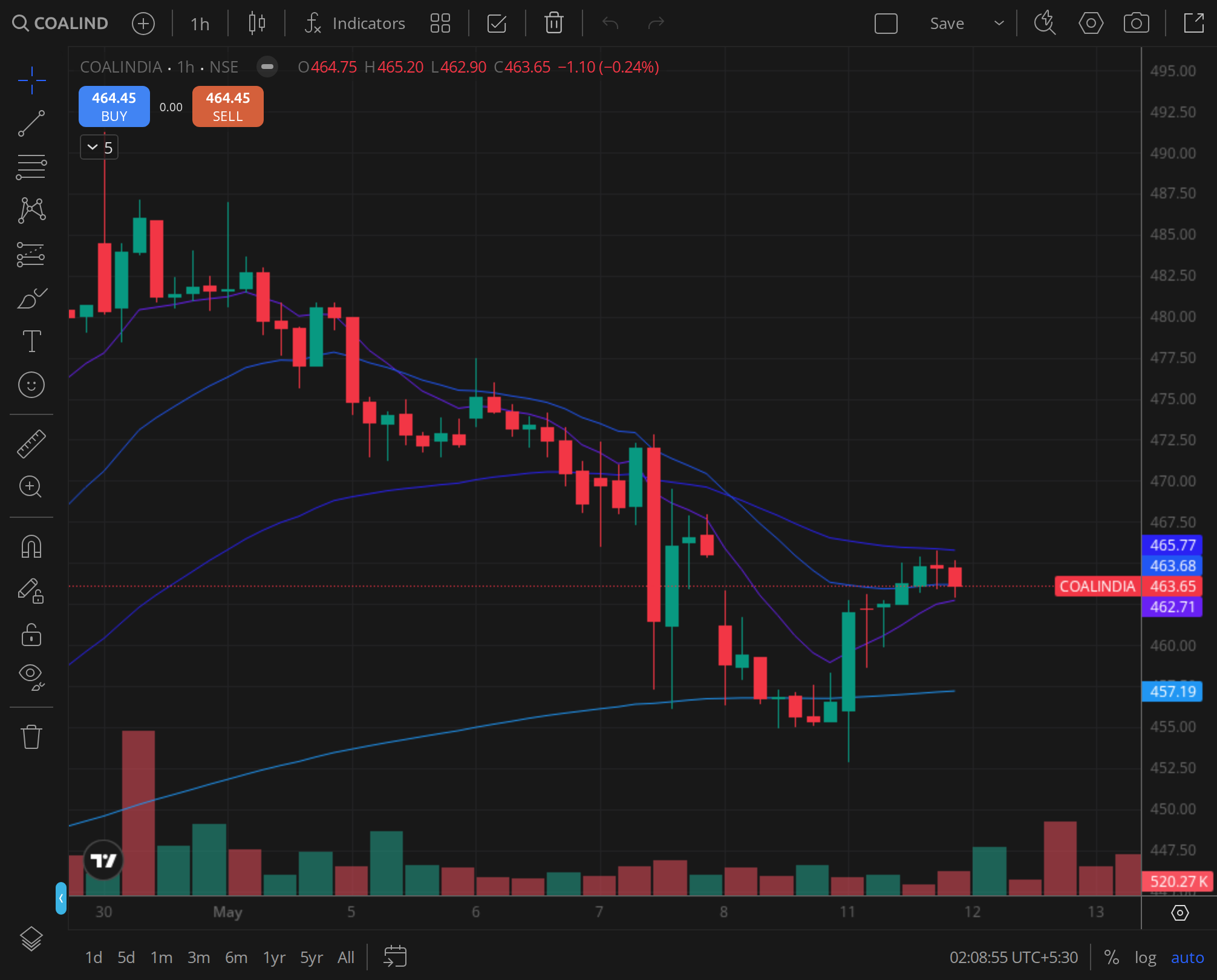
Caption: COALINDIA daily timeframe around 2025-09-24.
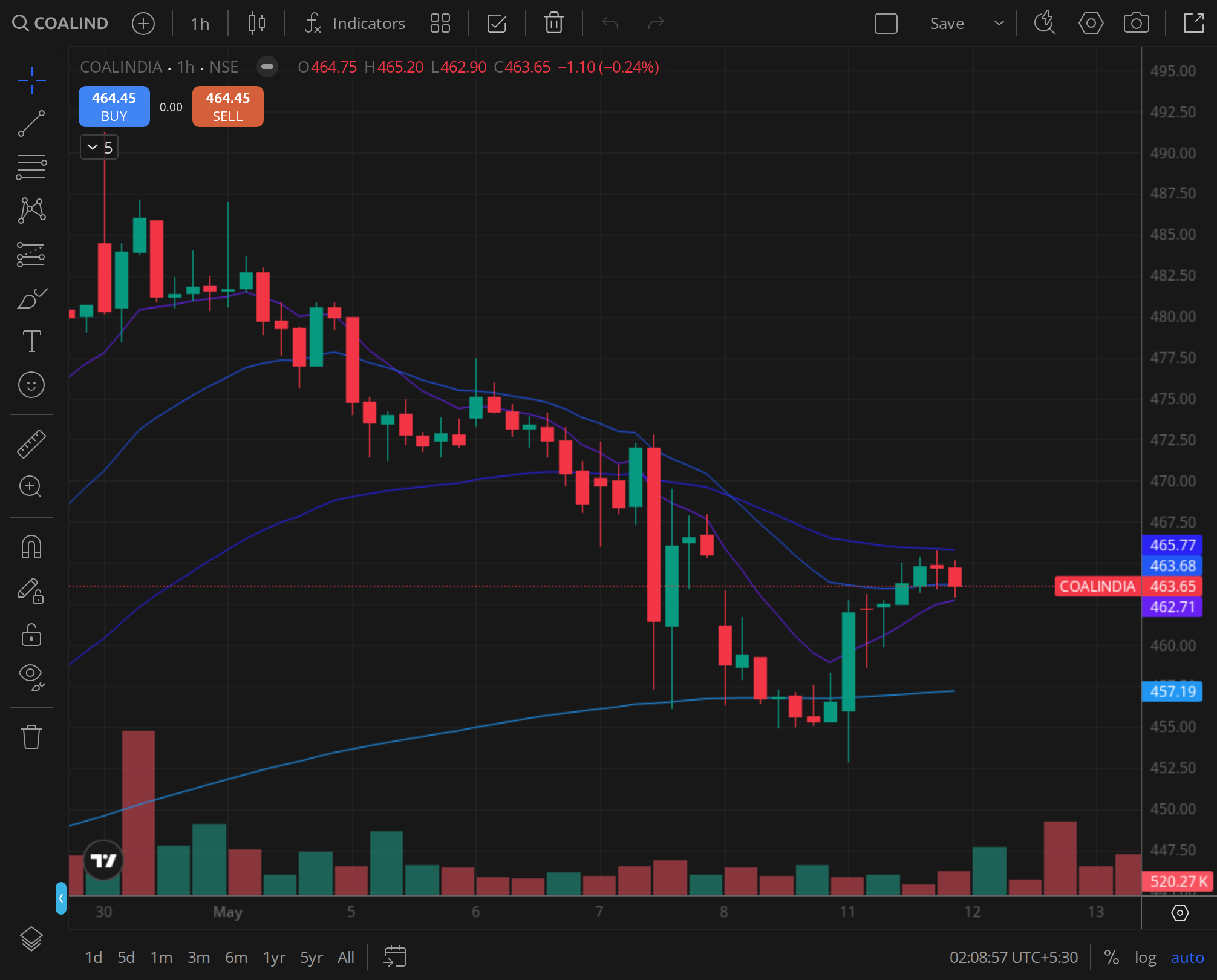
Caption: COALINDIA 30min timeframe around 2025-09-24.
By the time the September 24, 2025 session closed on the NSE, Coal India had been the quiet PSU of the year. Not the headline grabber. Not the multibagger story. A dividend-yielding state miner that had spent the better part of two years oscillating inside a range that institutional desks knew cold and retail screens largely ignored. The session itself was loud relative to the recent base, the kind of intraday tape that prompted a flurry of "breakout" tweets and a handful of brokerage notes nudging targets higher. The week after it told a different story. The month after it told a still more sober one. This Lookback walks through what the tape actually showed, what the fundamentals said, and where the false-positive lay.
The setup, going into late September 2025, was textbook PSU yield-trade arithmetic. Coal India had reported a Q1 FY26 print earlier in August, the standard volume-led set of numbers the street had come to expect, with the usual reminders about evacuation infrastructure, washery commissioning timelines, and the ever-deferred FSA price revision. Power demand had held up through the summer, the monsoon was tapering on schedule, and the offtake numbers were tracking toward the company's stated guidance for the year. None of this was new. None of it required a re-rating. The stock had been bid on yield and bought on PSU rotation flow, not on any narrative shift.
What changed in mid-September was flow, not fundamentals. The PSU basket as a whole had begun catching a renewed bid from domestic mutual funds after a soft August, defensives were back in vogue as the Nifty consolidated near its highs, and Coal India offered the cleanest combination of dividend visibility and beta-light exposure in the large-cap PSU universe. The buying was real. The question, as the September 24 session unfolded, was whether it was the start of something or the end of something.
The weekly chart was the single most useful piece of context for anyone trying to read the September 24 candle in isolation. Coal India had spent roughly eighteen months in a broad sideways structure after its 2024 upmove, the kind of multi-quarter consolidation that resolves in one of two ways. Either the stock holds the upper third of the range and grinds through resistance on incremental fundamental upgrades, or it fails at the range high on a flush of late buyers and rotates back toward the mid-range pivot. The September print sat right at the upper boundary of that band. There was no clean breakout closing print. There was no weekly close above the prior swing high that any disciplined desk would have called confirmation. What there was, instead, was a long upper wick on the weekly bar that printed against the highest weekly volume the stock had seen in months. That combination, range-high test, heavy turnover, and a failure to close at the highs, is a distribution signature, not an accumulation one. The desks that had been quiet buyers through the prior six weeks were the same desks unloading into retail demand on September 24.
The fundamental picture supported the read. Coal India's Q1 FY26 print, the most recent quarterly anchor available to anyone underwriting the September move, had been steady rather than spectacular. Volume offtake was tracking guidance. Realisations on the e-auction side had softened sequentially as imported coal landed cheaper into coastal power plants on the back of seaborne thermal coal weakness through the European summer. The FSA pricing question, the perennial overhang on any Coal India re-rating thesis, remained unresolved at the policy level. Margins were holding only because cost discipline on overburden removal contracts and a benign diesel input environment had absorbed what would otherwise have been a clear top-line headwind. None of this was bearish in absolute terms. All of it was incompatible with a fundamental breakout narrative.
The peer comparison made the dissonance sharper. NTPC, the other large-cap PSU energy play in the same rotation basket, had spent the same quarter delivering a cleaner earnings beat and a more durable capacity addition runway on the renewables build-out. NMDC, the other state mining comparable, had its own iron ore price tailwind to lean on. Coal India offered yield and stability. It did not offer the earnings acceleration that would have justified a sustained move above the upper boundary of its two-year range on volume alone. The buying into the September 24 session was rotation buying. Rotation flows reverse when the rotation completes.
The daily tape inside the August-to-October window made the distribution thesis legible without needing to invoke any indicator. Coal India had begun the period in a quiet drift from the August Q1 print, picked up a steady bid through the first three weeks of September as PSU flows rotated in, and arrived at September 24 stretched above its short-term moving average stack. The session itself printed wide-range and high-volume, the highest single-session turnover in the entire two-month window. The close was nowhere near the high of the day. The next two sessions failed to follow through. By the first week of October, the stock had given back the bulk of the September 22 to September 24 advance and was retesting the breakout pivot from below.
This is the part where retail tape-readers and institutional desks tend to part ways. The retail read on September 24 was "high volume breakout, follow-through likely." The institutional read was "highest volume day in two months, weak close, failed retest within seventy-two hours, this was the supply." Both reads were available in real time. Only one was correct.
The derivatives picture told the same story in a different language. Open interest in the September expiry had been building through the first half of the month on the call side, with strike concentration creeping higher as the stock ground up. The September 24 session saw a notable shift in the call OI distribution. Strikes near the spot saw call writing pick up, while put OI thinned out as traders rolled hedges off. That is the option-chain shape of a market that is no longer pricing further upside, not the shape of a market positioning for a breakout extension. The October series, which had begun building OI in the prior week, opened with a noticeably more balanced put-call distribution than the September contract had carried into expiry, and the early October sessions confirmed the cooling. FII derivative positioning in the index futures complex around the same window was net light on the long side, with the sectoral cash flow data showing domestic institutions as the marginal buyer rather than foreign desks. PSU rotation, again, not foreign re-rating.
Brokerage flow through the window was the noise variable. There were a handful of target price upgrades from domestic houses in the week of and immediately after September 24, the standard pattern of sell-side notes catching up to price action rather than leading it. A few foreign houses kept their existing neutral or underweight stances, citing the energy transition narrative and the long-run thermal coal demand question. None of the rating changes were thesis-altering. The price action had moved first, the notes followed, and the notes themselves did not survive the October rollover in any meaningful way.
The intraday signature of September 24 was the cleanest single piece of evidence in the entire setup. The session opened with a gap-up drive, ran into supply within the first ninety minutes, attempted a second push around mid-session that printed a lower high relative to the morning peak, and faded through the back half of the day on accelerating volume into the close. That pattern, opening drive into supply, failed retest, late-session distribution, is the canonical intraday shape of a stock being unloaded by patient sellers into excited buyers. It is not subtle. It is not ambiguous. The 30-minute tape on a stock as institutionally held as Coal India is essentially a real-time transcript of what the largest holders are doing, and on September 24 the transcript read sell, not buy.
The historical analog is worth a paragraph. Coal India had run a similar setup in early 2024, when an earlier wave of PSU rotation had pushed it to the upper end of its then-prevailing range on a high-volume session that failed to convert into a sustained breakout. The pattern then was the same as the pattern in late September 2025. Rotation flow lifted the stock into a known resistance shelf, a single wide-range session marked the distribution print, and the subsequent four to six weeks were spent rotating back toward the mid-range pivot. The 2024 episode resolved cleanly to the downside before the stock found buyers again at the lower end of the band. The 2025 episode was the same setup at a higher absolute level, and it resolved the same way over the October-November window that followed.
The verdict, looking back from May 2026, is straightforward. The September 24, 2025 move on Coal India was not justified by the fundamental setup, was not confirmed by the weekly close, was contradicted by the option chain, and was directly betrayed by the intraday tape on the day itself. The five-day forward read from the focus date was clearly negative, with the stock failing to hold the breakout pivot and rolling over into early October. The one-month forward read was a clean retracement of the September advance. The three-month forward read was a stock that had rotated back into the middle of its band and was once again being held for yield rather than for capital appreciation. Anyone who bought the September 24 candle and held it without a stop was carrying paper losses by Diwali. Anyone who read the tape as distribution and faded the move had one of the cleaner short-term setups the PSU basket offered that quarter.
VERDICT Stance: BEARISH (ex-post, on the September 24, 2025 setup) Horizon: 5d / 1mo / 3mo, all negative from the focus date Rationale: Weekly upper-wick distribution at range high, intraday late-session fade on highest two-month volume, option chain rolling defensive into October, and no fundamental catalyst to justify a sustained breakout. Rotation flow, not re-rating, and rotation flow reverses.