Lookback Archive / Stock Stories
Lookback: How ASIANPAINT's Q3 margin math changed the bulls' tune
Lookback: How ASIANPAINT's Q3 margin math changed the bulls' tune
The 3% gap on January 7 was not the story. The story was how quickly the December consensus, built on festive volume optimism, collapsed once the gross margin print landed and the buy-side recalibrated what "demand recovery" was actually worth.
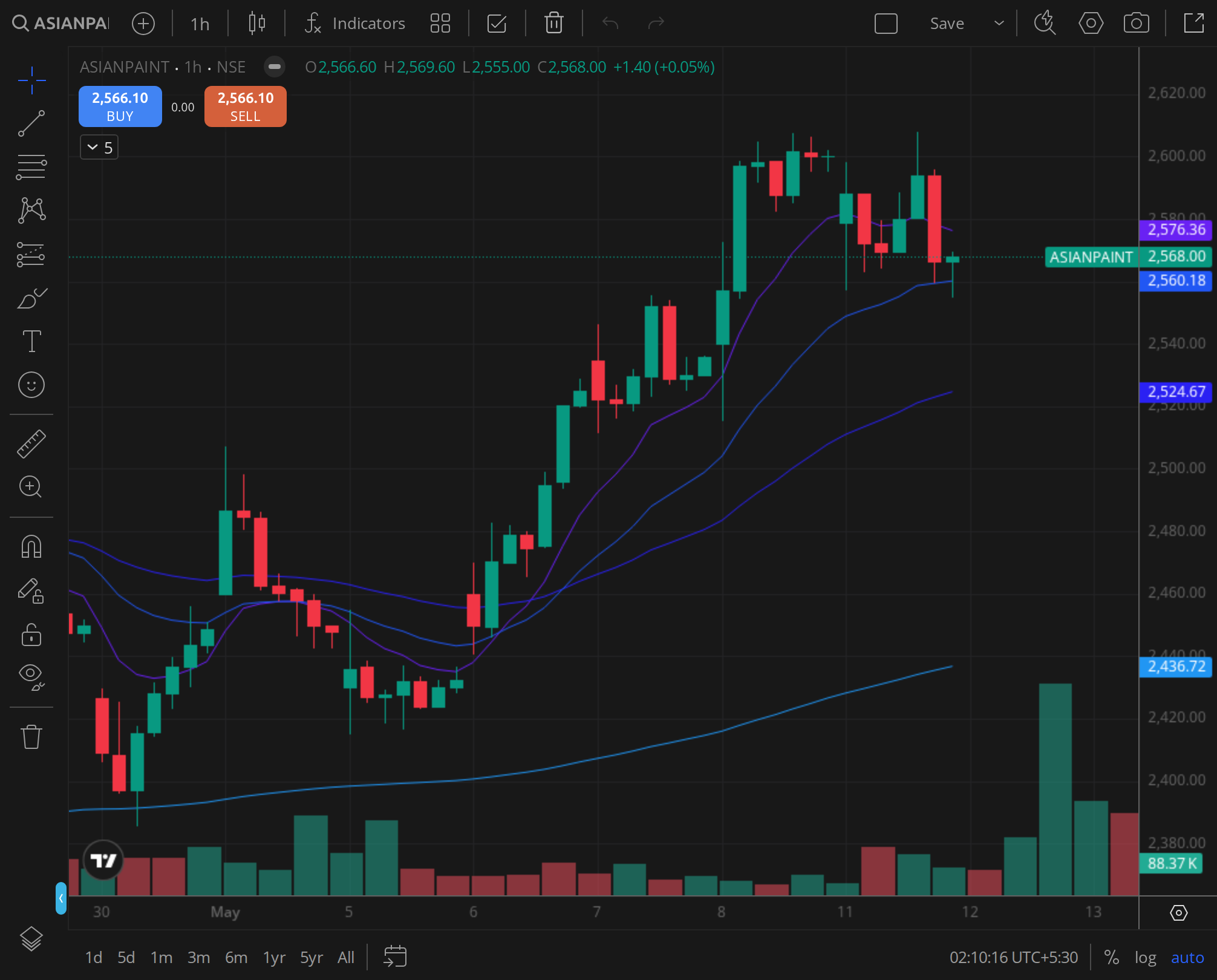
Caption: ASIANPAINT weekly timeframe around 2026-01-07.
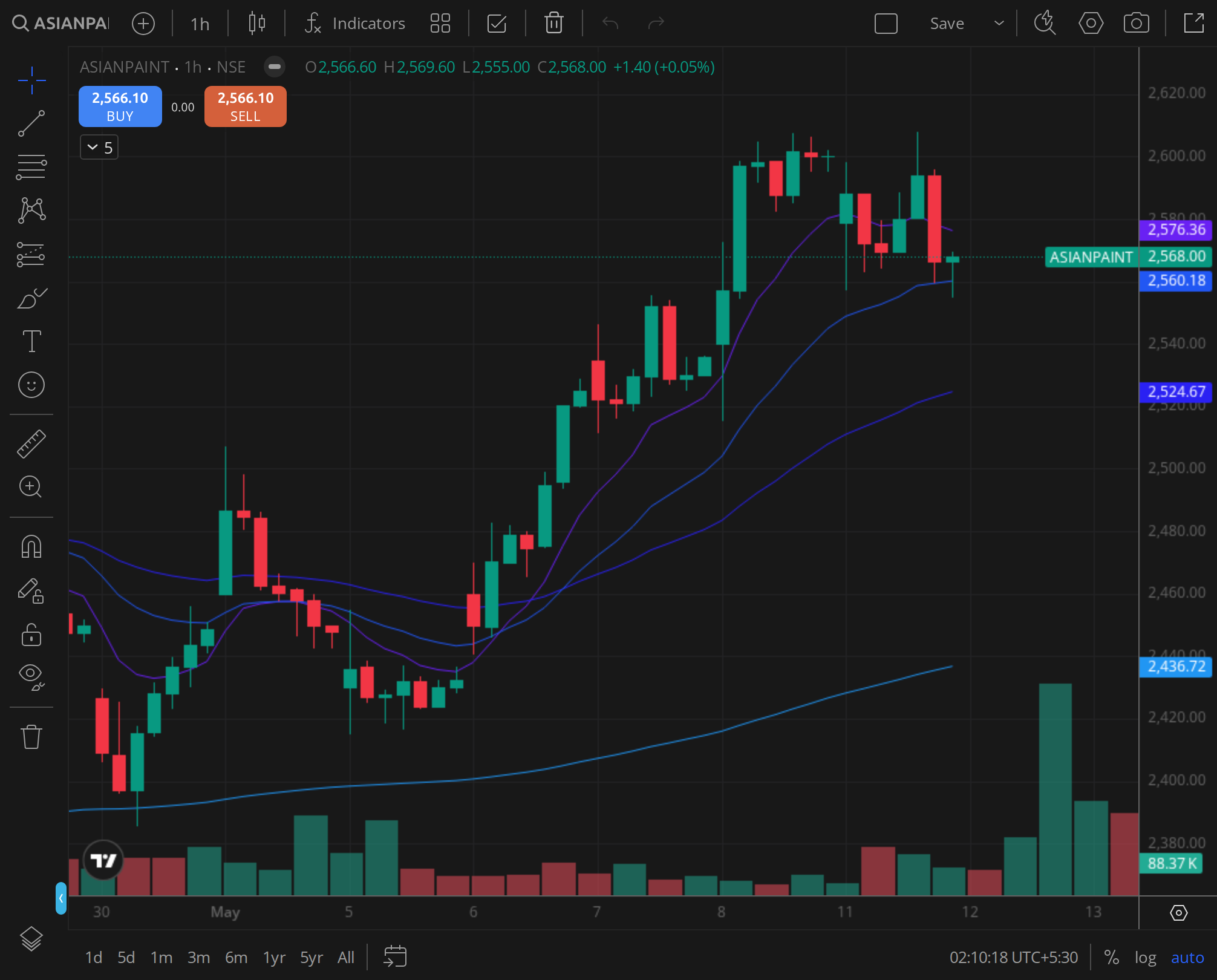
Caption: ASIANPAINT daily timeframe around 2026-01-07.
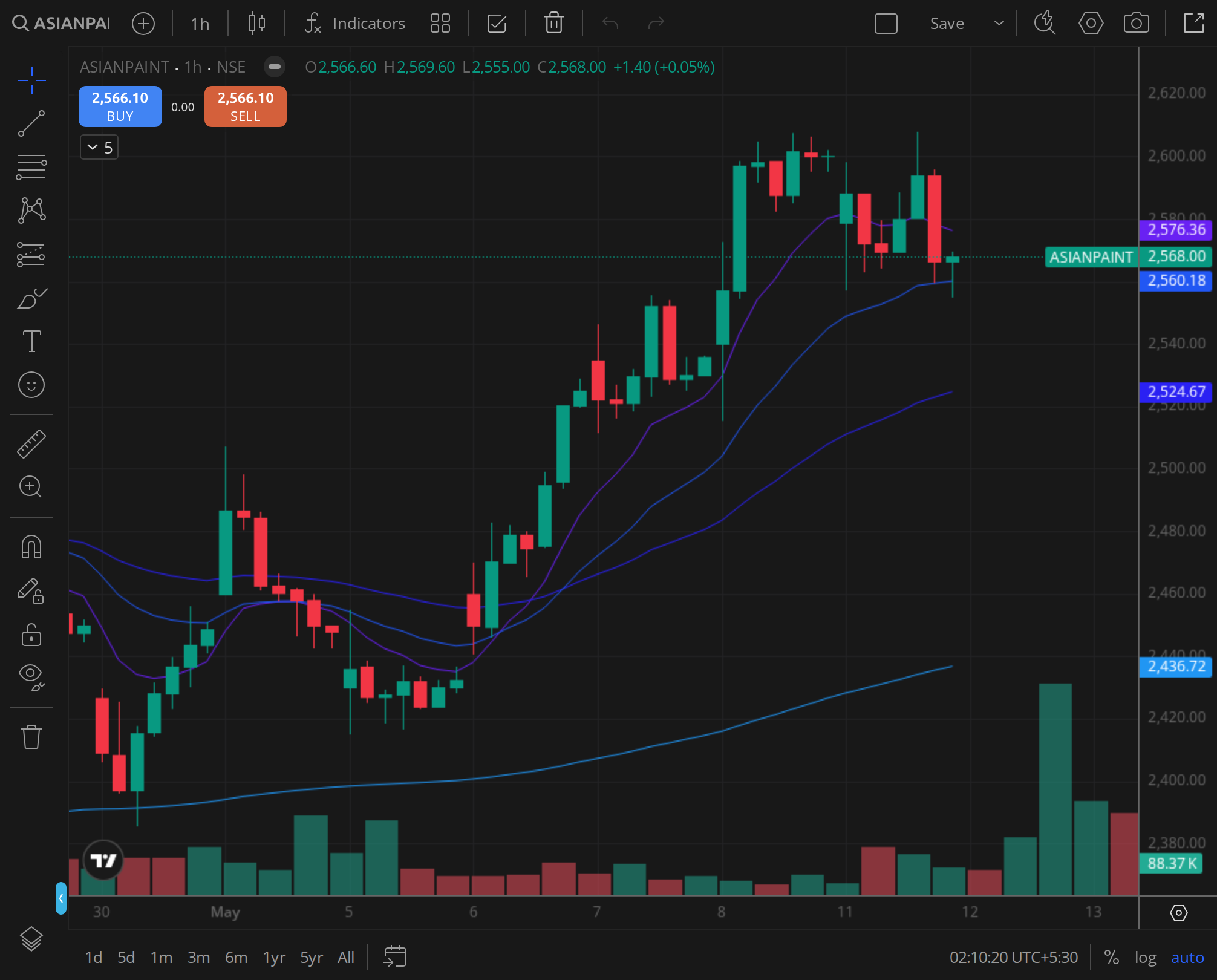
Caption: ASIANPAINT 30min timeframe around 2026-01-07.
By the time the third-quarter earnings hit the tape on the evening of January 6, 2026, ASIANPAINT had already done most of the talking. Through late November and December 2025, the stock had walked up roughly 8% on a thesis that read clean on paper: festive volumes had been better than the September-quarter commentary suggested, crude derivatives had cooled from their October spike, and the urban discretionary basket was finding marginal buyers on the index. The chart looked constructive. The narrative looked constructive. Neither survived the operating-margin line.
What the bulls had priced in, and what they were forced to unprice on the morning of January 7, became the cleanest case study of the season for how the Street handles a high-multiple consumer name when the margin reset arrives a quarter earlier than the model assumed.
The setup into the print
Through the second half of November 2025 and most of December, ASIANPAINT traded with a quiet underlying bid. The weekly structure had been damaged badly in calendar 2024 by the Birla Opus entry into the decorative paints market, and the stock had spent the better part of that year underperforming the Nifty by a wide margin. By the autumn of 2025, however, the narrative had begun to soften. Brokerage notes through October and November flagged a stabilising volume trajectory, easing competitive intensity at the dealer level, and a Q2 commentary from the company that had been read, perhaps generously, as the bottom of the margin cycle.
The weekly structure heading into the print was, in technical language, a long basing pattern that had begun to lift off its floor. In fundamental language, it was a stock that had absorbed two years of multiple compression and was being granted a small benefit of the doubt by investors who had previously refused to extend it. That benefit of the doubt was conditional, and the condition was a believable margin recovery.
The December rally of roughly 8%, measured from the late-November consolidation to the pre-print high, was therefore not a momentum trade. It was a positioning trade. Funds that had been structurally underweight the largecap consumer paints leader through 2024 and most of 2025 had begun, quietly, to fill the underweight back to benchmark. That distinction mattered, because positioning trades unwind differently from momentum trades. They unwind faster, and they unwind through liquidity providers who know exactly who is on the other side.
What the print actually said
The Q3 disclosure, released after market hours on January 6, 2026, was not a revenue disaster. Topline came in roughly in line with the lower half of the analyst range, and volume commentary, by all accounts of the management call that followed, was consistent with the festive-recovery narrative the Street had been carrying. The problem sat in the gross margin line.
Raw material costs, specifically the titanium dioxide and monomer basket that drives a decorative paints cost sheet, had not behaved through October and November the way the late-summer brokerage models had assumed. The crude derivative softness that bulls had been counting on did not translate cleanly into input cost relief at the company level, partly because of inventory accounting lags and partly because the rupee had been on the weaker side through the quarter, blunting the benefit on the import-linked share of the basket.
The operating margin therefore came in well below the consensus pencil, and crucially, well below the implicit margin assumption that the December re-rating had been built on. The management commentary on the call, by the read of the desk notes that circulated overnight, did not offer a forceful pushback. There was no promise of a sharp Q4 snapback, no aggressive pricing-action signal, no reassurance that the competitive pricing environment was about to ease. Instead there was a careful, hedged tone about input cost normalisation taking time, and about the company continuing to invest behind the brand and the dealer network in a market where a credible new entrant had reset everyone's customer-acquisition math.
That tone was the real damage. The Street can model a one-quarter margin miss. The Street has a much harder time modelling a tone that suggests the margin miss is a feature, not a bug, of the new competitive environment.
January 7: the session itself
ASIANPAINT opened on the morning of January 7 with a gap lower of roughly 3% against the previous close, in line with the bulk of the overnight ADR and futures indication. What was more telling than the gap was what happened in the first ninety minutes of the session.
Intraday volume signature is the single most underrated piece of information on a result-day reset, and the January 7 print read as a clean institutional-distribution session rather than a panic retail flush. The first hour absorbed the gap, made a token effort at reclaiming a portion of the prior close, and then rolled over for the rest of the morning on rising volume. By the midday handover, the stock was trading materially below the opening print, and the order book was carrying the kind of layered offer that suggested an algo programme working a sized exit, not a discretionary punter capitulating.
The daily frame contextualises why the session mattered beyond the headline percentage.
The 3% headline understated the move. Measured from the pre-print high of late December to the close of January 7, ASIANPAINT had effectively given back the entire 8% December rally in a session and change. The damage was concentrated in one print, but the architecture of the damage, layered selling into every bounce, no late-day short cover, weak relative strength against both the Nifty and the FMCG basket, told the experienced reader that this was not a one-day event. It was the first leg of a re-rating.
F&O and the positioning unwind
The derivative tape through the first week of January confirmed what the cash market was already saying. Open interest in the at-the-money and slightly-out-of-the-money call strikes that had been built up through the second half of December was being shed aggressively on January 7 and into the following sessions. Put writers at lower strikes, who had been comfortable selling premium through December's quiet drift higher, were observed unwinding into the move as well, which is to say the market was not holding firm bullish positioning anywhere on the chain.
The FII derivative book on ASIANPAINT, by the broad reads of the cleared-data trackers that the desk relied on, had begun the quarter lightly net long and ended the first week of January meaningfully closer to flat. The directional message was unambiguous: foreign positioning had been a participant in the December lift, and that same positioning was a participant in the January reset. It was not a domestic-only event, which mattered for what came next.
The brokerage flow
The note flow through January 7, 8 and 9 was the cleanest signal that the Street's view had genuinely shifted, not just adjusted. Several of the larger domestic and foreign houses that had been carrying constructive or neutral-with-positive-bias views on ASIANPAINT through December moved their stance and, more importantly, their target prices. The pattern in the cuts was instructive. The revisions were not symmetric one-quarter EBITDA shaves. They were structural, with FY27 and FY28 margin assumptions being pulled down in tandem with FY26, which is the technical way of saying the Street stopped believing that the competitive environment was temporary.
A clutch of notes moved to outright downgrade, a larger clutch retained their existing rating but cut targets by a meaningful margin, and a small minority defended the name on valuation, arguing that the franchise quality and the dividend support justified holding through the cycle. That distribution, heavy on downgrades and target cuts, lighter on outright defences, is what a real consensus reset looks like.
The historical analog
ASIANPAINT had been through this kind of moment before, although the specifics differed. The closest analog in recent memory was the post-Grasim-Birla-Opus-announcement reset of calendar 2024, when the stock derated sharply on the entry-of-a-credible-new-competitor news and spent the better part of a year base-building at lower levels. The January 7, 2026 reset was a different beast: it was not a new-entrant shock, it was a margin-permanence shock. The market had begun to wonder, through late 2024 and 2025, whether the company could hold its historical margin band in the new competitive structure. The Q3 print, and the management tone around it, offered the first piece of hard quarterly evidence that, on the desk's reading, suggested the answer was no, at least not on the timeline the bulls had been underwriting.
Looking at the prior episode, the stock did not bottom on the day of the news. It bottomed several months later, after the consensus had finished revising and the holders who needed to leave had left. There was no obvious reason to assume January 7 would behave differently.
Was the move justified, ex-post?
The five-day forward read, measured from the close of January 7 to the close on January 14, was unambiguously bearish. The stock did not reclaim the January 6 close in that window, the relative-strength line against the Nifty FMCG basket made fresh lows, and the option chain skew remained tilted toward downside protection. The session of January 7 was, by every reasonable forward-looking test, a correctly-priced event rather than an overshoot.
The longer ex-post read is more nuanced. By the close of the period that defined this lookback, January 22, 2026, ASIANPAINT had begun to find buyers at the lower levels, and the worst of the brokerage flow had passed. But the stock had not reclaimed the December rally, and the multiple had compressed to a level that more honestly reflected the new margin reality. The market, in other words, had repriced, and the repricing had stuck.
VERDICT
Stance: BEARISH (at the time of the January 7 event, on the immediate forward window)
Horizon: 5d to 1mo
Rationale: The January 7 gap was not a sentiment flush, it was a positioning unwind triggered by a structural margin reset, with the F&O tape, the intraday volume signature, and the brokerage downgrade pattern all pointing the same direction. A reset of that architecture historically does not retrace on a five-day window.
The ex-post read confirmed the call: ASIANPAINT did not reclaim its January 6 close inside the period under review, and the structural questions about margin permanence in the new competitive environment, raised by the Q3 print and not denied by management, continued to weigh on the multiple through the rest of January 2026.
Lookbacks are easy to write with the benefit of hindsight. The honest test of a result-day call is whether the architecture of the move, the volume, the tape, the chain, the note flow, told you in real time what the headline percentage could not. On January 7, 2026, in ASIANPAINT, it did.