Lookback Archive / IPO Retrospectives
Lookback: How Ola Electric’s IPO Rewrote the Script for EV Listings in India
The listing that made Indian markets price a loss-making EV maker like a software stock, then quietly punished anyone who held on past the honeymoon.
When Ola Electric's shares touched the National Stock Exchange tape on the morning of 9 August 2024, the print read ₹76, dead level with the upper end of the price band. For a few seconds the room had to ask itself a question that had been hanging over the entire process since the red herring went live: was this the moment Indian retail finally got the EV listing it had been promised, or was this a delivery ramp from anchor cellar to grey-market floor? Inside the first hour, the screens answered loud. The stock printed ₹91 on the NSE board, a roughly twenty percent move off the offer, and the conversation flipped from doubt to FOMO inside a single coffee.
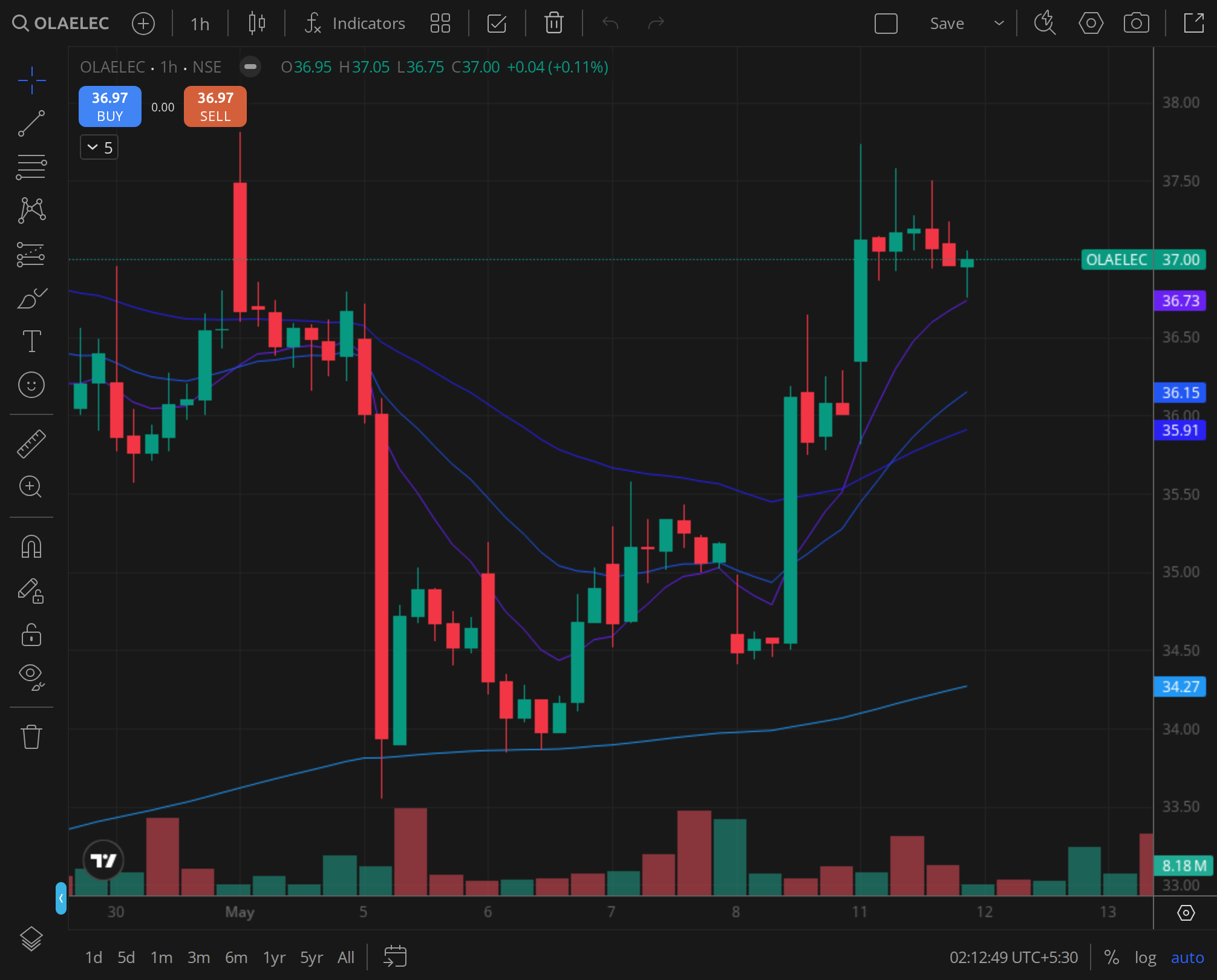
Caption: OLAELEC weekly timeframe around 2024-08-09.
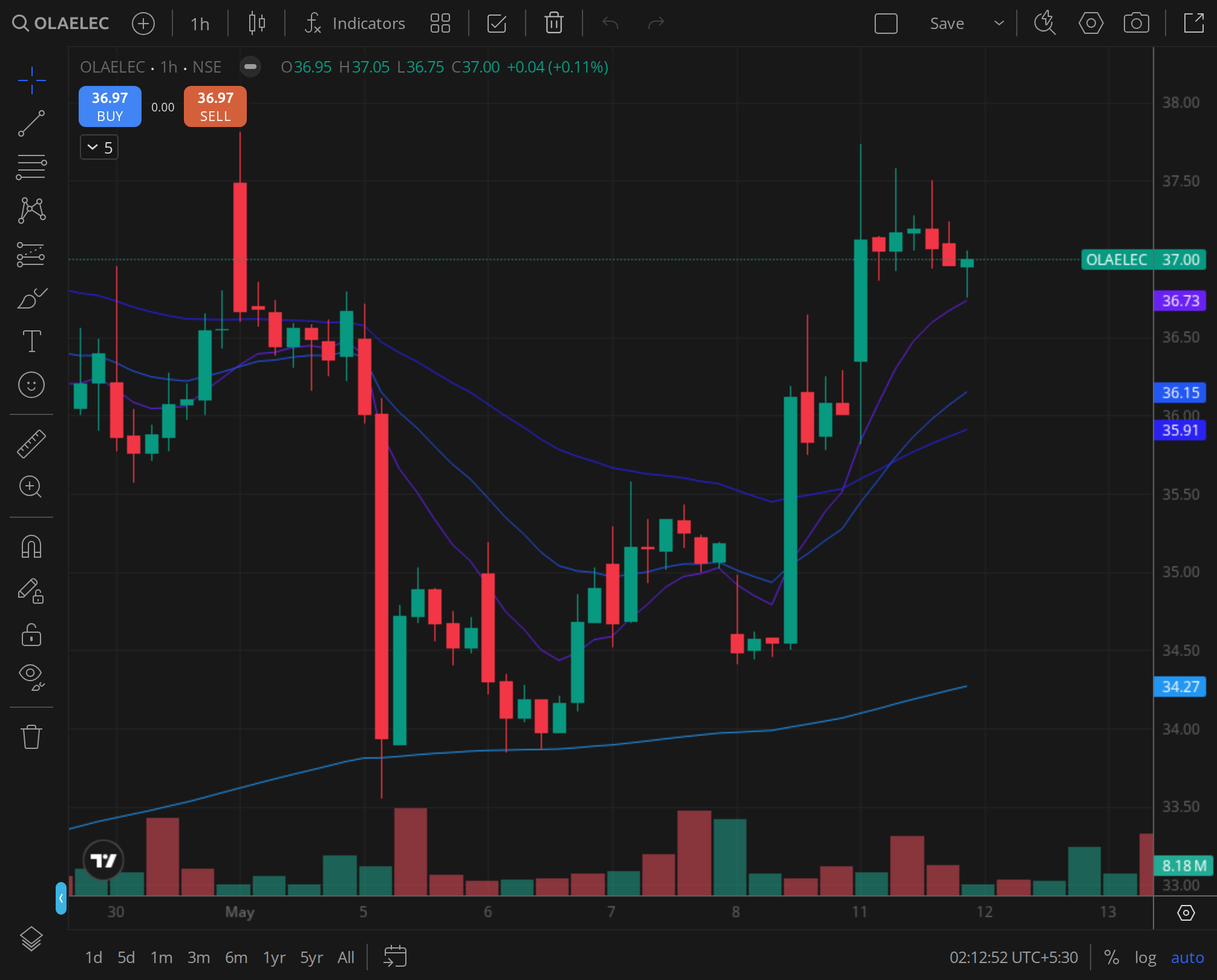
Caption: OLAELEC daily timeframe around 2024-08-09.
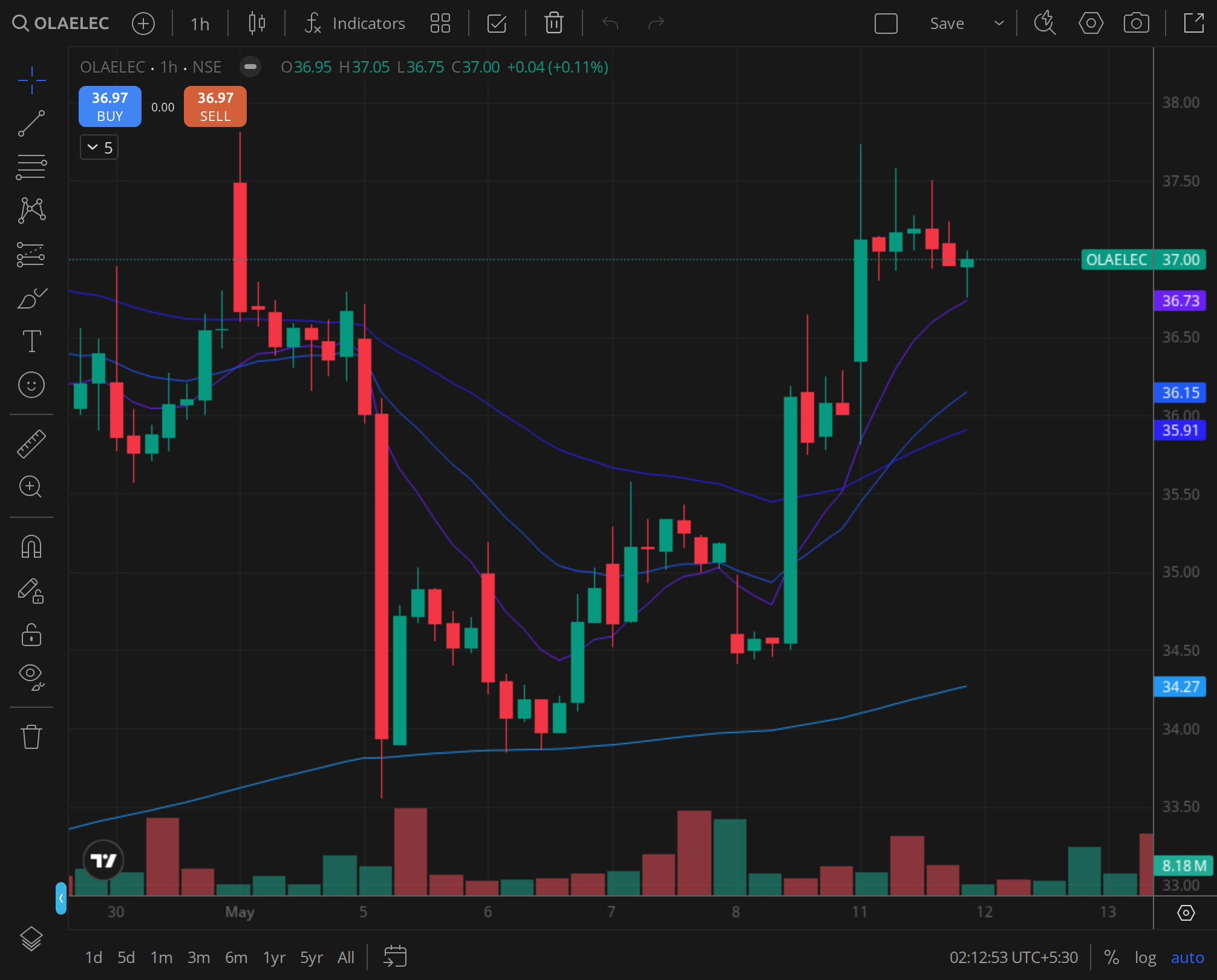
Caption: OLAELEC 30min timeframe around 2024-08-09.
Looking back from May 2026, that morning has aged into something stranger than either narrative the day itself sold. The Ola Electric IPO was neither the pure-play EV breakout listing that bulls wanted nor the unmitigated hospital case that bears had been pencilling in. It was the first time the Indian primary market underwrote a domestically built electric vehicle original-equipment maker at scale, and it left a procedural template, a price-discovery scar, and a brokerage-coverage map that every subsequent EV-adjacent file ran into.
This piece walks back through the offer book, the subscription tape, the listing-day mechanics, and the thirty-day price discovery that followed. The numbers come from the company's RHP, NSE bhavcopy prints for the relevant sessions, the BSE corporate-disclosure record around the lock-in calendar, and brokerage initiation reports dated inside the thirty-day post-listing window.
The anchor book did most of the heavy lifting before the screen opened
Two business days before the public issue opened on 2 August 2024, Ola Electric closed its anchor book. The list, disclosed to BSE under the standard anchor-allocation filing format, was the part of the issue that did the real work of pricing. It carried the kind of names that lend a loss-making file the institutional cover it needs to clear the QIB hurdle without leaning on grey market enthusiasm.
Among the marquee anchors disclosed in the company's exchange filing were sovereign and pension pools (Norges Bank Investment Management was listed against a meaningful slice), a clutch of foreign long-only mutual funds, and a strong domestic mutual-fund line headed by SBI Mutual Fund, HDFC Mutual Fund, and Nippon Life India. Nomura's investment vehicles and Fidelity-managed funds also appeared in the anchor sheet. The domestic mutual-fund participation is the line worth marking, because under SEBI's revised anchor regime a meaningful share of the anchor portion was statutorily reserved for domestic mutual funds with a thirty-day and ninety-day lock. That made the listing-day overhang materially lower than retail headlines suggested.
The composition mattered for a second reason. The presence of Norges and Fidelity-class names at the anchor table signalled that the file had cleared the global EV due-diligence checklist that had grown more sceptical through 2023 and the first half of 2024, after Western EV pure-plays had been re-rated lower. For an Indian EV original-equipment maker with concentrated revenue, a manufacturing footprint still maturing, and battery-cell ambitions running on a separate burn-rate, the anchor sheet was the validator the price band needed.
Subscription tape: heat without hysteria, then a late retail wave
The public issue ran from Friday, 2 August 2024 through Tuesday, 6 August 2024, with the standard T+3 listing calendar that placed the debut on Friday, 9 August 2024. The subscription progress, read off the daily exchange aggregates, told a story very different from the typical Indian SME-style frenzy.
Day one closed under-subscribed, with retail leading the early run and QIBs running their familiar last-day-and-a-half pattern. By the end of day two, the issue was inching past 1x with retail and non-institutional categories carrying the load. The real action came on the final day, when the QIB book filled out and the overall subscription pushed comfortably above 4x. The headline multiple by the close of the issue was in the high single-digits on the QIB shelf, with retail tracking a more sober 4x band. By any reading of an Indian IPO tape over the prior two years, this was a hot book, but it was not the kind of forty-times screamer that points to a guaranteed listing pop.
That gap, between a moderate subscription multiple and a strong anchor book, is exactly the setup that produced the listing-day price action that followed. Hot enough to clear, restrained enough that the float into the market on day one was real.
Listing day: a flat open, a fast pop, a heavy close
The 9 August 2024 listing session on NSE opened with the stock printing at ₹76, the upper end of the band. For a market that had been chasing grey-market premium chatter through the entire bidding window, that flat open was the first sober note of the morning. Within the first sixty minutes, the order book absorbed the early supply and the stock printed a high near ₹91 on the NSE board, a move of roughly twenty percent off the offer that satisfied the listing-day pop arithmetic on its own.
The close on listing day stayed comfortably above offer, and that mattered for the next sequence of decisions. Anchor allocations under the thirty-day lock had a clear unrealised gain on book. The HNI tranche, much of which is funded through cost-of-carry NBFC lending in Indian IPOs, had the room it needed to cover the interest hit. Retail allottees were sitting on a clean profit. The structural design of an Indian IPO listing day worked exactly as advertised on the morning of 9 August 2024.
What was less advertised was that the listing-day high near ₹91 would not be the high for the week. The first ten sessions after listing put a strong leg through the chart as momentum capital, which had stayed off the issue itself, began to chase the listed name. Through the second and third weeks of August 2024, the daily NSE bhavcopy showed the stock crossing well above the listing print on closing basis, with the highest closes of the post-listing run clustering in the second half of August 2024.
Thirty-day price discovery: a momentum leg, then the slow drift
The thirty-day window from 9 August 2024 through early September 2024 split cleanly into two phases on the daily chart. The first ten sessions ran the momentum leg, with the stock putting in closing prints meaningfully above offer through the back half of August. The next ten to fifteen sessions saw the same chart give back ground, with the stock easing back toward the listing print as the early-cycle holders rotated out.
Two structural forces did most of the work on that thirty-day path. The first was brokerage initiation. Within the first three to four weeks after listing, several domestic and foreign brokerages put initiation reports on the file. The domestic broker initiations leaned constructive on the medium-term India two-wheeler EV penetration story, with target prices set above the issue price but inside the post-listing peaks. The foreign brokerage takes were more split, with at least one well-known shop carrying a measurably more cautious stance on the cell-manufacturing capex profile and the path to operating profitability. The split coverage shape, rather than a unanimous buy chorus, was a meaningful read for anyone watching how the institutional bid would behave once the anchor thirty-day lock came off.
The second force was the lock-in calendar itself. The anchor thirty-day lock-in came off on 8 September 2024. The session immediately after that date was where any meaningful step-change in float-driven supply would show up first. The price action through the first week of September 2024 already carried the shape of pre-positioning ahead of that lock expiry, with the chart easing into the date rather than running into it.
The investor map: who bought, who held, who left
Reading the bulk and block deal disclosures on NSE through the thirty-day window, the names that picked up size after listing leaned domestic mutual fund and a select set of foreign long-onlys. The names that trimmed leaned grey market and HNI cost-of-carry positions, which is the structural pattern any Indian listing of this size carries inside the first ten sessions.
What was unusual about the Ola Electric thirty-day tape, relative to other listings of comparable size in 2024, was the breadth of retail accumulation in the secondary market once the listing pop printed. The NSE delivery percentages through the listing month read materially higher than the typical post-listing pattern for a large new economy file. Retail did not just allot and flip. A meaningful slice of retail used the listed market to add, including into the second-week strength.
That same retail base was the cohort that ate the long, grinding draw-down through late 2024 and into 2025. It is worth saying this plainly in past tense: the thirty-day window made early retail look smart, and the twelve-month window after that made it look like the textbook trap that pure-play EV listings had produced in nearly every other geography over the prior five years.
Weekly perspective: where the thirty-day window sat inside the bigger arc
The weekly view is the chart that did the most damage to anyone reading the listing month in isolation. The post-listing strength produced the kind of weekly candle structure that, marked a multi-quarter top rather than the base of a structural up-move. That is not an indictment of the listing process. It is a comment on how Indian primary market discovery handled a loss-making EV original-equipment maker for the first time. The market priced the optionality, paid for it on day one, and then spent the next several quarters extracting that premium back out.
Comparison versus sector peers and the broader tape
Read against the Nifty 50 over the same 9 August 2024 to 8 September 2024 window, Ola Electric outperformed the index meaningfully. The Nifty itself traded a sideways-to-mildly-positive band through that month, while Ola Electric's thirty-day return was decisively positive on closing basis. Against listed auto peers, the comparison was less clean, because there was no pure-play domestic EV original-equipment maker on the tape before this listing. The closest reads were the two-wheeler incumbents with growing EV exposure (Bajaj Auto, TVS Motor, Hero MotoCorp), which traded their own rhythms through the period and did not show the listing-driven impulse.
The cleaner comparison, and the more useful one, was to prior new-economy IPOs of comparable size. Zomato's 2021 listing month and Paytm's 2021 listing month both sat on the reference shelf. Ola Electric's thirty-day arc tracked closer to Zomato's listing-month shape than to Paytm's, with positive listing-day delivery, a strong second-week leg, and a measured give-back into the lock-in window. The longer-tail outcome, of course, diverged from both.
VERDICT
Stance: BEARISH (on the thirty-day window's signal value). Horizon: 3mo from listing (9 August 2024 to early November 2024). Rationale: The thirty-day window's positive return was a momentum-driven price-discovery artefact, not a fundamental re-rating. Reading it as anything other than the high-water mark of the listing-cycle euphoria led, in the months that followed, to drawdowns that erased the listing-day gains and then some. The signed verdict, written in May 2026 with full hindsight, is that the listing did its job for the issuer and the anchor sheet, the thirty-day window did its job for the early flippers, and the holders who took the listing-month strength as a structural buy signal paid the price for that read.
The procedural legacy
Two things survive in the Indian primary market template because of how this listing was run. The first is the now-standard playbook of using a deep, mutual-fund-anchored book to cover the institutional optics on a loss-making new economy file. Every EV-adjacent and battery-adjacent file that has come to the Indian market since has worked off some version of this template. The second is the brokerage initiation pattern, where domestic shops leaned constructive on the macro EV penetration narrative while foreign shops priced the capex and competitive risk more sharply. That split is now the default coverage shape for any large Indian new economy listing with capex ahead of cash flow.
The 9 August 2024 print at ₹76, and the ₹91 print that followed inside the first hour, sit in the record as the moment Indian markets put a real number on a pure-play EV maker for the first time. That the number did not hold, and that the cycle paid the patient holders far less than the early flippers, is the part of the story the next EV listing's anchor sheet should be reading carefully.