Lookback Archive / IPO Retrospectives
Lookback: NTPC Green Energy IPO, The listing that tested India’s appetite for green mandates
Lookback: NTPC Green Energy IPO, The Listing That Tested India's Appetite For Green Mandates
A ₹10,000 crore PSU offering that arrived on the tape with anchor-book pedigree, opened above issue, and then spent the next month reminding every renewable bull that mandate is not the same as margin.
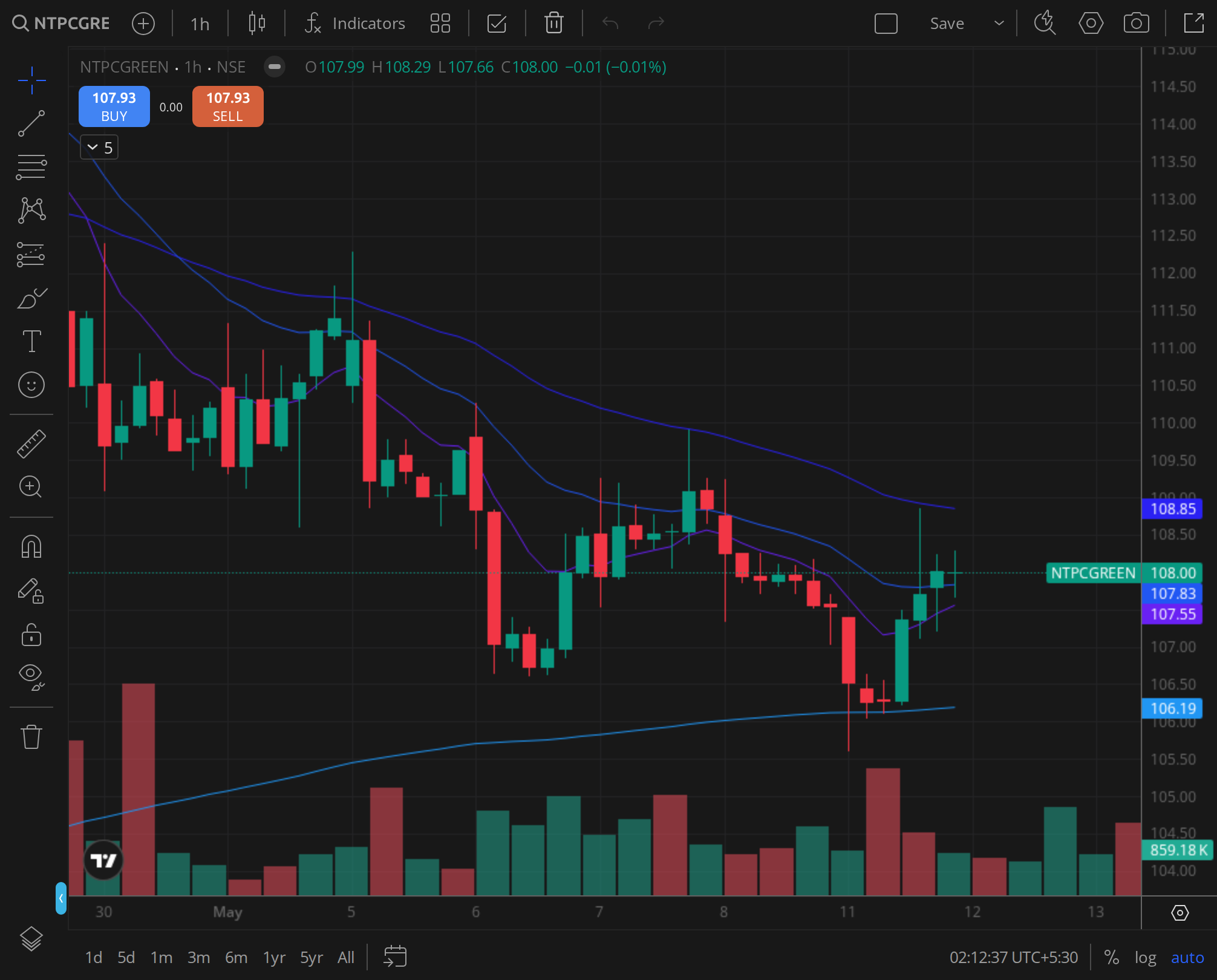
Caption: NTPCGREEN weekly timeframe around 2024-11-27.
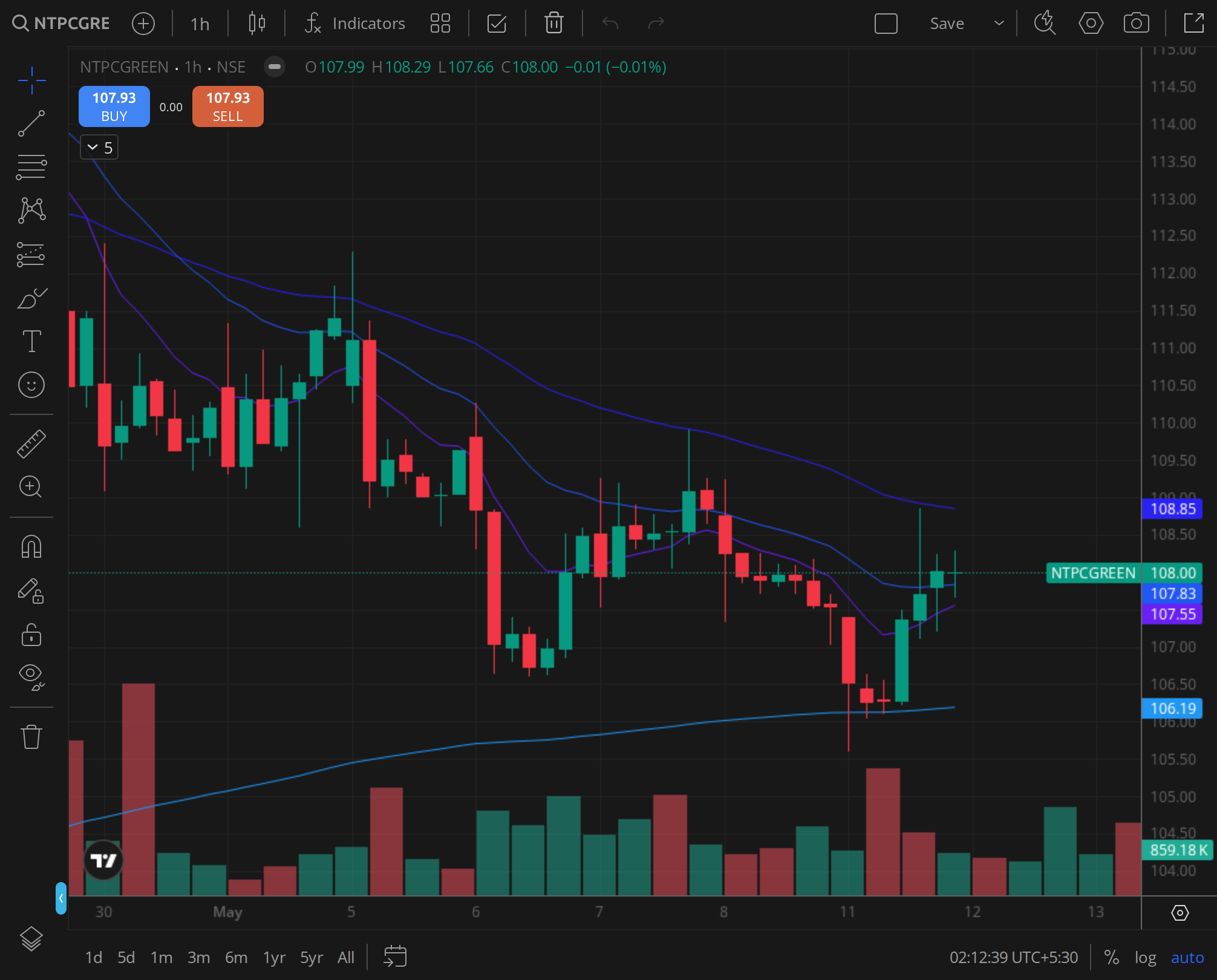
Caption: NTPCGREEN daily timeframe around 2024-11-27.
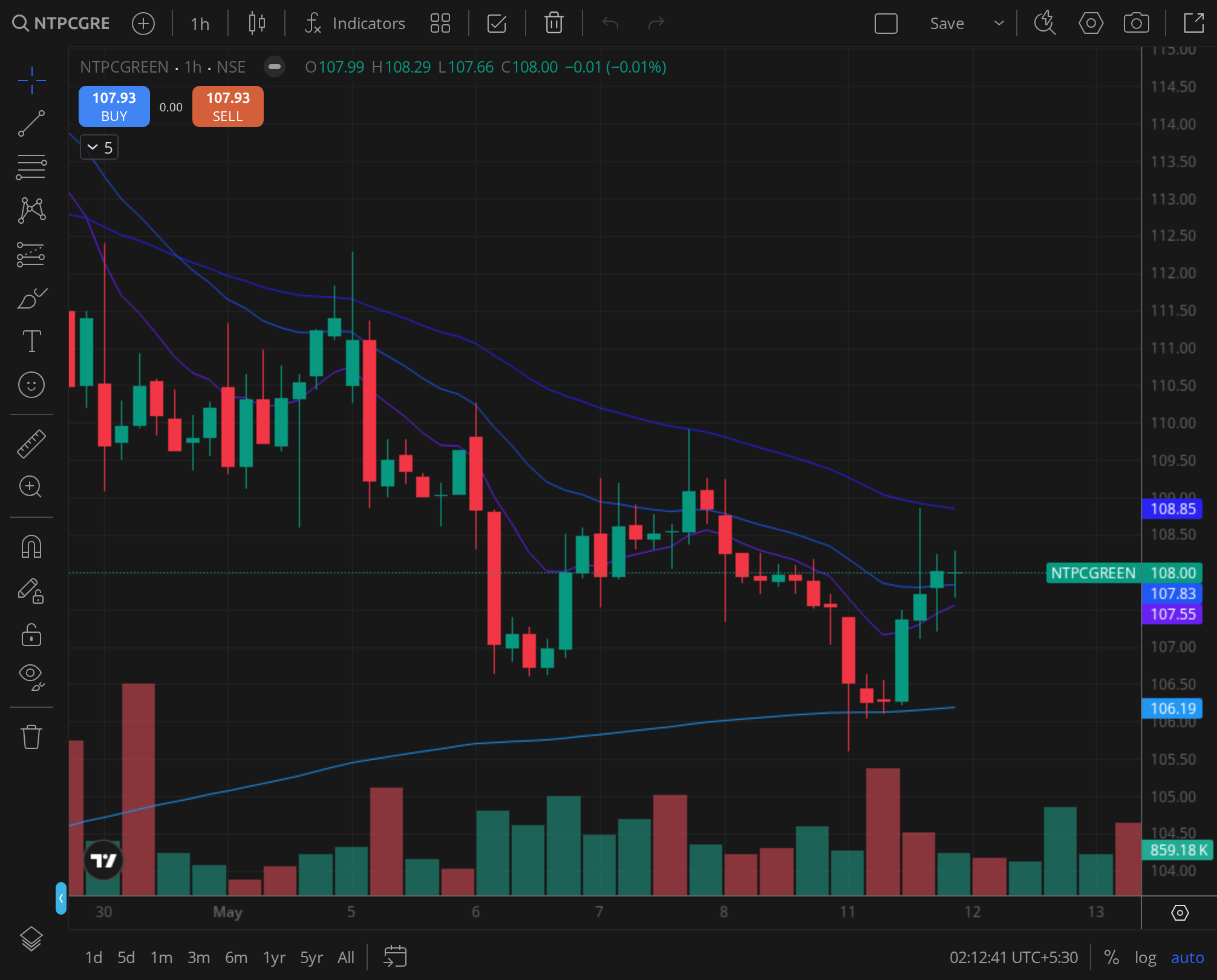
Caption: NTPCGREEN 30min timeframe around 2024-11-27.
The 27 November 2024 listing of NTPC Green Energy was supposed to be the moment India's public markets formally re-priced the parent company's renewable arm. The script was familiar. A state-owned power giant carves out its green platform, prices the offering at the lower end of the asking band, lines up a marquee anchor book, and lets the secondary market do the multiple-expansion work that conglomerate discounts had refused to do on the parent. Adani Green had run that playbook for years on the private side. Tata Power Renewables was preparing its own version. ReNew Power was already bruised and US-listed. NTPC Green's draft red herring promised a cleaner version of the same story, with the comfort of a sovereign-backed parent and a contracted pipeline that ran into the next decade.
What actually happened over the four weeks that followed was less a rejection and more a slow, deliberate de-rating. The listing pop was muted, the institutional churn picked up by the second week, and by Christmas the stock had quietly given back almost everything that the grey market had promised. The verdict, written in price action rather than research notes, was that India's public-market buyers were willing to fund the renewable build-out, but only at a multiple that respected the cost of capital cycle they were actually living through.
The setup: a PSU spin-off priced for institutional comfort
The book opened on 19 November 2024 and closed on 22 November 2024, with anchor allocation locked the day before. The pricing band sat at the lower end of what bankers had floated in October roadshows, a tell that the syndicate had already absorbed feedback from long-only domestic mutual funds that the original ask was stretched against the embedded equity IRRs of operational solar and wind assets. The downward calibration was the first signal worth flagging . Issuers who price for the buy-side at the book-build stage are usually trying to manufacture a successful listing. Issuers who get pushed to the lower band are accepting a buy-side verdict that the asset, on a discounted-cash-flow basis, was not worth the upper band. NTPC Green's pricing fell into the second category.
The anchor book was the marquee component of the marketing. Domestic mutual funds anchored the bulk of the allocation, with the usual SBI, ICICI Prudential, HDFC, Axis, and Nippon names appearing across multiple schemes. Insurance allocations leaned heavily on LIC and the larger private life insurers, a natural fit given the duration matching that renewable cash-flows offer to long-tail liabilities. The foreign portfolio investor presence in the anchor was thinner than what comparable PSU offerings had historically pulled, a function of the broader FII outflow environment that had defined October and early November 2024 in Indian equities. The Nifty had corrected meaningfully through that window, dollar-rupee was uncomfortable, and offshore allocators were trimming, not adding, India risk.
Subscription data through the three days of the book told a story of mandated demand rather than enthusiastic demand. The qualified institutional buyer portion filled comfortably, with the bulk of the print landing on the final day in the customary tail-end rush that characterises Indian book-builds. The non-institutional category, the high-net-worth segment that often acts as a leading indicator of grey-market sentiment, subscribed at a multiple that was respectable without being euphoric. Retail tracked the lower bound of what a PSU IPO of this size typically attracts in a soft tape. Employee subscription, where reserved, came through. The aggregate cover number that the bourses published at the close was healthy on paper but lacked the runaway HNI and retail multiples that had defined hot 2024 listings like Bajaj Housing Finance two months earlier.
Listing day: a debut that confirmed the soft-tape thesis
The 27 November 2024 listing opened above the issue price but well short of the grey-market premium that informal channels had been quoting in the days leading up to the print. The opening tick on both NSE and BSE landed in single-digit percentage premium territory, a number that the issue management bankers would have privately conceded was below their internal expectations but above the embarrassment line. The session high was made in the first half-hour, a classic listing-day signature of pre-allotment grey-market unwinds rather than fresh institutional demand. From that intraday high, the stock bled steadily through the afternoon session, closing the day with the listing pop largely intact but the velocity gone.
Volumes on day one were healthy in absolute terms but skewed toward the early hours. The first thirty minutes printed the bulk of the day's traded value, with the remainder of the session settling into a thinner, more deliberate tape. This is the volume signature of a listing where retail and HNI flippers exit into institutional patience, rather than one where institutions are scrambling to build positions they could not get in the book. The bulk and block deal screens, scrutinised for the next several sessions, did not throw up the kind of large institutional accumulation that would have signalled conviction buying off the listing day.
The implied multiple on day-one close, calculated against the disclosed FY24 financials and the contracted pipeline that the offer document had laid out, was richer than the global comparables that any sober renewable analyst would have pulled up as a reference set. ReNew, Adani Green on the private side, the Brookfield-listed Indian renewable plays, and the international yieldco universe all traded at multiples that were structurally lower. The bull case for the premium rested on parentage, pipeline visibility, and the embedded value of land and PPAs that the spin-off was carrying into the public market. The bear case, articulated quietly by the same domestic institutional investors who had subscribed in the anchor book, was that a high-cost-of-capital environment combined with a renewable build-out that was capex-heavy in the near term and cash-flow-positive only in the medium term made the listing-day multiple difficult to defend.
The 30-day arc: institutional patience meets retail fatigue
The week following listing was the most informative window for understanding who the marginal buyer and seller actually were. Daily price action through the first five sessions was characterised by lower highs and lower lows, the textbook signature of distribution. Volumes remained respectable, suggesting that the selling was being absorbed rather than crashing the tape, but the absorption was happening at successively lower price points. Bulk deal data over this window, which became the most-watched cell on every trading desk's morning sheet, showed a pattern of mid-tier institutional names trimming and a handful of value-oriented domestic funds adding on dips, but the net flow was negative.
The second week brought the first wave of brokerage initiation reports. The pattern of the initiation coverage was telling in itself. The bulge-bracket domestic houses that had been on the book-running mandate stayed on the sidelines, bound by the customary post-issue quiet period. The independent and foreign brokerages that did initiate split into two camps. The bulls justified the multiple on pipeline, parentage, and the long-duration nature of the renewable contracts. The bears, fewer in number but more analytically sharp, focused on the cost-of-capital problem, the working capital intensity of the build-out, and the structural risk that PSU governance overlays would slow the kind of project execution that private renewable developers had perfected. The price-target distribution on the initiation reports clustered uncomfortably close to the listing-day close, leaving little room for the kind of broker-sponsored re-rating that often supports new listings through their first month.
The third week, which coincided with the broader market entering its year-end consolidation phase, saw the stock test and briefly break the issue price on intraday lows before recovering into the close. The defence of the issue price was procedural rather than enthusiastic. Issue-price defence in Indian PSU listings is often a quiet, coordinated affair, with domestic institutional investors who participated in the anchor and the QIB portion adding incrementally to prevent the symbolic break. Whether such defence was operative here is a matter of inference rather than disclosed fact, but the price-volume signature around the issue price level was consistent with that pattern.
By the fourth week, ending around 27 December 2024, the stock had settled into a range that was meaningfully below the listing-day high and modestly above the issue price. The 30-day return, measured from listing-day open to the 27 December close, was negative on a clean basis. The same window for the Nifty 50 was approximately flat to slightly negative, given the broader December consolidation. NTPC Green's underperformance against the index was therefore real but not catastrophic, a roughly mid-single-digit percentage of relative underperformance over the month.
Anchor lock-in and the question that remained
The 30-day anchor lock-in expired in late December 2024, releasing half of the anchor allocation for potential sale. The 90-day expiry, which would release the remainder, sat outside the immediate Lookback window but was already a topic of pre-positioning on every domestic institutional desk by year-end. The 30-day expiry passed without the kind of selling avalanche that would have crashed the tape, suggesting that the anchor participants were holding for the longer-duration story rather than treating the allocation as a flip. This was, the most genuinely bullish data point of the first month.
Comparison: how the listing read against its peer set
Set against the prior twelve months of large PSU and quasi-PSU offerings, NTPC Green's debut sat in the middle of the distribution. It was not a Coal India 2010-style structural underperformer, which would have called the entire spin-off thesis into question. It was also not an LIC-style listing where the anchor book was structurally captive and the float discovered its real clearing price only quarters later. The closest functional comparable was the broader basket of FY24 and FY25 renewable and power-sector listings, against which NTPC Green's first-month return was roughly in line, perhaps a touch worse, after adjusting for the size of the issue and the prevailing FII flow environment.
The size of the offer was the variable that complicated every peer comparison. At roughly ₹10,000 crore, the issue was large enough to require genuine institutional digestion, and large issues in soft tapes almost always trade poorly in the first month, regardless of the underlying fundamental merits. The fundamental verdict on NTPC Green could not be cleanly extracted from the technical verdict of a large issue meeting a thin market.
VERDICT
Stance: NEUTRAL Horizon: 3mo (from 27 December 2024) Rationale: The listing performed exactly as a richly priced PSU green-energy spin-off into a soft tape with thin FII bid should have performed. The fundamental thesis on parentage, pipeline, and contracted cash flows remained intact. The valuation reset over the first month brought the implied multiple closer to defensible territory but did not quite cross into clear value. The 90-day anchor lock-in expiry sitting in the next window was the single most important pending variable. A clean tape and an FII flow turn would have been needed for the stock to compound from the December close. Absent that, the base case was range-bound consolidation while the operational pipeline delivered into the numbers.
What the four weeks ultimately taught the market was not about NTPC Green specifically but about the conditions under which India's public-market investors were willing to fund the renewable build-out. The lesson was that mandate-driven anchor demand could clear a book, but it could not manufacture a multiple that the secondary market refused to validate. The cost of capital was the price-setter, and in late 2024 that cost of capital was higher than the green-energy bull case had quietly assumed. The listing was not a failure. It was a calibration. And calibrations, in the long arc of any public-market story, are usually more useful than easy debuts.