Lookback Archive / IPO Retrospectives
Lookback: Hyundai Motor India's listing day discount
Lookback: Hyundai Motor India's listing day discount
India's largest ever public offering opened red, closed red, and spent a month proving that size without scarcity is just supply.
The first tick on the NSE screen at 10:00 IST on 22 October 2024 said everything the grey market had been whispering for a week. Hyundai Motor India opened at ₹1,860, a 1.5% discount to the upper-band issue price of ₹1,960, and the order book on either side told you the float was settling in for a long, unglamorous price-discovery session rather than a euphoric pop. By the close, the stock had clawed back some ground but still finished under the issue price, a result that would have been unremarkable for a mid-cap auto-ancillary listing and was instead deeply unusual for what had been sold as the marquee Indian primary market event of the decade.
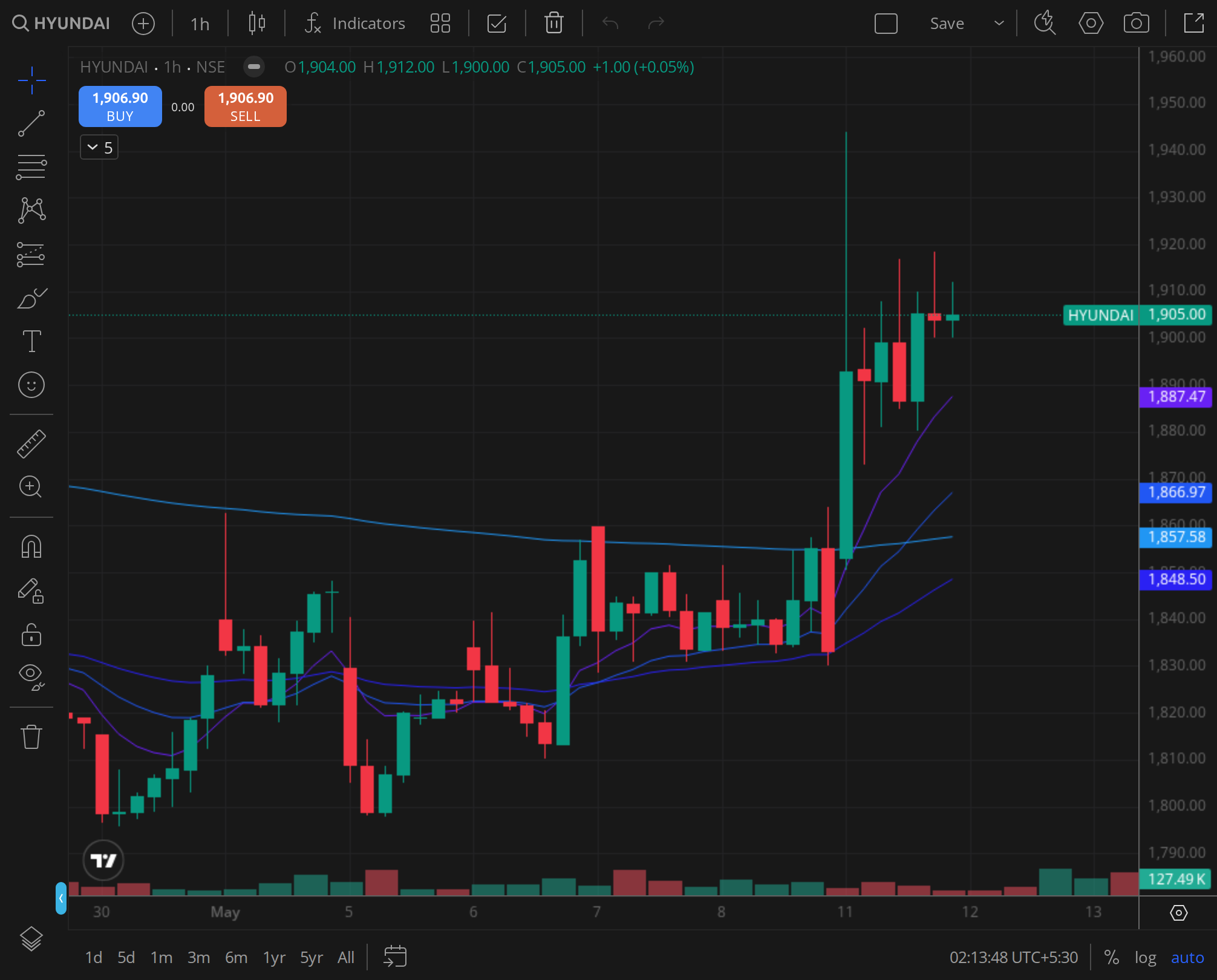
Caption: HYUNDAI weekly timeframe around 2024-10-22.
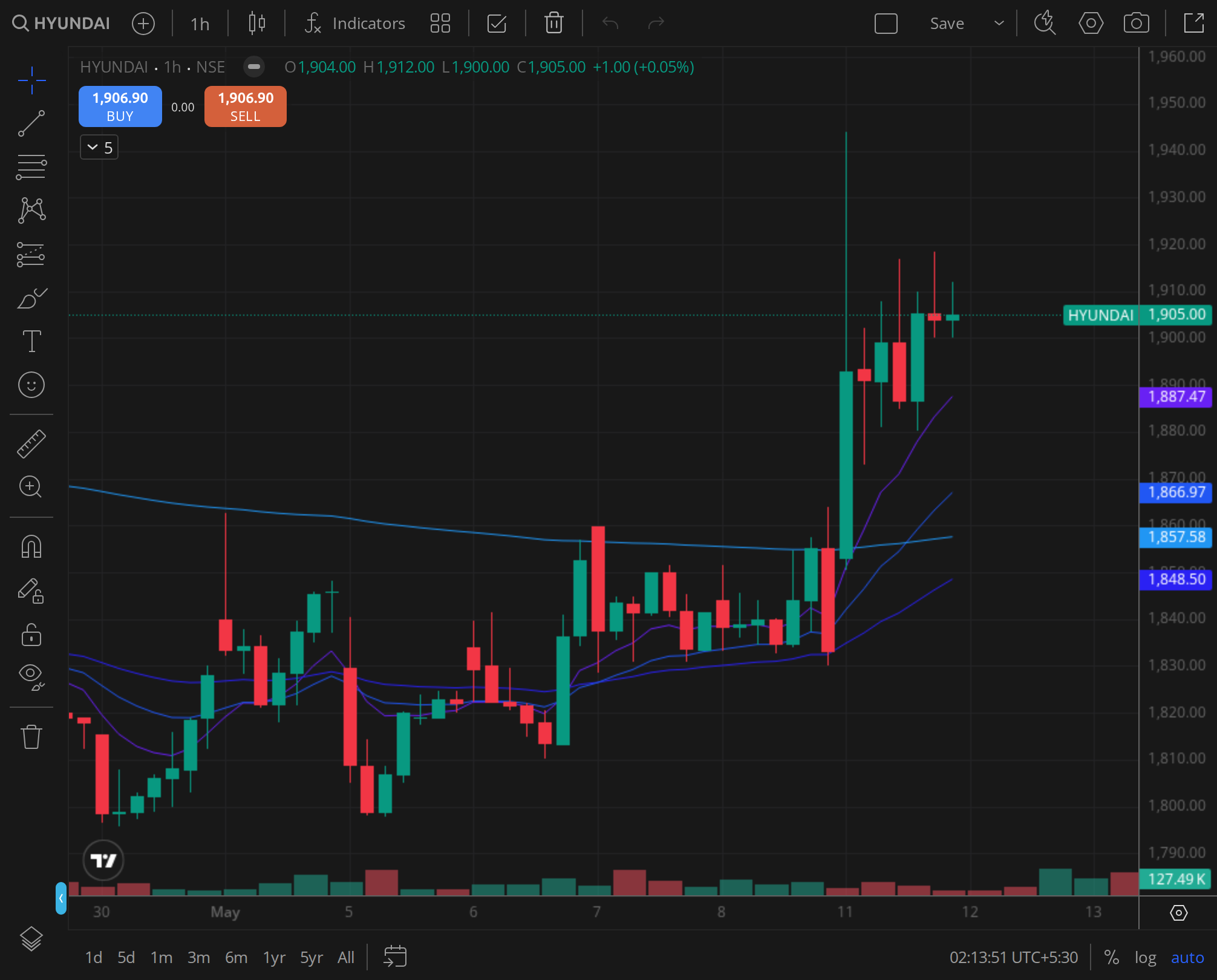
Caption: HYUNDAI daily timeframe around 2024-10-22.
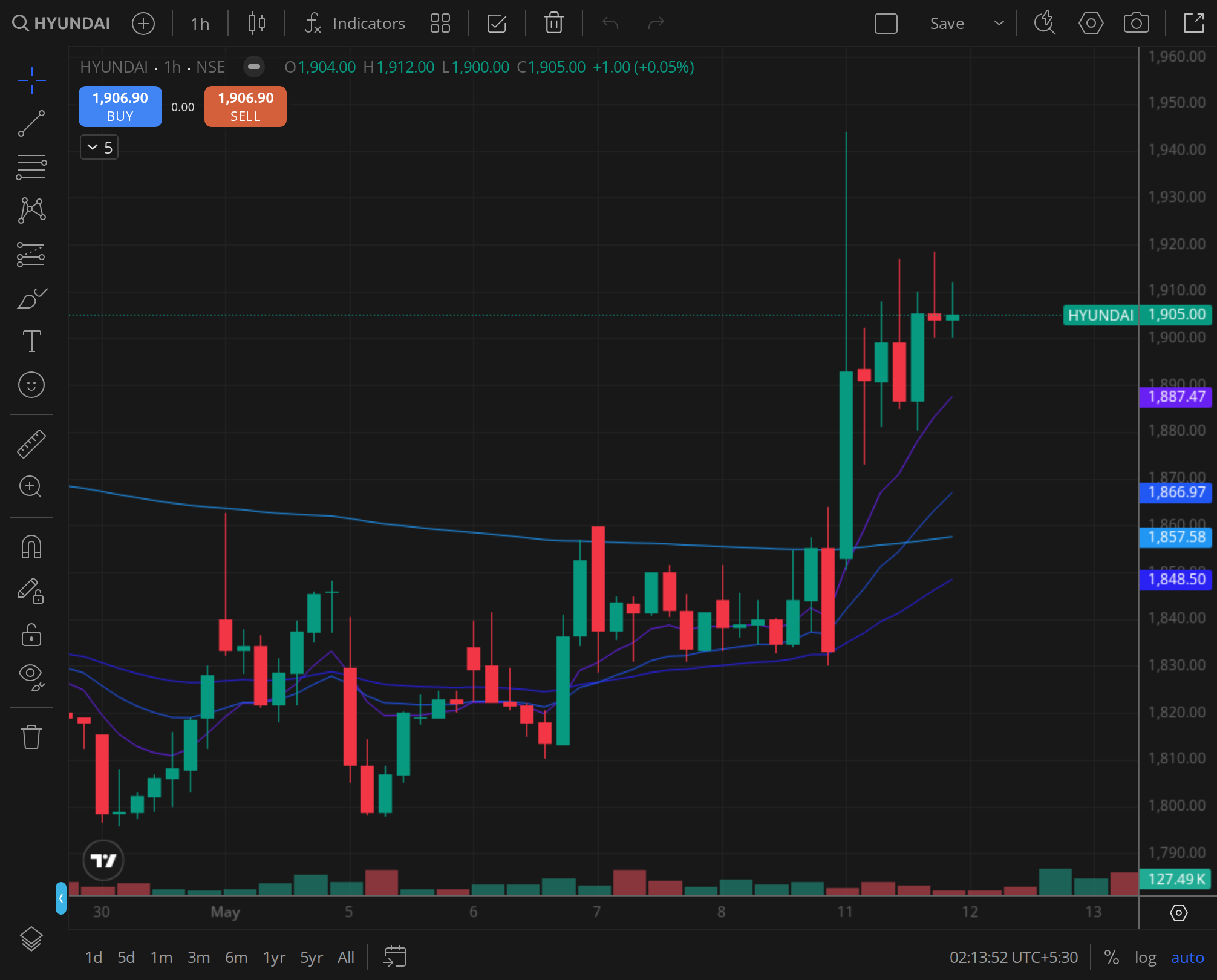
Caption: HYUNDAI 30min timeframe around 2024-10-22.
The size mattered. At roughly ₹27,870 crore, the offering was the largest in Indian capital markets history, eclipsing LIC's 2022 record by a comfortable margin. The structure mattered more. The entire issue was an offer for sale by the Korean parent Hyundai Motor Company, meaning not a single rupee flowed to the operating Indian subsidiary. The book-building exercise was, in essence, a liquidity event for the promoter dressed up as a coming-of-age moment for India's second-largest passenger vehicle maker. That tension between narrative and structure sat at the heart of how the listing actually traded.
The anchor book that looked stronger than the float behaved
The anchor allocation, finalised on 14 October 2024, had read like a credibility roster. Domestic mutual funds took the bulk of the anchor book, with the largest Indian asset managers placing meaningful tickets, and a long list of marquee foreign long-only names appeared on the allocation sheet. The narrative going into the public issue window was that the anchor quality alone would set a floor under the listing, and the brokerage circular notes that landed in client inboxes through 15 and 16 October leaned hard on this framing.
That framing did not survive contact with the order book. The three-day subscription window, which opened on 15 October and closed on 17 October, produced an aggregate book that was subscribed a little over two times overall. The composition of that subscription was the tell. Qualified institutional buyers came in late and heavy, taking the QIB portion to a multiple that reflected anchor follow-on demand rather than fresh institutional appetite. The non-institutional category, traditionally the leveraged HNI book that front-runs listing-day pops, subscribed at a fraction of what comparable large-cap IPOs in 2023 and 2024 had drawn. The retail portion stayed below full subscription through most of the window and crept across the line only on the final day.
For a market that had been trained through 2023 and the first half of 2024 to read HNI subscription multiples as a leading indicator of listing-day gains, the Hyundai book was a screaming caution. The grey market premium, which had peaked above ₹570 in the week before the issue opened, had compressed to under ₹50 by the morning of the listing, and by 21 October was reportedly trading at a discount. The unofficial market had got the call right while the official narrative was still selling the anchor sheet.
Day one: a session that priced the offer correctly
The intraday on 22 October was instructive precisely because it was so well behaved. The stock opened at ₹1,860, drifted to an intraday low in the ₹1,807 to ₹1,820 zone in the first hour of trade as the listing-pop sellers met an empty bid, and then steadied through the middle of the session as institutional buy programmes that had failed to get filled in the anchor book absorbed the float between ₹1,830 and ₹1,850. There was no panic sell, no circuit, no breach of the lower band. The close was a few rupees above the open but a clear margin below the ₹1,960 issue price.
What the day-one tape revealed was that the offering had been priced at the top of the demand curve rather than the middle. The brokerage notes that landed in client mailboxes the next morning were uniformly polite, with target prices clustered in the ₹2,150 to ₹2,400 zone over a twelve-month horizon, but the language had shifted from the pre-IPO drumbeat. Phrases like "long gestation," "wait for better entry," and "patience required" appeared in titles that had, two weeks earlier, used "marquee" and "rare opportunity." The sell-side recalibration was rapid and, accurate.
The intraday microstructure of 22 October was as clean a read on real institutional demand as one could ask for. The thirty-minute bars showed buying concentrated in the post-1:30 PM IST window, the hour when domestic mutual funds traditionally execute allocation top-ups, and selling concentrated in the first ninety minutes, when retail allottees who had hoped for a listing pop hit the bid.
The thirty-day drift
The story between 22 October and 21 November 2024 was not a crash. It was something more interesting, a slow leak that priced in the structural overhang of a 100% offer for sale by a foreign parent into a market that was simultaneously digesting a sharp FII reversal across Indian large caps. Foreign institutional flows had turned negative in the first week of October and stayed negative through most of November, with monthly outflows running at multi-year highs as global allocators rotated out of Indian equities towards a re-rated China trade and a US election-driven dollar move.
In that flow environment, a freshly listed ₹27,870 crore float with no parent buyback signal, no insider buying, and no immediate catalyst beyond quarterly results was always going to drift to where domestic mutual fund SIP flows could absorb it. That clearing price, through late October and into the first half of November, sat in the ₹1,750 to ₹1,830 band. The stock traded as much as 10% below the issue price intraday in early November before recovering some ground into the H1 results print.
The peer comparison through the same window was unkind. Maruti Suzuki India, the obvious benchmark, traded broadly flat to mildly negative over the 22 October to 21 November period, which meant Hyundai underperformed its closest sectoral peer by a meaningful margin in its first month as a listed entity. The broader Nifty 50 was also down over the period, but Hyundai's drawdown was steeper, and the relative performance versus the Nifty Auto index was the cleanest indictment of the listing's price discovery.
Who bought, who sold, who waited
The shareholding disclosures and the bulk and block deal feed through October and November 2024 told a coherent story. Domestic mutual funds were net buyers through the month, adding to positions on every meaningful down day, with the largest accretions concentrated in the second and third weeks of November. Foreign portfolio investors, outside of the anchor follow-on, were net neutral to mildly negative, a pattern consistent with the broader FII risk-off positioning rather than a Hyundai-specific call. Retail holders, predictably, were sellers into strength and dormant on weakness.
The HNI category, which had stayed away from the IPO subscription, did not come back as a listing-day buyer either. That absence mattered. In the post-Covid Indian IPO cycle, the HNI book had been the marginal price-setter on listings from Zomato through Mamaearth, and its absence on Hyundai marked a clear regime shift in how the leveraged primary market participant was reading large offer-for-sale structures. The signal was that the smart leveraged money had decided the issue was fully priced and was content to wait for a structural drawdown rather than chase a listing pop.
The lock-in calendar provided a quieter backdrop than the headline numbers suggested. Because the issue was 100% OFS by the parent, there was no employee or pre-IPO investor lock-in expiry to worry about in the conventional sense. The anchor lock-in expiries, split into the standard thirty and ninety day buckets, came and went without dramatic price action, which itself was informative. The market had already discounted the supply by the time the calendar markers arrived.
The comparison the market kept making
The cleanest historical analogue was LIC's May 2022 listing, the previous holder of the largest-IPO crown. LIC had opened at a discount to its issue price, drifted lower through its first month, and taken many quarters before reclaiming its IPO band. The structural parallels were obvious. Both were enormous offers for sale with no proceeds to the operating entity. Both arrived in markets that were either turning or already in a risk-off phase. Both carried strong household brand recognition that did not translate into a primary-market pop.
The lesson the Hyundai listing reinforced was that brand strength and primary market arithmetic are different problems. A household name with no scarcity in the float and a fully extracted price band will trade like supply, not like a story. The brokerage initiation notes that came out in the four weeks after listing, from the bulge-bracket Indian houses through the foreign sell-side, all eventually landed on the same fundamental conclusion that the long-term franchise was solid, the SUV-heavy mix was strategically right, the export book was a credible optionality, and the entry point was patience-dependent. None of those notes called for chasing the stock at ₹1,960.
What the verdict was, and what it taught
Looking back from May 2026, the Hyundai listing reads as the cleanest case study of the late 2024 Indian primary market reset. The cycle had been running hot through 2023 and the first half of 2024, with retail-led listing pops setting the tone, and the Hyundai pricing committee had clearly anchored on that environment when finalising the band. By the time the issue actually opened for subscription, the market it was being priced into had already changed, and the offer structure left no room to absorb that change.
The signal for any practitioner reading the tape in real time was in the grey market premium compression and the HNI subscription weakness. Both were available before the listing day and both were correctly bearish. The anchor book glamour was, in the event, a lagging indicator dressed up as a leading one.
VERDICT
- Stance: BEARISH (at the time of listing, retrospectively confirmed)
- Horizon: 1mo (the call that mattered was the thirty-day drift, not the multi-year franchise call)
- Rationale: A 100% OFS at the top of the band, into a turning FII tape, with a collapsing GMP and absent HNI book, was a textbook setup for sub-issue-price drift, and that is exactly how the first month traded.