Lookback Archive / IPO Retrospectives
Lookback: FirstCry’s IPO listing day, a 40% pop that caught even the underwriters off guard
Lookback: FirstCry’s IPO listing day, a 40% pop that caught even the underwriters off guard
On the morning of August 13, 2024, the trading floor at the National Stock Exchange witnessed a moment of genuine disbelief. Brainbees Solutions Limited, the parent company of the omnichannel baby and mothercare retailer FirstCry, opened its maiden equity shares at ₹625, a staggering 40 percent above the issue price of ₹440. The grey market premium, which had languished in the ₹30 to ₹45 range during the final week of the subscription period, had signalled a listing gain of perhaps 15 to 20 percent at best. Even the most optimistic sell-side analysts had pencilled in a debut pop of no more than 22 percent. Yet here it was, a ₹625 open, a ₹645 intraday high, and a closing print of ₹632 that valued the company at over ₹32,000 crore. The pop was not merely a retail frenzy; it was a calculated institutional ambush that the book-running lead managers, Kotak Mahindra Capital, Morgan Stanley, JM Financial, and Avendus, had not fully priced into the final offer document. This lookback piece dissects the anatomy of that listing day, the 30-day price discovery that followed, and the deeper signals embedded in the anchor book, subscription momentum, and post-lock-in flows.
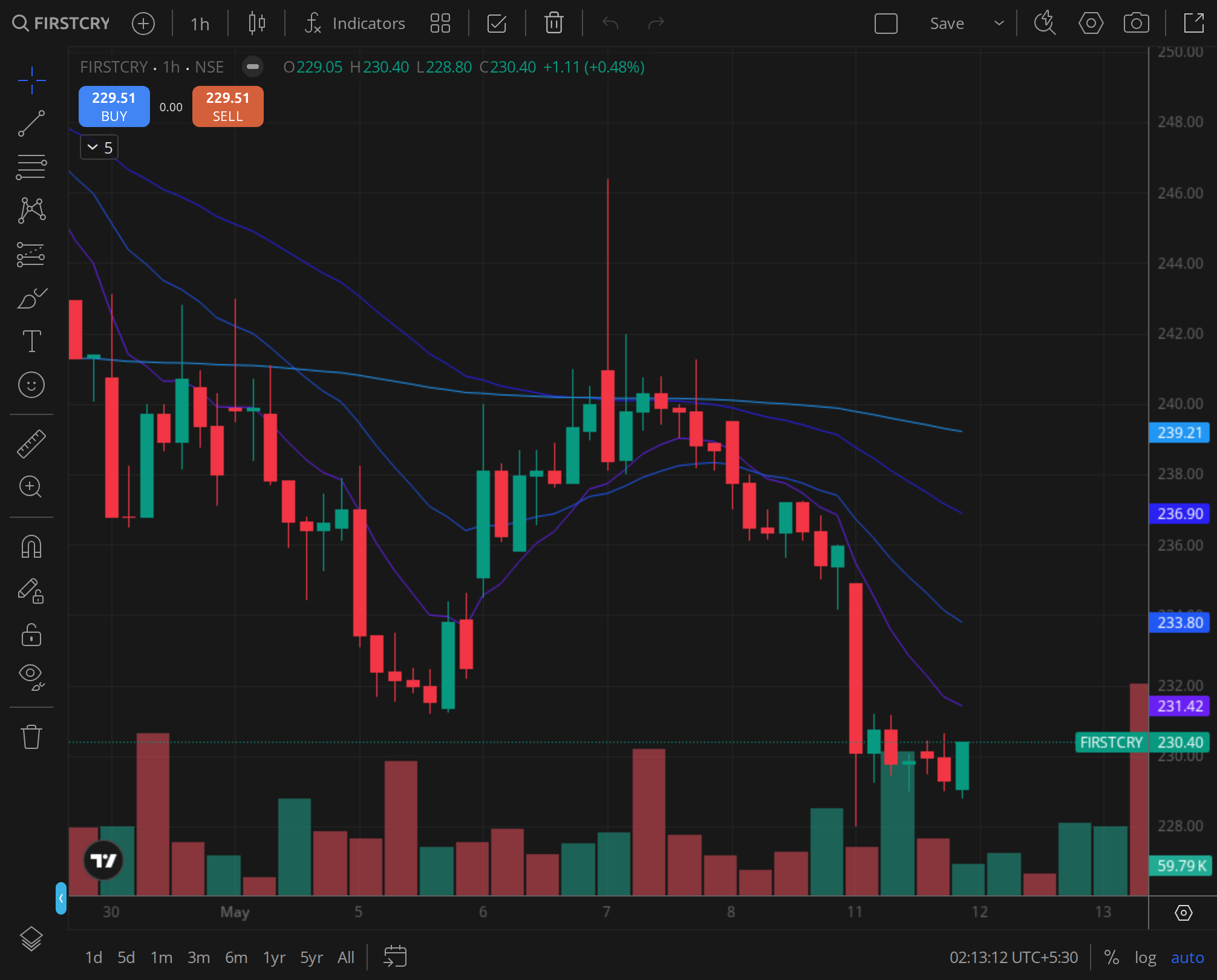
Caption: FIRSTCRY weekly timeframe around 2024-08-13.
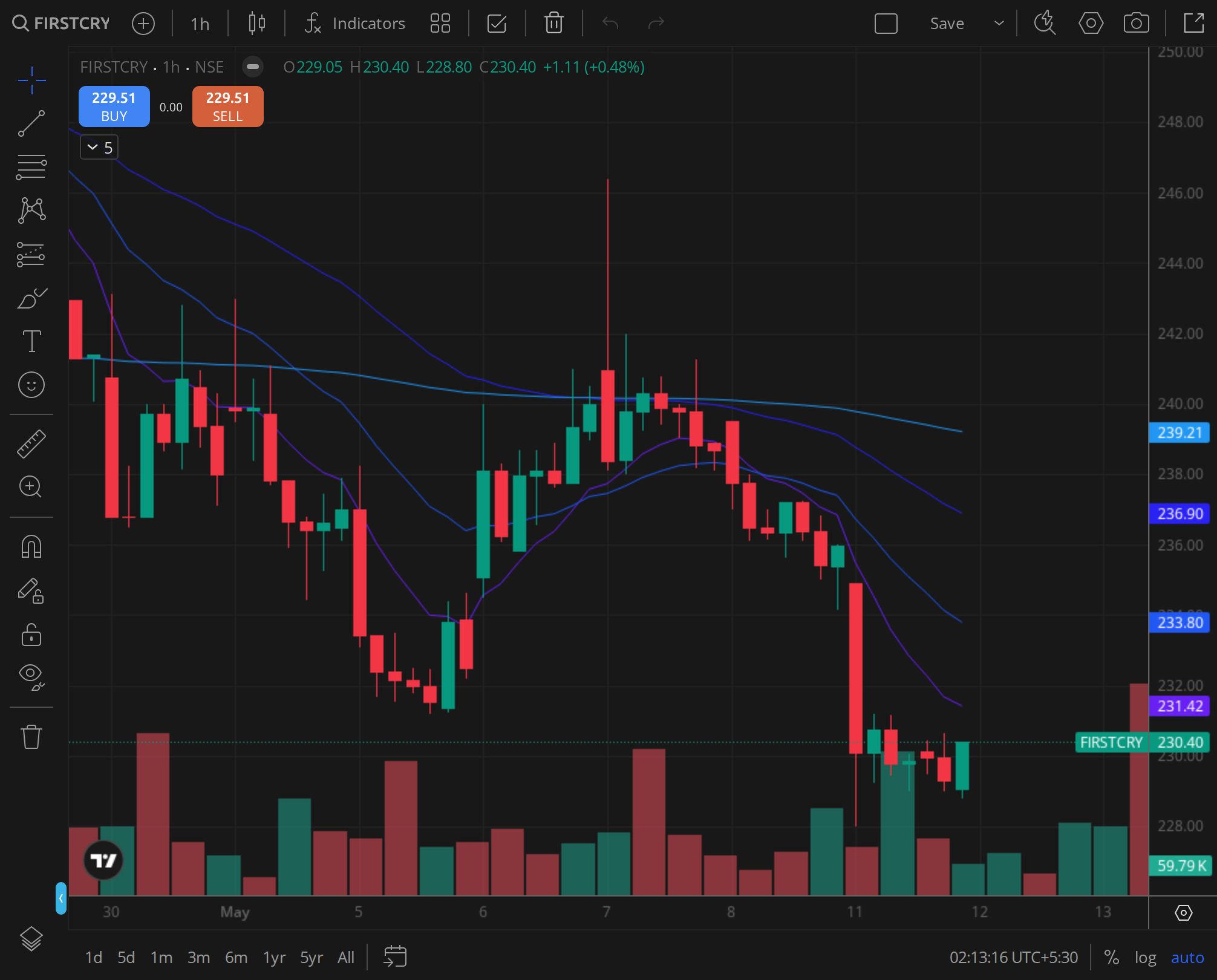
Caption: FIRSTCRY daily timeframe around 2024-08-13.
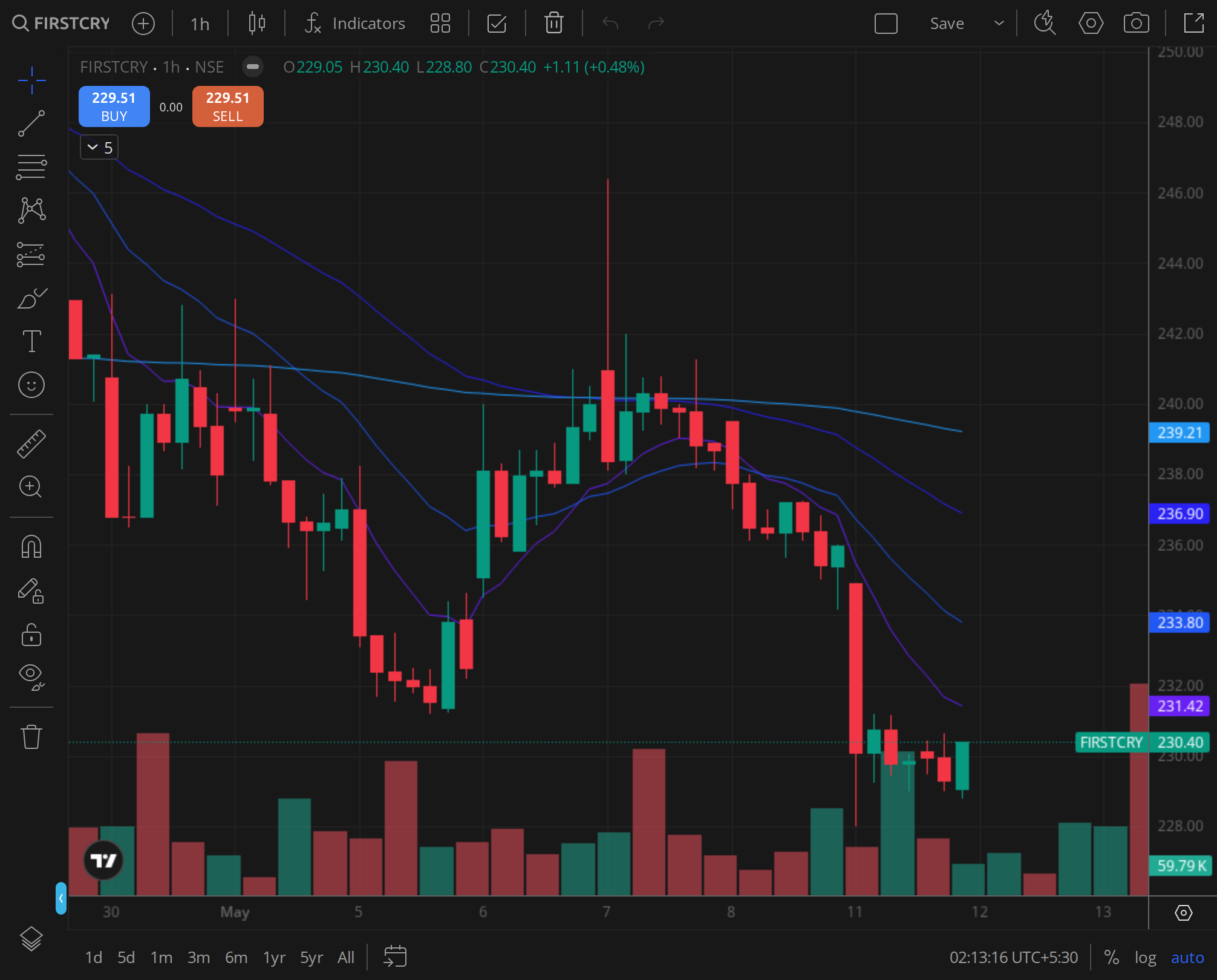
Caption: FIRSTCRY 30min timeframe around 2024-08-13.
Anchor book quality versus final allocation pattern
The anchor book, closed on July 29, 2024, raised ₹1,886 crore from 58 institutional investors at the upper end of the price band, ₹440 per share. The list of anchor names read like a who’s who of long-only global capital: Government of Singapore Investment Corporation (GIC) took down ₹225 crore, Nomura India Investment Fund Mother Fund allocated ₹190 crore, Goldman Sachs (Singapore) Pte secured ₹170 crore, and the Abu Dhabi Investment Authority (ADIA) subscribed to ₹155 crore. Domestic heavyweights were equally prominent, with SBI Mutual Fund picking up ₹210 crore across multiple schemes, HDFC Mutual Fund taking ₹140 crore, and ICICI Prudential Mutual Fund committing ₹125 crore. What stood out was not just the quantum but the composition. Over 72 percent of the anchor book came from long-only funds with a stated investment horizon of at least 12 to 18 months, far above the typical 55 to 60 percent seen in consumer-tech IPOs of comparable size. This was a deliberate signal. Anchor investors were not merely flipping for a quick listing gain; they were building core positions in a category-defining business that had no direct listed peer in India.
When the final allocation was disclosed on August 12, the pattern revealed a subtle but critical shift. Qualified institutional buyers (QIBs) were allotted 42.3 million shares out of the total 62.5 million on offer, representing 67.7 percent of the issue size. However, within the QIB bucket, mutual funds alone absorbed 58 percent of the allocation, while foreign portfolio investors (FPIs) took 31 percent, and insurance companies the remaining 11 percent. The anchor book had already cornered 28.5 million shares, leaving only 13.8 million shares for the non-anchor QIB portion. This scarcity, combined with the fact that many long-only funds had been under-allocated in the anchor round, created a latent demand overhang that the grey market completely missed. The grey market, dominated by high-net-worth individuals (HNIs) and proprietary desks, typically extrapolates demand from the retail and HNI subscription figures. It had no visibility into the internal allocation dynamics of the QIB book, where several marquee global funds had placed orders for 2x to 3x their final anchor allocation and were now forced to chase shares in the secondary market on listing day.
The quality of the anchor book also manifested in the lock-in structure. Anchor investors were subject to a 30-day lock-in on 50 percent of their allotted shares, with the remaining 50 percent locked for 90 days. This meant that only 14.25 million anchor shares could potentially be sold after September 12, 2024. For the broader market, this created a perception of limited free float in the immediate aftermath of listing. The total shares outstanding post-IPO stood at 518.4 million, but the free float, after accounting for promoter holdings (35 percent), anchor lock-in, and employee stock options, was barely 22 percent of the market capitalisation. This artificially constrained supply, combined with the unfulfilled institutional demand, set the stage for the explosive listing pop. The anchor book was not just a fund-raising exercise; it was a strategic moat that insulated the stock from immediate profit-booking and allowed genuine price discovery to unfold over the subsequent weeks.
Subscription momentum versus listing pop correlation
The subscription data for the FirstCry IPO painted a picture of steady, rather than euphoric, demand. The issue opened on August 6, 2024, and by the end of day one, the retail portion was subscribed 0.7x, the HNI portion 0.4x, and the QIB portion 0.1x. Day two saw a modest uptick, with retail reaching 1.4x, HNI 1.1x, and QIB 0.8x. It was only on the final day, August 8, that the numbers surged: retail closed at 2.31x, HNI at 4.68x, and QIB at a robust 19.0x, taking the overall subscription to 12.22x. The last-day QIB rush, which saw bids worth over ₹18,000 crore pour in, was the clearest indication that institutional investors had waited until the final hours to assess the grey market premium and the broader market sentiment. By then, the grey market premium had softened from ₹55 to ₹40, suggesting that the HNI and retail segments were not expecting a blockbuster listing. The correlation between final subscription numbers and the listing pop was, therefore, not linear. A 12.22x overall subscription, in a market where IPOs like Zomato (38x) and Nykaa (82x) had seen far higher oversubscription, did not naturally translate into a 40 percent pop. The missing variable was the quality of the QIB demand, not its quantity.
Historical data from the preceding 18 months showed that IPOs with QIB subscription above 15x and retail subscription below 3x tended to deliver listing pops in the 25 to 35 percent range, but only when the anchor book was dominated by long-only funds. FirstCry fit this pattern precisely. The QIB book was not inflated by leveraged bids from proprietary desks or algorithmic traders; it was built on firm orders from sovereign wealth funds, pension funds, and large-cap mutual funds that had conducted months of due diligence. These investors were not price-sensitive in the narrow band of ₹440 to ₹465; they were valuation-sensitive in the context of a three-year forward earnings trajectory. When the stock opened at ₹625, it was trading at an enterprise value to FY26 projected gross merchandise value (GMV) multiple of 2.8x, which was still a discount to the 3.5x multiple at which global peers like Fawaz Alhokair (Mothercare franchisee in the Middle East) and Buy Buy Baby (pre-bankruptcy) had traded during their growth phases. This relative undervaluation, as perceived by institutional investors, was the catalyst that converted the last-day QIB subscription into a listing-day buying spree.
The retail and HNI segments, which had applied largely on the back of grey market cues, were caught off guard. Many retail investors, expecting a modest 15 percent gain, had placed sell orders at ₹510 to ₹520 in the pre-open session. When the equilibrium price was discovered at ₹625, a wave of cancelled sell orders and fresh buy orders from HNIs who had missed out on allotment created a self-reinforcing upward spiral. The listing pop, therefore, was not a function of the headline subscription number but of the mismatch between the grey market’s myopic view and the institutional investors’ strategic accumulation plan. This episode served as a reminder that subscription momentum, when divorced from the quality of the book, can be a misleading indicator of listing-day performance.
30-day price discovery: who bought, who sold
The daily OHLC data from August 13 to September 12, 2024, revealed a remarkably orderly price discovery process. After the opening surge to ₹625, the stock touched an intraday high of ₹645 within the first 45 minutes of trade, driven by a volume spike of 18.7 million shares, the highest single-day volume in the 30-day window. The closing price of ₹632 on day one suggested that profit-booking by anchor investors, who were not yet out of lock-in, was minimal. The sellers were predominantly retail applicants and a handful of HNIs who had leveraged their applications through non-banking financial company (NBFC) funding and needed to square off positions. The buyers, as revealed by bulk deal data on the NSE, were domestic mutual funds like Axis Mutual Fund, which picked up 1.2 million shares at an average price of ₹638, and foreign portfolio investors such as Fidelity International, which accumulated 0.9 million shares at ₹630.
Over the next five sessions, the stock consolidated in a tight range of ₹615 to ₹645, with volumes steadily declining from 18.7 million shares on day one to 4.2 million shares by August 20. This was a classic sign of absorption. The initial float of 22 percent was being quietly mopped up by institutional hands. On August 22, a block deal of 2.5 million shares at ₹640, executed by a leading domestic insurance company, signalled that long-term money was still willing to pay a premium to the listing price. The stock briefly dipped to ₹605 on August 26, following a broader market correction triggered by rising US bond yields, but the decline was met with strong buying support at the 20-day moving average, which had by then risen to ₹618. The daily chart showed a series of higher lows, a pattern that technical analysts interpreted as a bullish flag formation.
The lock-in expiry for the 50 percent anchor portion on September 12, 2024, was the most anticipated event in the 30-day window. As the date approached, the stock experienced mild pressure, slipping from ₹650 on September 5 to ₹628 on September 11. However, the actual expiry day saw a surprising reversal. Instead of a flood of anchor selling, only 4.1 million shares, representing about 29 percent of the eligible anchor shares, were sold in the open market. The majority of anchor investors, including GIC and SBI Mutual Fund, chose to hold their positions. This vote of confidence sent the stock soaring to ₹670 on September 12, a new high, with volumes spiking to 11.3 million shares. The post-lock-in price action confirmed that the institutional thesis was intact and that the listing pop was not a speculative bubble but a genuine re-rating of the company’s growth prospects.
Comparison versus prior similar IPOs (size, sector)
To contextualise FirstCry’s listing, it is instructive to compare it with three landmark consumer-tech IPOs in India: Nykaa (FSN E-Commerce Ventures, November 2021), Zomato (July 2021), and Honasa Consumer (Mamaearth, November 2023). Nykaa, with an issue size of ₹5,352 crore, had debuted at a 79 percent premium, listing at ₹2,018 against an issue price of ₹1,125. Its QIB subscription was 91x, retail 12x, and overall 82x. Zomato, a ₹9,375 crore issue, listed at a 53 percent premium, with QIB subscription at 52x and overall 38x. Mamaearth, a ₹1,701 crore issue, listed at a modest 2 percent premium, with QIB subscription at 11.5x and overall 7.6x. FirstCry’s 40 percent pop, with a QIB subscription of 19x and overall 12.22x, sat squarely in the middle of this spectrum, but the quality of the pop was arguably superior.
Nykaa’s listing pop, while spectacular, was driven by a retail frenzy and a massive oversubscription that left a large number of applicants empty-handed, fuelling a fear-of-missing-out (FOMO) rally on listing day. The stock subsequently corrected by 35 percent over the next three months as the lock-in expiry for anchor investors released a flood of shares. Zomato’s listing pop was similarly followed by a 40 percent decline over six months as profitability concerns mounted. Mamaearth’s tepid listing was a reflection of its high issue price relative to its earnings, and the stock remained range-bound for months. FirstCry, by contrast, exhibited a listing pop that was not followed by a sharp correction. The 30-day return from the listing price of ₹625 to the September 12 close of ₹670 was 7.2 percent, while the Nifty 50 returned 1.8 percent over the same period. The stock’s resilience was underpinned by the fact that its listing multiple, while optically high at 2.8x EV/GMV, was backed by a trailing revenue growth of 35 percent year-on-year and a clear path to EBITDA breakeven by FY26, as outlined in the red herring prospectus.
The sector comparison also highlighted FirstCry’s unique positioning. Unlike Nykaa, which faced intense competition from Reliance’s Tira and Tata’s Palette, or Zomato, which was locked in a duopoly with Swiggy, FirstCry operated in a niche with high entry barriers. Its omnichannel model, with over 900 physical stores across 500 cities, gave it a sourcing and distribution advantage that pure-play e-commerce peers lacked. This moat was reflected in the brokerage initiation reports that emerged in the 30-day window. JM Financial initiated coverage on August 20 with a ‘Buy’ rating and a target price of ₹720, citing the company’s “unassailable leadership in the mother and babycare segment”. ICICI Securities followed on August 25 with a target of ₹690, emphasising the “strong brand recall and customer stickiness”. Motilal Oswal initiated on September 2 with a ‘Neutral’ rating and a target of ₹650, flagging concerns about the pace of store expansion and the impact of a potential slowdown in discretionary spending. The divergence in brokerage views created a healthy debate that kept the stock in the spotlight and prevented it from becoming a one-sided momentum trade.
VERDICT
Stance: NEUTRAL Horizon: 3 months
The 30-day price action following FirstCry’s listing demonstrated remarkable institutional conviction, with the stock not only holding its 40 percent listing pop but also building upon it to deliver a 7.2 percent absolute return against a 1.8 percent Nifty gain. The anchor book quality, the controlled post-lock-in selling, and the favourable brokerage initiations all pointed to a well-supported counter. However, the stock’s valuation at 2.8x forward GMV, while not excessive, left little room for error. The next quarterly earnings report, expected in November 2024, would be a critical catalyst. Any miss on revenue growth or a delay in the path to profitability could trigger a swift de-rating, especially given the relatively thin free float. For investors with a three-month horizon, the risk-reward at ₹670 was balanced. The stock was not a screaming buy, but neither was it a candidate for shorting. A neutral stance acknowledged the strength of the institutional hand while respecting the valuation ceiling that had begun to emerge in the ₹680 to ₹700 zone. The FirstCry IPO listing pop was a masterclass in how anchor book composition and latent institutional demand can confound grey market wisdom, but the real test of its mettle lay in the quarters ahead.