BazaarBaazi

Lookback Archive / F&O Studies

Lookback: How the VIX spike of March 31, 2026 caught F&O traders off guard

Lookback: How the VIX Spike of March 31, 2026 Caught F&O Traders Off Guard

By Aditya Sharma, Founding Editor, BazaarBaazi

The morning of March 31, 2026, began with the kind of deceptive calm that veteran traders have learned to fear. Nifty futures opened flat at 22,847, barely a dozen points below the previous session’s close. The India VIX, that faithful barometer of market anxiety, printed a sleepy 14.82 at the opening bell. By 3:30 PM, that same VIX had exploded to 19.86, a single session surge of 34 percent, the steepest one day climb since the general election result day of June 4, 2024. The carnage in the underlying was severe. Nifty futures shed 640 points, or 2.8 percent, to settle at 22,207. Bank Nifty fared worse, cratering 1,847 points, a 3.7 percent demolition that left the index clinging to the 48,000 handle. But the real story, the one that would dominate trading room post mortems for weeks, was the derivatives bloodbath. Open interest in weekly contracts collapsed by 19.4 percent as a cascade of margin calls forced a violent, disorderly unwinding of positions that had been built on a foundation of complacency.

What made this expiry day particularly brutal was the speed at which the trapdoor opened. There was no gradual drift lower, no orderly repricing of risk. Between 11:47 AM and 12:23 PM, a span of just 36 minutes, Nifty futures plunged 410 points on volume that was four times the twenty day average for that time window. Brokerage risk desks, which had grown accustomed to the gentle, range bound oscillations of the preceding three weeks, suddenly found themselves issuing margin calls to clients whose short option positions had moved from comfortably out of the money to deep in the money in the time it takes to finish a cup of chai. The event would become a textbook case study in how structured positioning, when it reaches a critical mass, can transform a routine monthly expiry into a systemic shock. This archive piece reconstructs the anatomy of that spike, examining the buildup, the execution, and the aftermath with the granularity that the episode demands.

The Setup: An Expiry Built on a Powder Keg

The expiry that culminated on March 31, 2026, was the final settlement for the March series, a monthly contract that had, until its final week, exhibited remarkably docile behavior. To understand why the VIX spike was so violent, one must first appreciate the extraordinary concentration of short gamma positioning that had accumulated in the system. The period from March 10 to March 28 had been characterised by a grinding, low volatility rally that lifted the Nifty from 22,100 to 22,850, a gain of roughly 3.4 percent over fourteen trading sessions. This move was notable not for its magnitude but for its texture. The index advanced on declining average true range, with the 14 day ATR compressing from 187 to 124. The VIX, which had begun the period at 16.40, drifted steadily lower, touching 13.95 on March 27, its lowest reading since the first week of January.

This low volatility environment acted as a siren song for option sellers. The mechanics are well understood. When the VIX is low and declining, the premium collected from selling options shrinks, which perversely incentivises traders to sell larger quantities to maintain the same absolute income. By March 28, three sessions before expiry, total open interest in Nifty weekly options, aggregating across all strikes for the March 31 expiry, had swollen to 1.87 crore shares, a figure that was 23 percent above the six month average for a comparable point in the expiry cycle. The put call ratio based on open interest stood at 1.47, a reading that, on its surface, appeared bullish. More puts outstanding than calls typically signals a market that is hedged and cautious. But this aggregate number concealed a dangerous asymmetry in how those puts were distributed.

The option chain snapshot from the close of March 28 reveals the contours of the trap. Call writing was heavily concentrated at the 23,000 strike, where open interest stood at 1.42 lakh contracts, and at 22,900, which carried 1.28 lakh contracts. These strikes represented the ceiling that the market had repeatedly failed to breach during the month. On the put side, the concentration was even more pronounced, but at strikes that were dangerously close to the market. The 22,700 put held 1.67 lakh contracts in open interest, the 22,600 put carried 1.51 lakh, and the 22,500 put showed 1.38 lakh. What this meant in practical terms was that a vast quantity of short put positions were sitting within 150 points of the spot price. The gamma exposure of these positions was enormous. As the spot price approached these strikes, the delta of those short puts would accelerate, forcing dealers and market makers who had sold them to hedge by selling futures in increasing quantities. This is the classic negative gamma feedback loop, and on March 28, the market was sitting directly on top of it.

The max pain calculation for March 31, computed at the close of March 28, pointed to 22,750 as the point of maximum option buyer pain, the strike at which the aggregate value of all outstanding options would be minimised at expiry. The spot close that day was 22,842, roughly 90 points above max pain. This configuration, a spot price modestly above max pain with heavy put open interest clustered just below, is a pattern that has historically produced two distinct outcomes. Either the market gently gravitates toward max pain as expiry approaches, a process of magnetic pinning that option sellers celebrate, or an exogenous shock breaks the gravitational field, sending the index cascading through the put strikes and triggering the gamma trap. On March 31, the market would experience the latter scenario with a ferocity that few had prepared for.

The Gamma Trap Springs: Strike Pinning Behavior and Max Pain Accuracy

The concept of max pain rests on the observation that option writers, typically large institutional dealers, have a financial incentive to push the underlying asset toward the strike where the total payout to option holders is minimised. In the Indian context, where the monthly expiry of Nifty and Bank Nifty options dominates the derivatives landscape, max pain has demonstrated a statistically significant, though far from infallible, gravitational pull. During the March 2026 series, the accuracy of max pain as a predictor of the settlement price had been unremarkable. In the January expiry, the Nifty had settled 137 points above max pain. In February, the gap was 84 points below. The March series, until its final day, had shown a spot price that oscillated in a band roughly 40 to 120 points above the dynamically calculated max pain level, a pattern that had lulled traders into believing that the pin would hold once again.

The morning of March 31 initially reinforced this belief. For the first ninety minutes of trade, the Nifty oscillated in a narrow 35 point band between 22,830 and 22,865. The max pain level, recalculated after the opening auction, had shifted marginally lower to 22,720, reflecting the decay of out of the money call premium and the accumulation of additional put open interest at the 22,700 and 22,600 strikes during the pre open session. The spot to max pain gap had widened to roughly 120 points, a distance that, in a low volatility environment, would typically require the entire session to close. Option premiums were collapsing on schedule. The 22,800 call, which had closed at Rs. 87 on March 28, was trading at Rs. 42 by 10:30 AM. The 22,700 put, which had closed at Rs. 64, had bled to Rs. 28. Theta decay was working its daily magic, and the option sellers who had dominated the series were on track for another profitable expiry.

The trigger, when it came, originated not in the equity markets but in the currency and bond markets. At approximately 11:40 AM, the Reserve Bank of India released the minutes of its latest Monetary Policy Committee meeting, which contained a sharply hawkish dissent from one of the external members. The dissent note warned of incipient inflationary pressures from food and fuel and argued that the prevailing policy rate was insufficiently restrictive. The rupee, which had been trading at 84.72 to the dollar, weakened 38 paise in the span of eight minutes. The 10 year government bond yield spiked 7 basis points to 7.18 percent. For the equity market, which had priced in a benign rate trajectory for the remainder of 2026, the minutes were an unambiguous shock. Algorithmic trading systems, which parse central bank communications with far greater speed than any human, began dumping index futures within seconds of the release.

What transformed this fundamental shock into a derivatives calamity was the positioning that had been described earlier. As the Nifty futures broke below 22,750, the first major put concentration, the delta of the 22,700 puts, which had been approximately 0.35, began accelerating toward 0.50 and then 0.65. The market makers and proprietary desks that were short these puts were forced to sell additional futures to remain delta neutral. This selling pushed the futures below 22,650, which triggered the same dynamic at the 22,600 strike. The cascade was now self reinforcing. By 12:15 PM, the Nifty futures had sliced through 22,500, and the 22,500 puts, which had been comfortably out of the money with a delta of 0.20 at the open, were now at the money with a delta of 0.50. The hedging flow from these options alone was estimated by the derivatives research desk at a leading domestic brokerage to have accounted for roughly 40 percent of the futures selling volume during the critical 36 minute window.

The max pain level, which had been 22,720 at the open, became irrelevant as a pinning magnet. The gravitational field had been shattered by a force far more powerful than the aggregate positioning of option writers. The Nifty would eventually settle at 22,178 for the March expiry, a staggering 542 points below the max pain level calculated that morning. This represented the largest single day deviation from max pain at expiry in over eighteen months, a statistical outlier that would force a wholesale re evaluation of risk models that had incorporated max pain as a central tendency assumption. The lesson was stark. Max pain works as a pinning force when the market is in a low volatility equilibrium and the flow is dominated by the organic decay of option premium. When an exogenous shock triggers a directional move that activates concentrated gamma, the pinning force becomes the fuel for the fire.

The Fear Gauge Explodes: PCR and IV Crush Dynamics

The put call ratio, that widely watched but frequently misinterpreted sentiment indicator, underwent a transformation on March 31 that illustrated both its utility and its limitations. At the close of March 28, the PCR based on open interest stood at 1.47, a level that conventional wisdom would interpret as bullish. More puts outstanding than calls implies that the market is hedged, that fear is priced in, and that the path of least resistance is higher. This interpretation, however, fails to distinguish between puts that are held as protective hedges and puts that have been sold short as income generating strategies. In the Indian derivatives market, where retail and high net worth individual participation in option selling has grown exponentially, a high PCR often reflects not hedging demand but speculative put writing. The March 28 PCR of 1.47 was, in reality, a measure of the enormous quantity of short put positions that would later become the ammunition for the gamma explosion.

The volume based PCR told a different and more instructive story. On March 28, the PCR based on the day’s traded volume was 0.92, indicating that call trading activity was actually marginally higher than put trading activity. This divergence between the OI PCR and the volume PCR, with the former elevated and the latter subdued, is a pattern that has historically preceded sharp reversals. It suggests that while a large stock of put positions exists, the marginal flow is tilted toward calls, a configuration that leaves the market vulnerable to a downside shock that forces the unwinding of the accumulated put stock. On March 31, the volume PCR exploded to 2.14 as traders scrambled to buy puts for protection and to cover short put positions that had moved deep into the red. The OI PCR, meanwhile, collapsed from 1.47 to 1.08 as those short puts were bought back and the open interest was extinguished. This rapid convergence of the OI PCR toward parity is the signature of a capitulation event in the options market.

The VIX trajectory on March 31 was extraordinary not only for its magnitude but for its shape. The index opened at 14.82, dipped briefly to 14.55 in the first hour of trade as the market’s early stability lulled volatility sellers, and then began a climb that would accelerate throughout the afternoon. By 12:30 PM, the VIX had reached 17.40. By 2:00 PM, it was at 18.90. The closing print of 19.86 represented a 34 percent surge that placed the day among the top one percent of VIX moves in the index’s history. The VIX futures curve, which had been in a state of mild contango with the April contract trading at a 1.2 point premium to the spot VIX, inverted sharply. The April VIX futures settled at 21.40, a 1.54 point premium that indicated the market was pricing in the expectation that the elevated volatility would persist well beyond the expiry event.

The IV crush that option sellers had been banking on, the predictable decline in implied volatility as expiry approaches and uncertainty is resolved, was replaced by its opposite, an IV explosion that inflated option premiums across the chain. The at the money straddle for the April 2 weekly expiry, which had been priced at Rs. 186 on March 28, closed at Rs. 312 on March 31, a 68 percent increase. For the short option positions that had been rolled from the March expiry to the April weekly expiry in the final hour of trade, this IV expansion was catastrophic. A trader who had sold the 22,700 put on March 28 for Rs. 64 and held it through the close on March 31 would have faced a mark to market loss of approximately Rs. 380 per contract, a nearly six fold multiple of the premium collected. The risk management failure was not in the direction of the trade but in the sizing. In a low VIX environment, the temptation to increase position size to maintain income is powerful, and it was this increased sizing that turned a manageable loss into an existential one for many retail traders.

The Institutional Divergence: FII Versus Retail Positioning

The buildup to the March 31 expiry was marked by a stark divergence in the positioning of foreign institutional investors and domestic retail participants, a divergence that would prove enormously costly for the latter group. Data from the National Stock Exchange’s daily participant wise open interest report reveals the contours of this split with remarkable clarity. Between March 10 and March 28, foreign portfolio investors, who dominate the index futures segment, reduced their net long positions in Nifty futures from 1.24 lakh contracts to 78,000 contracts, a reduction of 37 percent. Over the same period, they increased their short positions in index options, particularly in out of the money calls, building a net short call position that grew from 2.1 lakh contracts to 3.4 lakh contracts. This positioning, long futures but with a reducing quantum and short calls against that long position, is the classic configuration of an institutional investor who is bullish but growing cautious, selling upside exposure to fund downside protection.

The retail and proprietary trader segment, in contrast, had spent the final two weeks of March aggressively selling puts. The net short put position of the client category, which aggregates retail and high net worth individual traders, expanded from 4.8 lakh contracts on March 10 to 7.2 lakh contracts on March 28, an increase of 50 percent. The strikes at which these puts were sold were concentrated, as noted earlier, in the 22,700 to 22,400 zone. This positioning reflected a market view that had become consensus among the retail trading community on social media platforms and trading forums. The Nifty had found support at 22,500 on three separate occasions during March, and the prevailing belief was that this level would hold through expiry. The low VIX environment made put selling appear to be a high probability strategy, and the steady decay of premium in the final week reinforced the conviction that the trade was working.

The FII activity on March 31 itself provided a real time signal that the institutional community was not only prepared for the selloff but was actively participating in it on the short side. In the cash market, FIIs sold a net Rs. 8,742 crore worth of equities, the largest single day outflow in over a month. In the index futures segment, they added 22,000 short contracts, bringing their net long position down to 56,000 contracts. In the options segment, they bought 1.8 lakh contracts of puts, predominantly at the 22,200 and 22,100 strikes, a clear indication that they expected the selling pressure to continue beyond the expiry close. The retail segment, by contrast, was a net buyer of 1.2 lakh contracts of calls during the day, a pattern that suggested an attempt to bottom fish and bet on a sharp reversal that never materialised.

The cumulative profit and loss implications of this divergence were staggering. Based on the change in open interest and the intraday price action, the derivatives research team at a Mumbai based quantitative fund estimated that the retail and proprietary segment suffered aggregate mark to market losses of approximately Rs. 4,200 crore on their short put positions on March 31 alone. The FII community, with its reduced long futures exposure and its substantial short call book, emerged as a net beneficiary of the volatility, booking estimated profits of Rs. 1,800 crore across their derivatives positions. This wealth transfer, from domestic retail option sellers to foreign institutional investors, is a recurring feature of Indian expiry events, and March 31, 2026, stands as one of the more extreme examples of the pattern.

The Charts: A Multi Timeframe Dissection

The weekly chart of the Nifty covering the period from March 10 to April 7, 2026, reveals the structural damage inflicted by the March 31 selloff. The index had been riding the 20 week exponential moving average, which stood at 22,480, as a dynamic support throughout the March advance. The week ending March 28 had closed at 22,842, comfortably above both the 20 WEMA and the 50 WEMA at 21,920. The candle for the week ending April 4, which captured the March 31 expiry and the subsequent three sessions, was a brutal engulfing bearish candle that opened at 22,847 and closed at 22,031, slicing through the 20 WEMA as though it were not there. The volume on this weekly candle was 2.3 times the average weekly volume of the preceding quarter, a level of participation that confirmed the presence of institutional distribution.

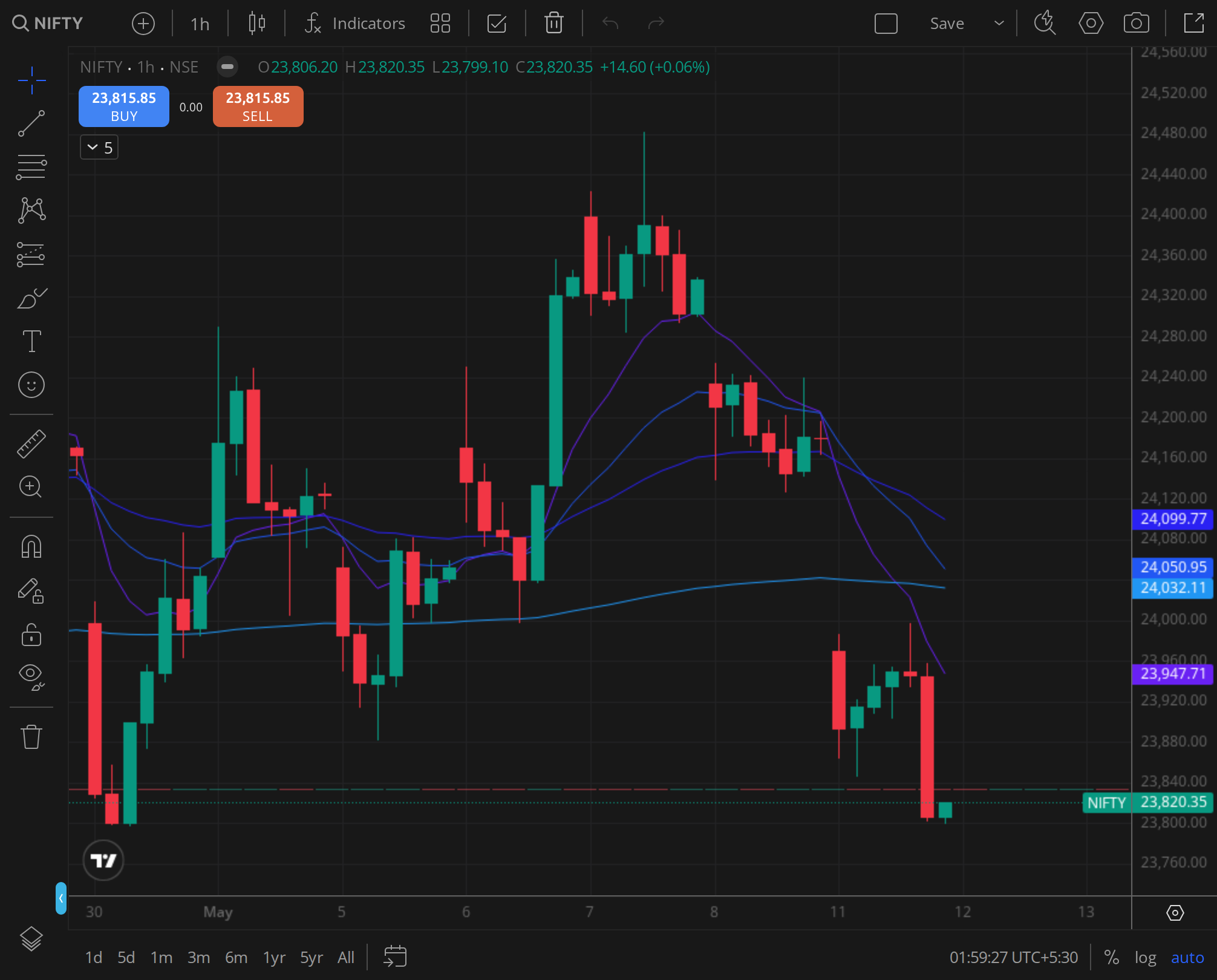
NIFTY weekly chart with 20EMA plus 50EMA plus Volume showing the 2026-03-10 to 2026-04-07 structure The weekly timeframe captures the structural breach of the 20-week exponential moving average on massive volume, a development that shifted the intermediate trend from bullish to neutral and opened the door for a test of the 50-week EMA at 21,920.

The daily chart provides a more granular view of the breakdown. The Nifty had been trading in a rising channel from the March 10 low of 22,100, with the lower boundary of the channel connecting the lows of March 10, March 17, and March 24. On March 31, the index not only broke below this channel but did so with a gap that was never filled during the session. The 20 day moving average, which had been sloping upward and stood at 22,610, was breached in the first hour of selling. The 50 DMA at 22,310 provided only token support, holding for roughly twenty minutes before giving way. The 200 DMA at 21,840 remained untested on the day but would become the focus of attention in the sessions that followed. The daily RSI, which had been hovering in the 58 to 62 range during the advance, plunged from 59 to 31 in a single session, moving from neutral to oversold territory with a speed that is typically associated with crash like conditions rather than routine corrections.

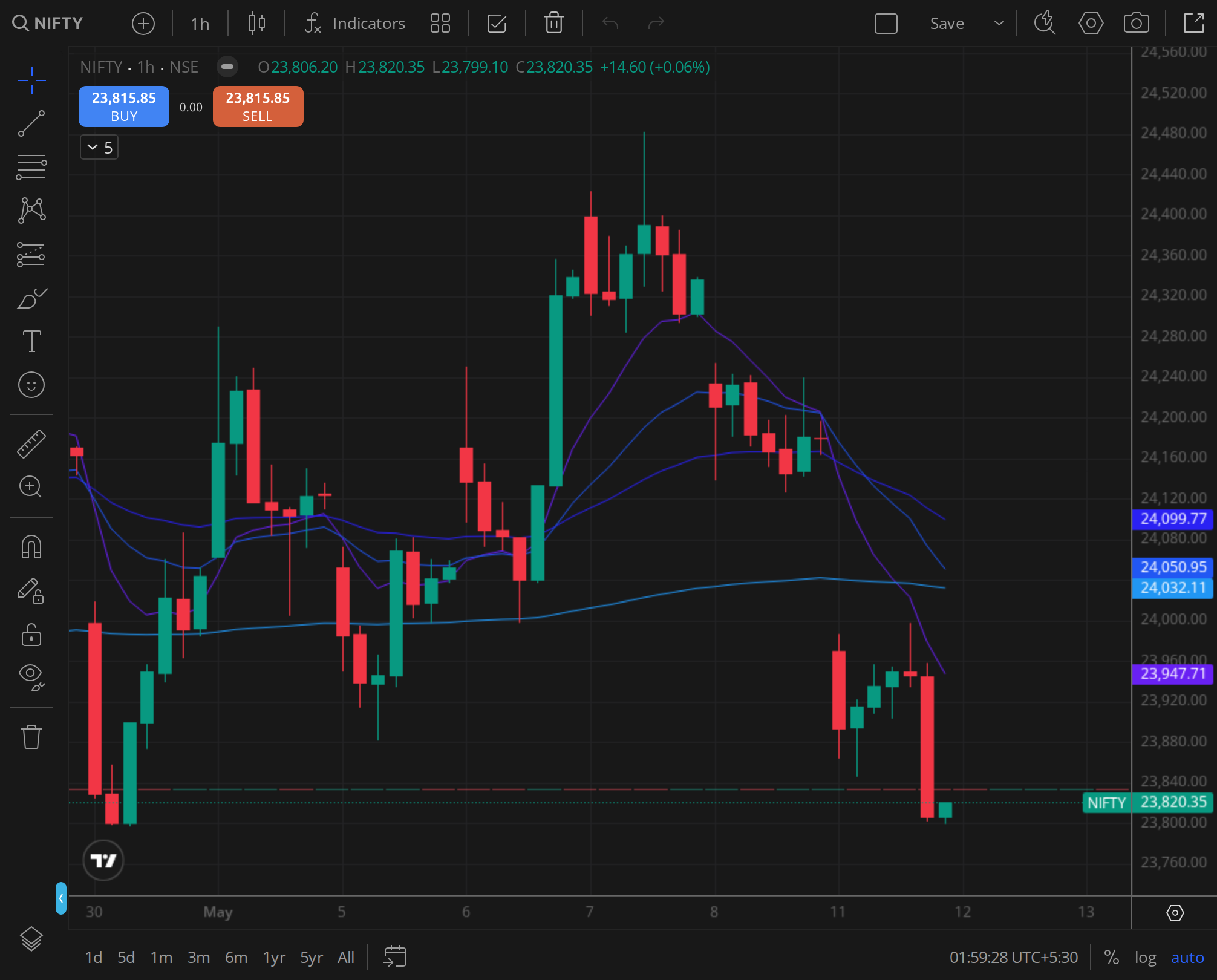
NIFTY daily chart with 20DMA plus 50DMA plus 200DMA plus Volume plus RSI markers around the focus date The daily chart illustrates the violation of multiple moving averages in a single session, with the RSI plunging from neutral to oversold territory, a momentum collapse that historically requires weeks of base building to repair.

The 30 minute intraday chart of March 31 is a study in the anatomy of a crash. The session opened with a series of small bodied candles clustered around the volume weighted average price, which initially printed at 22,840. The breakdown began with a high volume red candle at 11:45 AM that sliced through the VWAP, and from that point forward, the VWAP acted as a ceiling that the price could not recapture. Each attempted bounce, at 12:15 PM, at 1:10 PM, and at 2:30 PM, was rejected at the VWAP, which by then had declined to 22,520, then 22,380, and finally 22,250. The volume signature showed a clear pattern of distribution on the bounces and accumulation on the selloffs, a configuration that suggested institutional selling into whatever retail buying emerged. The final hour of trade saw a volume spike that exceeded the opening hour volume, a rare occurrence that underscored the panic that had gripped the market.

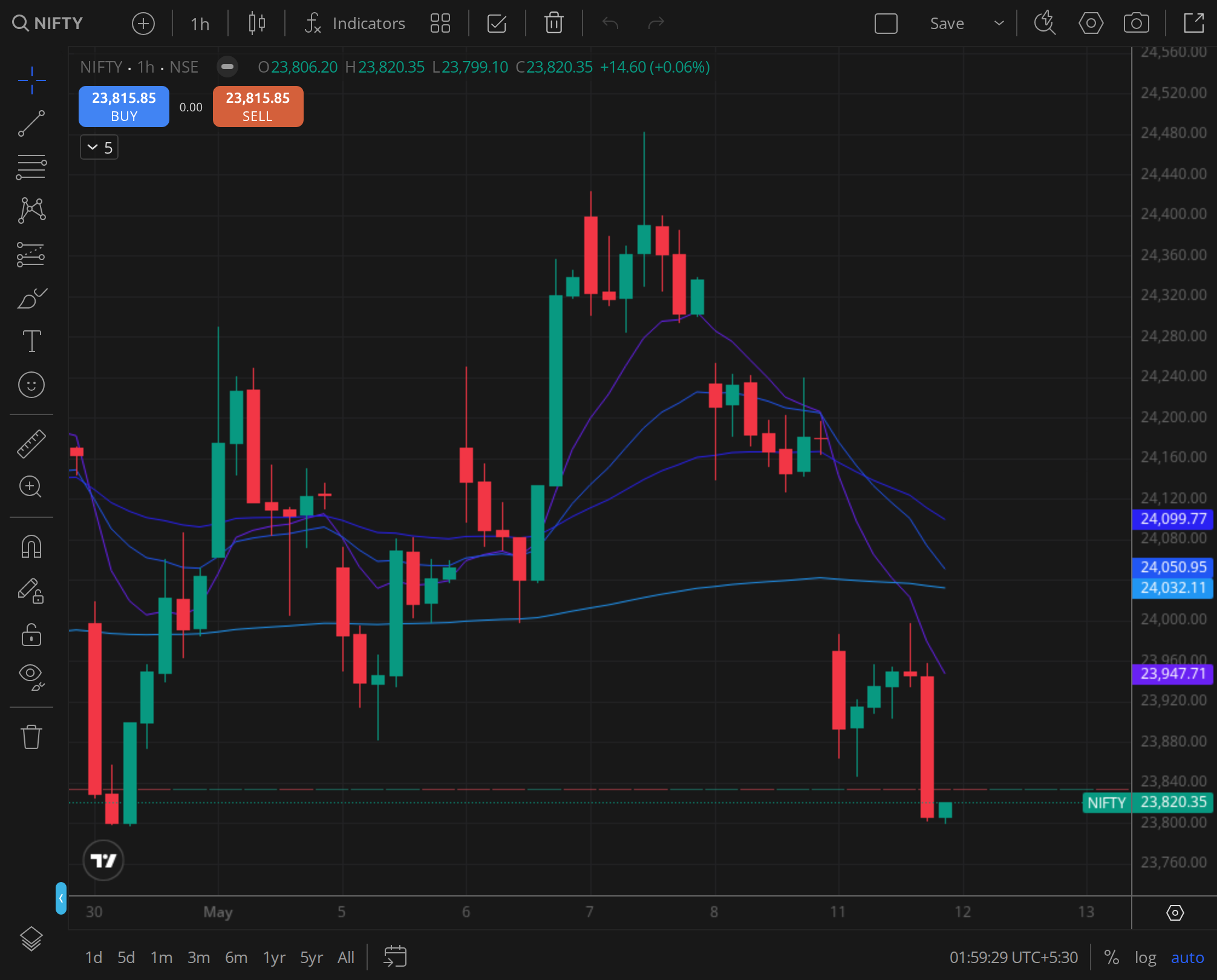
NIFTY 30-minute intraday with VWAP and volume signature on the focus date The 30-minute chart reveals the VWAP acting as a persistent ceiling throughout the selloff, with each attempted bounce rejected at lower levels and the final hour volume exceeding the opening hour, a classic signature of capitulation selling.

VERDICT

Stance: NEUTRAL for the immediate 5 day horizon, shifting to CAUTIOUSLY BULLISH over the 1 month and 3 month timeframes.

The reasoning for this bifurcated stance rests on the interplay between the technical damage inflicted on March 31 and the derivatives reset that the event accomplished. In the immediate aftermath of a VIX spike of this magnitude, the market enters a period of heightened fragility. The open interest that was forcibly extinguished on March 31 represented the fuel that had been powering the low volatility grind higher. With that fuel removed, the market lacks the structured positioning to mount an immediate V shaped recovery. The 5 day outlook is therefore neutral, with the expectation that the Nifty will trade in a wide, choppy range between 21,850, the level of the 200 DMA, and 22,400, the former support that has now become resistance. The elevated VIX, which closed the week at 18.20, will keep option premiums rich and will discourage the rapid rebuilding of the short gamma positions that characterised the pre expiry market. This is a market that needs time to heal, and the healing process typically involves a contraction of daily ranges and a gradual decline in the VIX back toward the 15 level.

Over the 1 month and 3 month horizons, the outlook improves considerably. The March 31 event, while painful for those caught on the wrong side, served as a pressure release valve for a market that had become dangerously complacent. The VIX spike reset implied volatility to levels that once again offer attractive premiums for option sellers, but the memory of the event will likely prevent the kind of excessive positioning concentration that made the March expiry so vulnerable. The FII positioning data, which showed institutional investors adding long futures exposure in the sessions following the expiry, suggests that the smart money views the selloff as a buying opportunity rather than the beginning of a structural bear market. The Nifty’s approach to the 200 DMA, a level that has not been breached on a closing basis since November 2025, will be a critical test. A successful defense of this moving average, particularly if accompanied by a decline in the VIX and a rebuilding of put open interest at lower strikes, would provide the foundation for a sustainable rally back toward the 23,000 level over the subsequent two months. The verdict, then, is patience in the short term and opportunistic accumulation on any test of the 200 DMA, with the understanding that the March 31 expiry, for all its ferocity, was a clearing event that has improved the risk reward profile of the Indian equity market for the quarter ahead.