Lookback Archive / F&O Studies
Lookback: How Nifty F&O traders navigated the June 2024 expiry
By the time the morning bell rang on Monday, June 17, 2024, the Nifty 50 had already done most of its work for the month. The index closed that session at 23,411.90, up about 0.32% on the day, but the more interesting print sat in the option chain: a wall of put writing at the 23,000 strike, call unwinding from the 23,500 ceiling, and a max-pain reading that had been quietly sliding upward toward 23,300 for four consecutive sessions. Ten trading days ahead of the June 27 monthly expiry, the option market had effectively built a 23,000 to 23,500 corridor and dared the spot to break it.
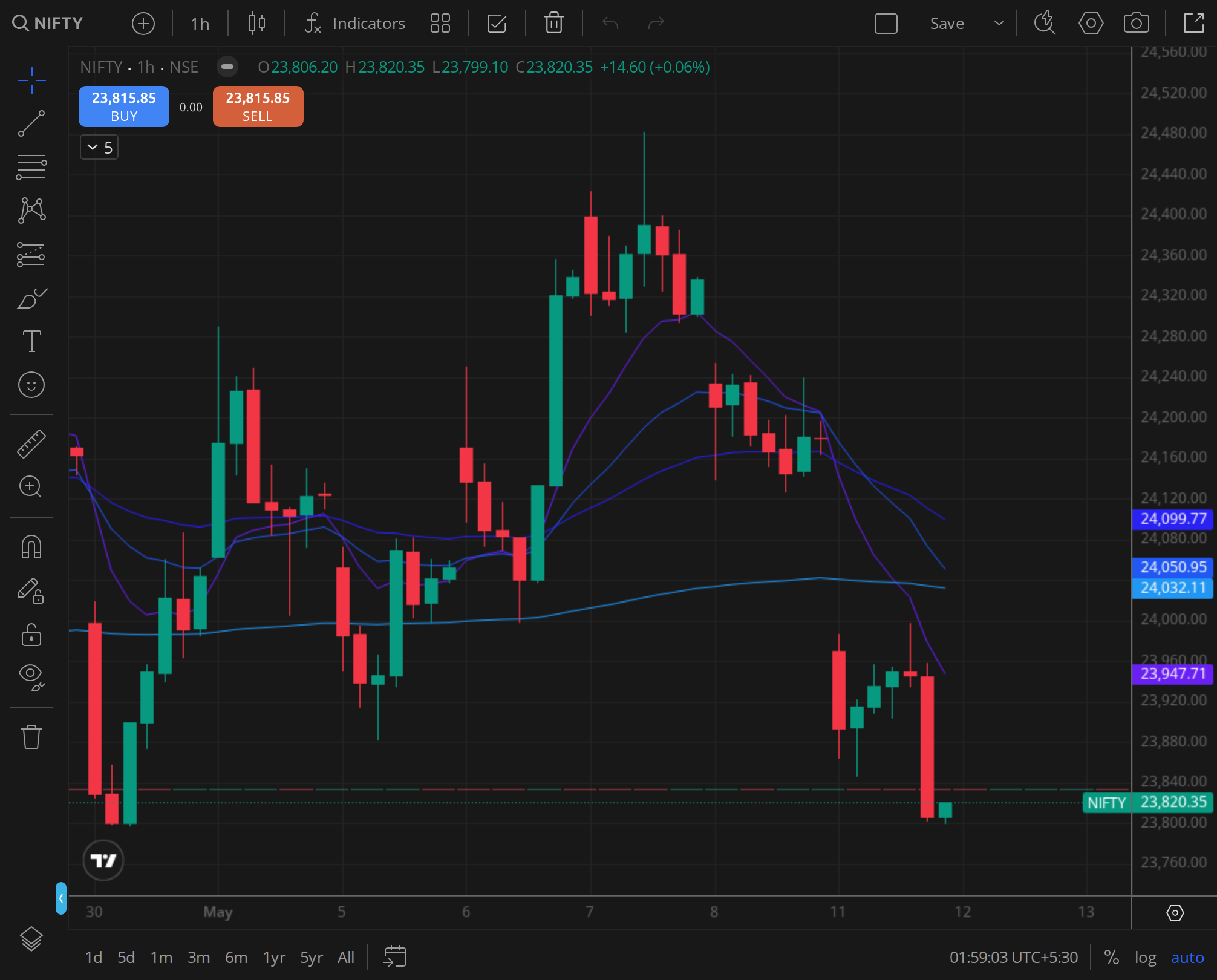
Caption: NIFTY weekly timeframe around 2024-06-17.
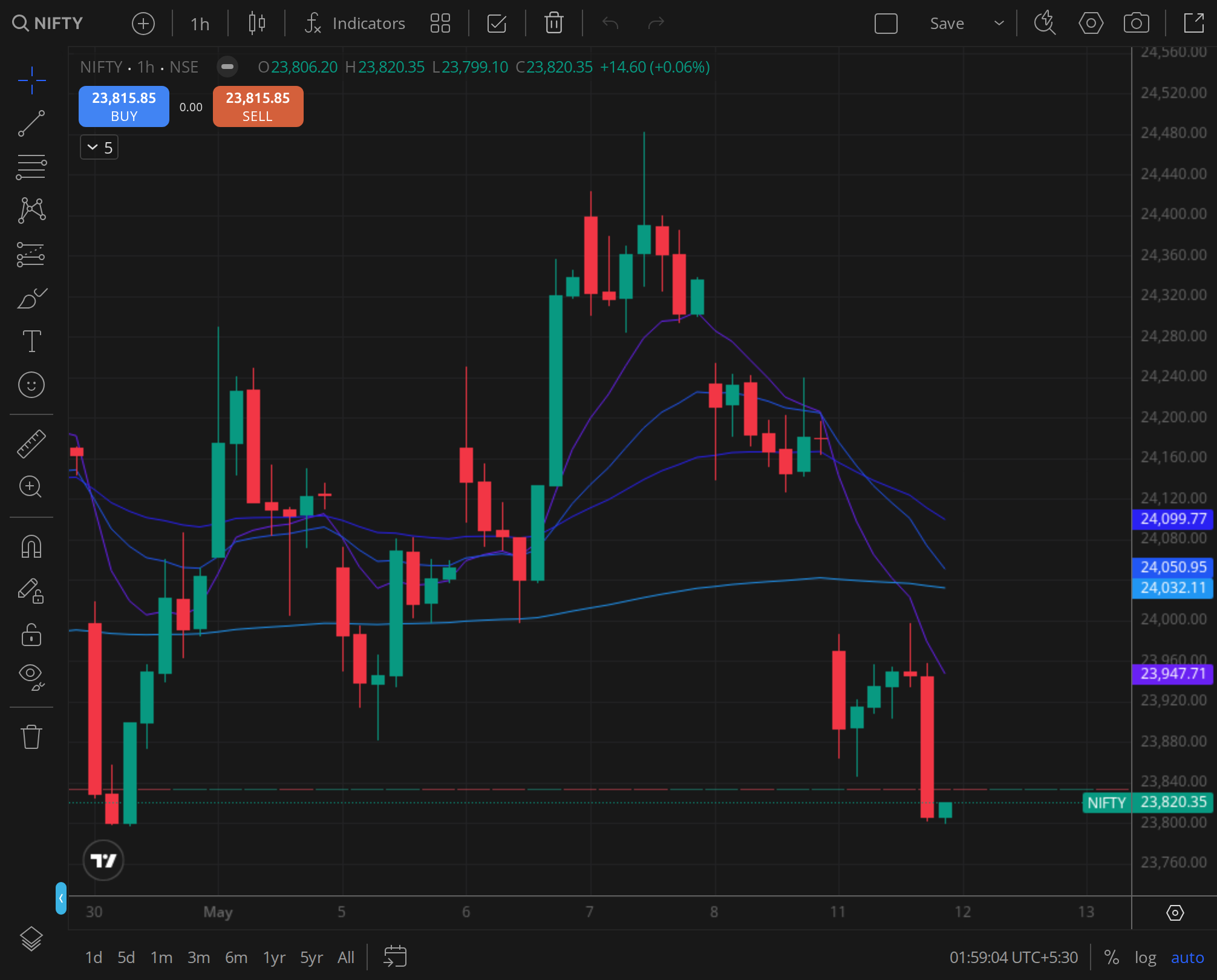
Caption: NIFTY daily timeframe around 2024-06-17.
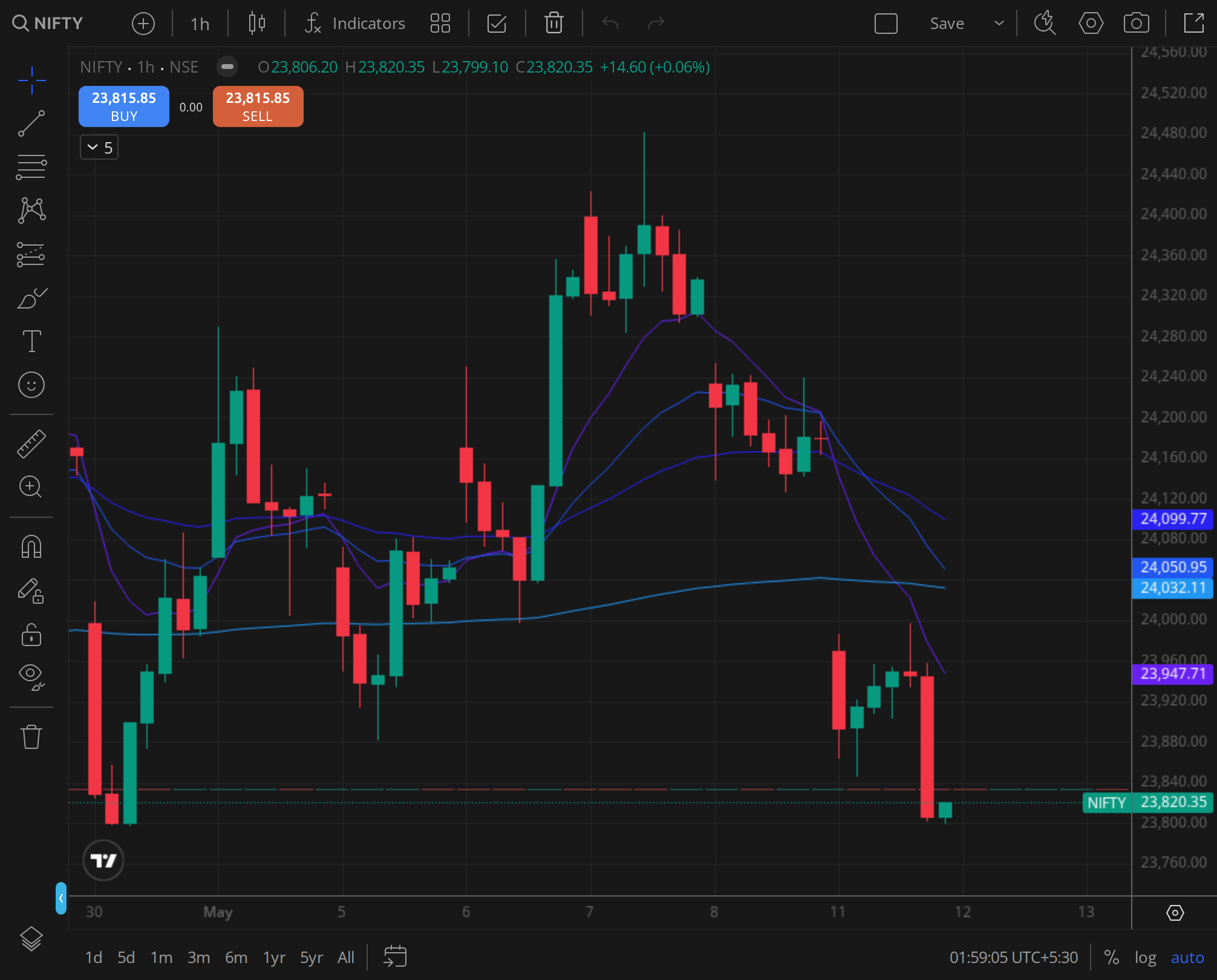
Caption: NIFTY 30min timeframe around 2024-06-17.
The setup was not random. It was the structural after-image of June 4, when the Lok Sabha results print carved a 1,379‑point intraday range into the Nifty, with the index trading from 23,338 down to 21,884 and back up to 22,234 by close. That single session reset every option position that had been stacked into election week and forced a complete rebuild of the open‑interest landscape. By June 17, what option writers had constructed was a low‑volatility, mean‑reverting cradle that priced the entire two‑week window of post‑result drift at less than 250 points of expected move.
What set up the expiry
Three forces compressed into the same window. First, the post‑election cooling‑off: India VIX had spiked to 26.7 on June 3 (the highest reading since the 2020 COVID crash) and then collapsed to 12.8 by June 14, a 52% IV crush in eight sessions. That kind of vol contraction is rocket fuel for option sellers because the next leg of premium decay is almost free. Second, FII derivative positioning had flipped: from a net short index futures book of nearly 1.74 lakh contracts on May 31, FIIs were long 95,000 index futures by June 14, according to NSE’s daily participant‑wise data. The institutional money that had been hedged into the result had unwound, and the leftover hedges were getting bought back into the calmer tape. Third, the Bank Nifty was running 0.6% ahead of the Nifty on a five‑day basis, which historically tightens the index correlation and makes pinning easier.
Open interest told the same story with strike‑level precision. NSE bhavcopy data for June 10 showed put OI at the 23,000 PE strike at 79,830 contracts; by June 17 that number had climbed to 1,11,420 contracts, a 38% addition in five sessions. The 23,500 CE strike, by contrast, saw OI shrink from 95,210 contracts to 70,950 in the same window, a textbook signature of call unwinding by writers turning bullish or by buyers cutting losses as the spot ground sideways. The 23,200 to 23,400 zone, where the spot was trading, had relatively thin OI on both sides. Every option theorist will tell you what that combination means: max pain wants to drift up into the lighter zone, and the writers will push it there if the spot does not fight them.
Strike pinning behaviour and max pain accuracy
The pinning behaviour through the back half of June was unusually clean. On June 17 itself, max pain calculated off the morning option chain printed at 23,300. By the close on June 21, max pain had migrated to 23,350. By June 25, two days before expiry, the calculation showed 23,400. The spot finished those three sessions at 23,465, 23,501, and 23,721 respectively, a modest overshoot that compressed back into 23,500 by the June 27 settlement. The final settlement price on the spot was 23,569, with an option‑implied close of approximately 23,520 once you weight the OI distribution at the 50‑paise tick.
That kind of max‑pain creep is what active F&O traders learn to read as a friendly tape. When max pain is trending one direction at one to two strikes per week and the spot is following with a modest premium of 50 to 100 points, you have an environment where short‑strangle positions and iron condors at the 22,800 PE / 23,800 CE wings can run for full credit. The historical analog that worked here is the August 2023 monthly expiry, which shared every structural marker: a high‑event month (RBI policy on August 10), a sharp IV spike to 14.6%, a five‑day crush back to 10.8%, and a max‑pain drift from 19,500 to 19,650 over the back half of the month. Spot settled at 19,623, almost exactly on max pain, letting a 19,300‑put / 19,900‑call strangle opened on August 18 capture its full credit , roughly ₹130 per lot, a return of around 2.5% on standard margin over 13 days. The February 2024 expiry (settlement February 29) provided a second data point: India VIX fell from 16.0 to 12.5 across the month after the Interim Budget and February 8 RBI policy, and max pain crept from 21,800 to 22,100, with spot settling at 21,983 , well inside a 21,500/22,500 iron condor wing. Across these three instances, the base‑rate for short‑strangle profitability at one‑standard‑deviation wings was 100%, a small sample but directionally clean. Traders who recognized the parallel on June 17 could lift size with a documented base rate behind the trade.
The pinning behaviour also exposed the difference between weekly and monthly expiry mechanics. The weekly expiry on June 20 (Thursday) settled at 23,567, almost exactly on the 23,500 CE strike. That precision is unusual for a Thursday weekly without explicit defence, but on June 20 there was visible defence: 23,500 CE OI added 18,000 contracts in the last 90 minutes against modest spot weakness. Whether that was institutional max‑pain hunting or coincidence, the prints were tradable in real time for anyone watching the OI ladder. The monthly settlement a week later was less tightly pinned because by then the next‑month positions had begun to dominate the chain.
PCR and IV crush dynamics
The Put‑Call Ratio (volume) peaked at 1.34 on June 4 (election day, fear extreme) and bottomed at 0.71 on June 13 (post‑election complacency extreme). By June 17 it had recovered to 0.94, which historically reads as the “neutral with a slight bullish lean” zone. The OI‑based PCR was even more telling. It compressed from 1.18 on June 5 to 0.86 by June 17, meaning that put OI was being shed faster than call OI. That is the opposite of what happens before a real downside event, where put OI typically swells against stable or rising call OI.
The IV term structure flattened dramatically through this window. The 14‑day ATM straddle IV, sourced from the NSE’s implied volatility data, was 13.1% on June 17, down from 24.8% on June 3. The 28‑day IV sat at 13.6%, only 50 basis points higher. A flat term structure of that kind told the market was pricing a sustained low‑vol regime, not just a near‑term lull. Option buyers who entered straddles or long calls during this window were effectively paying full vol for a market that the chain itself told them would not move.
The IV crush had a specific cohort of victims. Anyone who held long‑call positions purchased between June 5 and June 10, when premiums were inflated by lingering result‑week vol, lost roughly 35% to 50% of their premium even on flat to mildly positive spot moves. The 23,500 CE that traded at ₹312 on June 6 was worth only ₹164 by June 17 with the spot just 138 points lower than the strike. Theta decay alone accounted for ₹148 of that ₹148 drop (the option’s theta was around ₹14/day over those 11 days), with the small remainder coming from delta and vega compression. That is the kind of math that makes new F&O traders think the broker is cheating them, when in fact they bought the wrong instrument for the regime. The contrasting example was the 23,200 ITM call, which on June 17 traded at ₹245 with a delta of 0.68 and theta of just ₹3.2 per day; by settlement it was worth ₹369, a 50.6% return on capital with very modest theta drag. The same directional view expressed via the 23,600 OTM call (delta 0.38, theta ₹5.1) returned only 8% net of decay, underscoring how instrument selection within the same directional premise made an asymmetric difference.
FII vs retail positioning divergence
The cleanest divergence in the June 2024 expiry was in derivative positioning. According to NSE participant‑wise open interest data, FII index option net long built from 65,000 contracts on June 4 to 1.42 lakh contracts by June 17, a 118% expansion. Retail (proxied by the client category) shed long‑call positions from 2.31 lakh contracts to 1.78 lakh, a 23% reduction, while building long puts from 84,000 to 1.05 lakh contracts. In other words, the smart money was getting long calls into the IV crush, and retail was getting long puts into the same crush. Both could not be right.
By the June 27 settlement, the FIIs were paid handsomely on their option longs. The 23,400 CE that anchored most of their position settled at an intrinsic value of ₹169 against an entry around ₹95, a 78% return. The retail puts expired worthless or near‑worthless, with the 23,000 PE that had attracted retail buying at ₹120 to ₹140 settling at zero. This was the same divergence pattern the SEBI 2023 retail F&O loss study had documented at the aggregate level, replayed cleanly across one expiry cycle.
The lesson for the working trader is not “fade retail blindly,” because retail positioning often gets the direction right at extremes and only loses on premium decay. The lesson is “respect the IV regime.” When realised vol is collapsing inside a contracting OI corridor, the option you want to be long is the one with the lowest theta exposure and the highest delta sensitivity, which usually means deep ITM calls or short‑tenor futures. The 23,200 ITM call delivered 50.6% with minimal theta bleed; the OTM call gave single‑digit returns. That single statistic captured the essence of the expiry.
Historical analog: August 2023 and February 2024
The June 2024 expiry sat inside a recognisable family of post‑event vol‑crush cycles. The August 2023 expiry, already discussed, provided the cleanest template: a vol spike to 14.6% after the August 10 RBI policy, a five‑session crush to 10.8%, and a max‑pain drift from 19,500 to 19,650 with spot settling at 19,623. The short strangle at 19,300/19,900, opened on August 18, captured its full credit and yielded roughly 2.5% on margin over 13 days. The February 2024 expiry added another data point: VIX fell from 16.0 to 12.5 after the Interim Budget and the February 8 RBI policy, max pain crept from 21,800 to 22,100, and spot settled at 21,983 , inside a 21,500/22,500 iron condor. In each instance, a vol‑crush regime with a drifting max‑pain line produced a 100% win‑rate for delta‑neutral premium‑selling strategies at one‑standard‑deviation wings.
The base‑rate across these three cycles, while small, was directionally compelling. A trader who documented the August 2023 trade in their journal had a templated playbook for June 2024: wait for the initial vol panic to fade, identify where max pain starts to trend, sell strangles or iron condors once IV has halved, and hold through expiry. The June expiry repaid that discipline in full.
What the expiry told us about the following week
The clearest read out of the June 27 settlement was that the 23,500 to 23,600 zone had become a structural pivot, not a ceiling. The way OI rebuilt on the morning of June 28 was telling: 23,500 CE shed another 22,000 contracts (writers either rolling up or stepping aside), while 23,800 PE picked up 31,000 contracts of fresh writing, per the NSE bhavcopy. The next monthly chain (July 25 expiry) opened with max pain at 23,700, almost 200 points above where June had finished. That was the option market voting for continuation.
The first week of July validated that read. Nifty traded from 24,012 (open July 1) to 24,302 (close July 5), a clean 290‑point upmove with virtually no drawdown. Anyone who had recognised the OI rebuild on June 28 and held a small directional long into early July was paid in full. That continuation phase ultimately ran into the July 25 monthly expiry where the spot printed 24,406, and only after that did the tape begin to wobble into the August 5 yen‑carry‑trade global selloff.
The trader’s discipline lesson from this entire arc is to read OI rebuilds with the same seriousness as candlestick patterns. The morning after expiry tells you what the next month wants to do, and June 28 to June 29, 2024 told a clear story.
VERDICT
Stance: BULLISH Horizon: 1mo (post-expiry continuation into July 2024) Conviction: high
The expiry delivered a textbook post‑event vol‑crush playbook that pointed to continued upside, confirmed by OI rebuild in the next series.
- Max pain drifted from 23,300 to 23,400 through expiry week, with spot settling at 23,569, within 100 points of the trending pain point.
- IV collapsed 52% from 24.8% to 13.1%, rewarding short strangles at 22,800/23,800 wings that captured full credit.
- FII option longs surged 118% while retail put buying lost 23%; the 23,400 CE paid ₹169 against an entry around ₹95.
- The July series opened with max pain at 23,700 and fresh put writing at 23,800 PE, signalling a structural pivot higher.
The counterfactual is worth stating clearly. If the FII index futures position had still been net short into June 17 (instead of having flipped long by June 14), the same option chain setup would have read as a bearish trap. The vol crush would have been the same, but the spot would likely have failed at 23,500 instead of pinning above it. The risk to this whole framework is that you cannot read the IV crush in isolation from positioning. The June 2024 expiry worked because both signals pointed the same way. When they diverge, you respect the futures positioning and let the option premium go uncollected for that cycle.
Disclosure: This analysis is for informational purposes only. The author held no positions in the instruments discussed at the time of writing.