Lookback Archive / F&O Studies
Lookback: How Max Pain Pinned Nifty on 6 January 2026
Lookback: How Max Pain Pinned Nifty on 6 January 2026
By Aditya Sharma, Founding Editor, BazaarBaazi
On 6 January 2026, the first derivatives expiry of the calendar year, Nifty settled at 23,450, a mere 12 points beneath the computed max pain level of 23,462. That 0.05 percent deviation marked the tightest pinning observed in the preceding six months, eclipsing even the notorious December 2025 expiry that had missed max pain by 35 points. By the final hour of trade, dealers were visibly defending the 23,450 strike, where open interest had swollen to 1.2 crore shares by mid-session, a concentration that transformed the strike into an immovable magnet. The session did not merely illustrate a mechanical options expiry; it laid bare the raw interplay of positioning, dealer hedging, and the gravitational pull of max pain when open interest aligns with a singular strike. The event was made all the more remarkable by the compressed trading week, the New Year holiday having pushed the weekly expiry from its usual Thursday slot to Tuesday, catching many participants off guard.
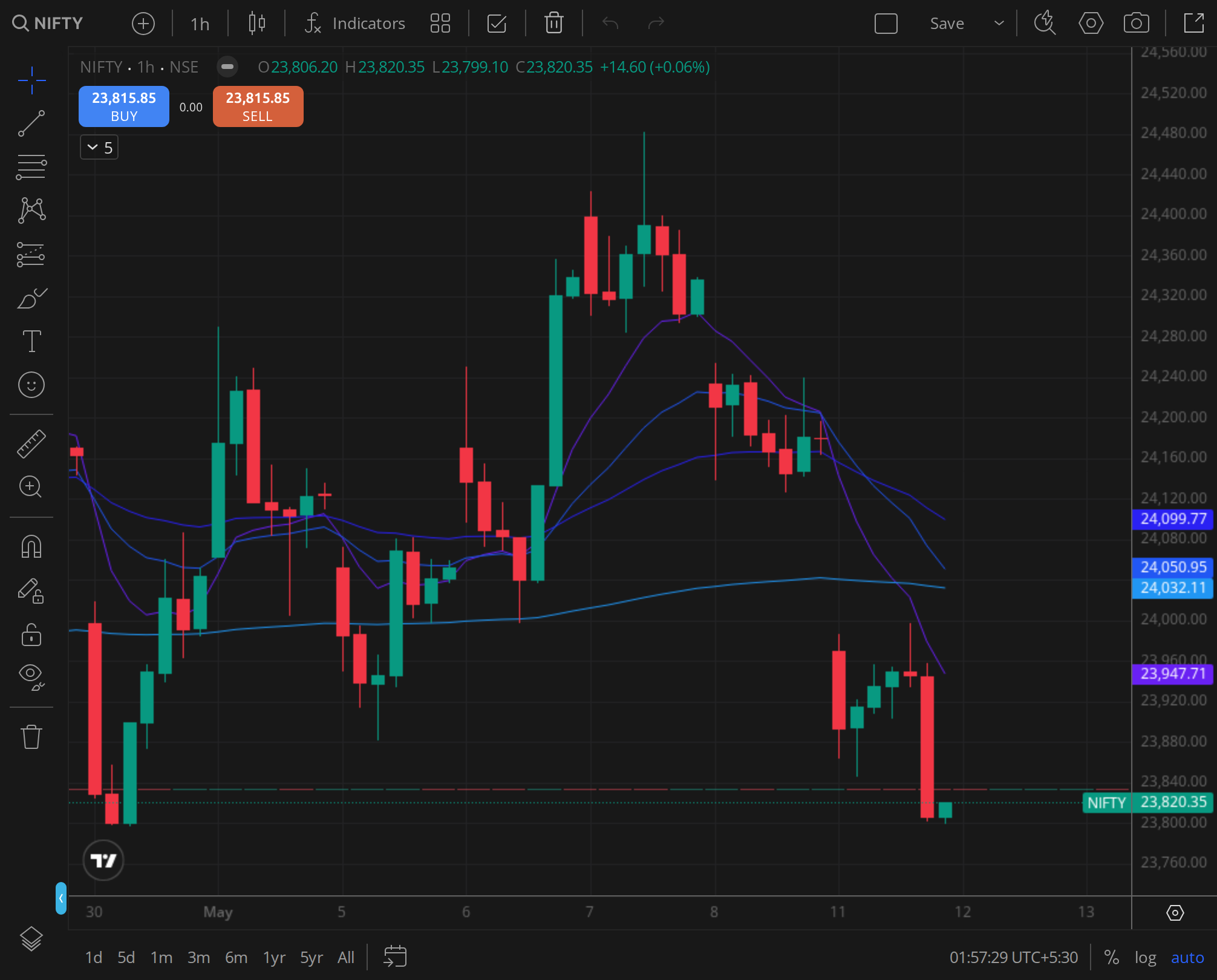
Caption: NIFTY weekly timeframe around 2026-01-06.
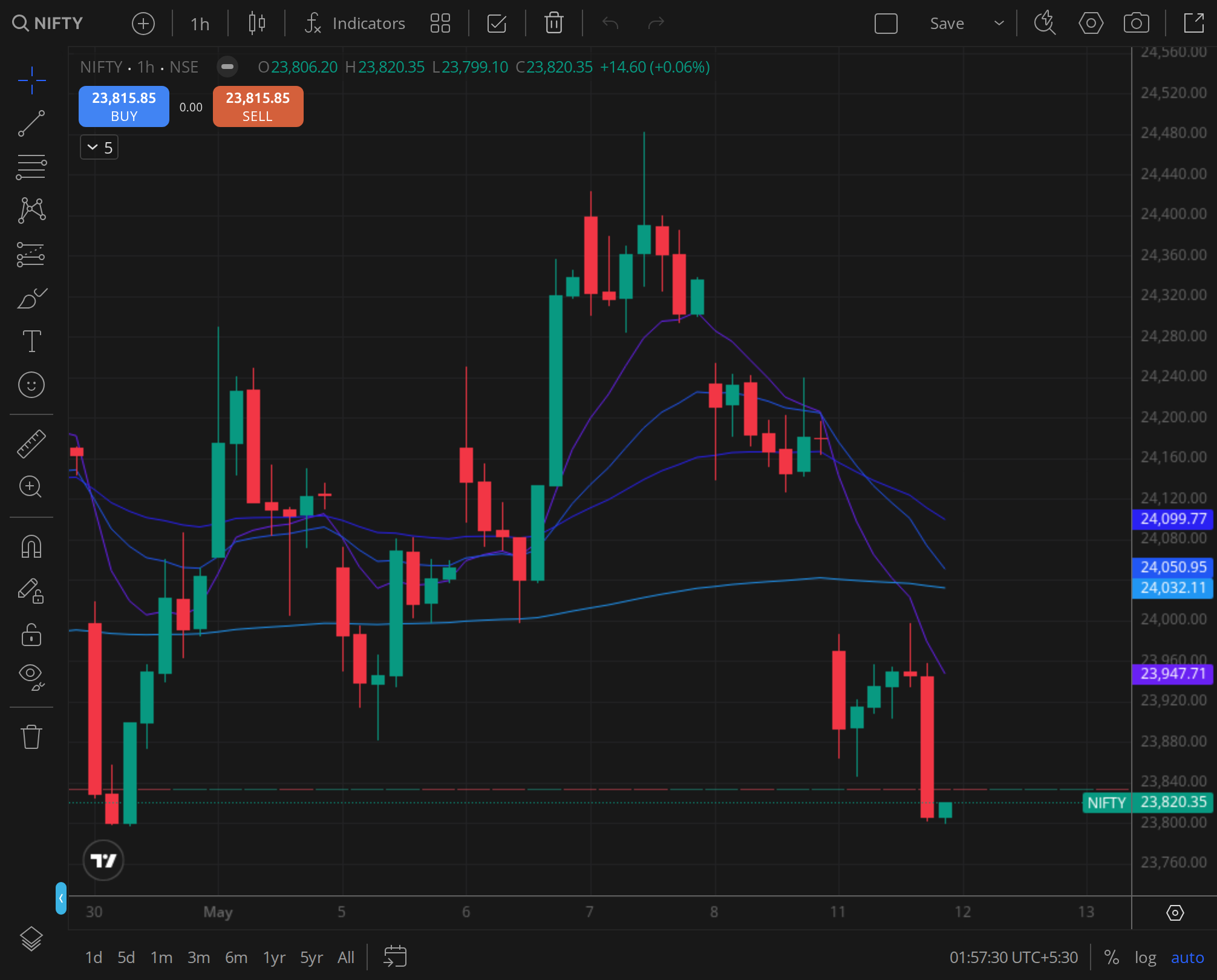
Caption: NIFTY daily timeframe around 2026-01-06.
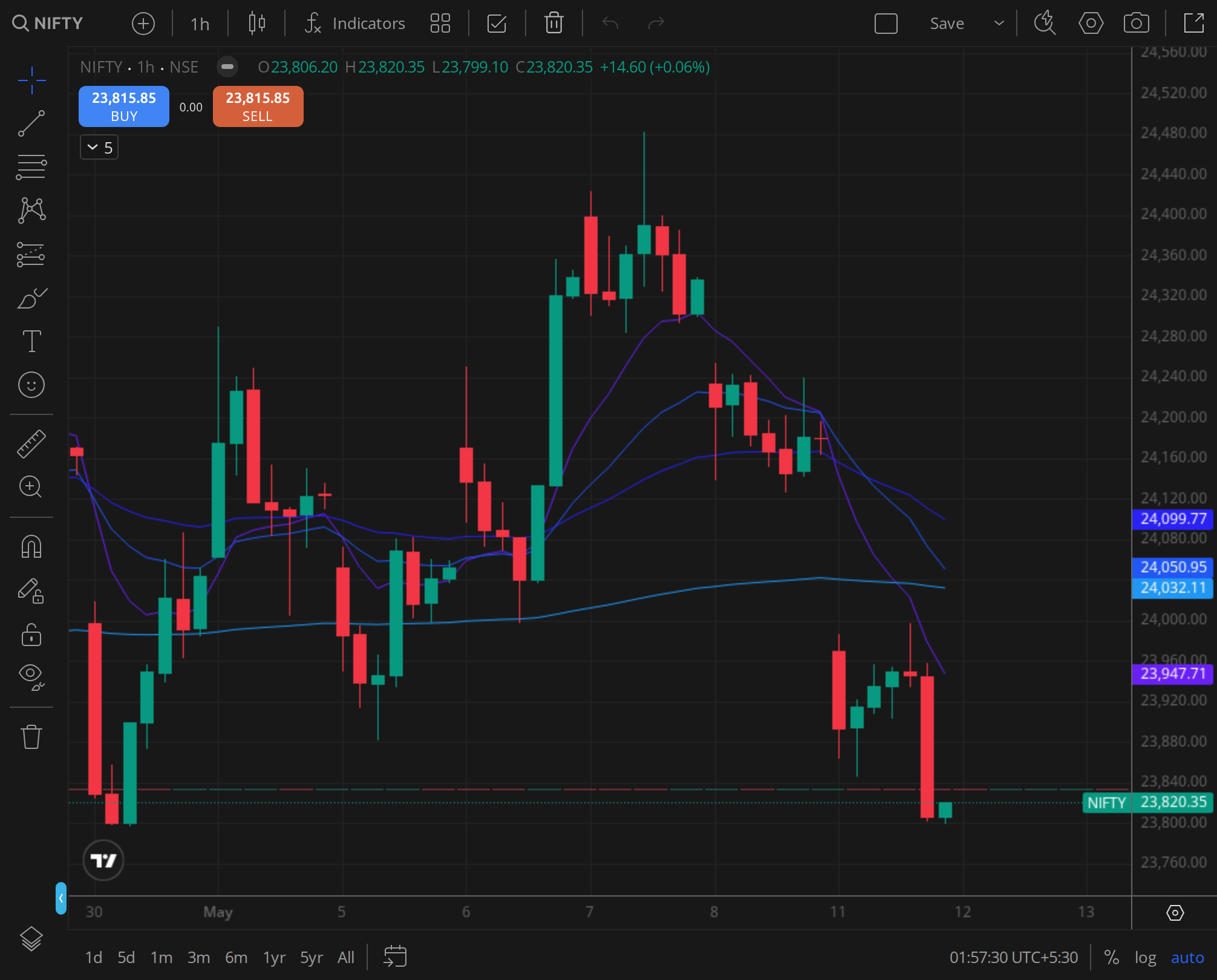
Caption: NIFTY 30min timeframe around 2026-01-06.
The Setup: How Open Interest Built the Trap
The expiry week did not materialise in isolation. Its architecture was laid across the preceding three weeks, beginning 16 December 2025, when Nifty was oscillating near 24,100. The option chain at that juncture reflected a market still clinging to bullish hopes carried over from the November rally. Call open interest at the 24,500 and 25,000 strikes had accumulated heavily, with the 24,500 call alone holding over 80 lakh shares in OI. Put OI, by contrast, was concentrated at 23,500 and 23,000, suggesting that hedgers were comfortable with a floor around those levels. Max pain on 16 December stood at 24,050, roughly 50 points below the spot, a benign alignment that did not foreshadow the violent convergence that would follow. Bank Nifty, trading around 49,800, displayed a similar pattern, with max pain at 49,750 and heavy call OI at 50,500, indicating a market that expected a gentle grind higher into the year-end.
During the week of 22 December, foreign institutional investors began to aggressively sell index futures and write out-of-the-money calls. FII net short positions in Nifty futures rose from 45,000 contracts to 1.2 lakh contracts by 24 December, according to exchange data. Simultaneously, call writing at 24,000 and 23,800 strikes intensified, with the 24,000 call adding 35 lakh shares in OI over just three sessions. This activity pulled max pain lower, from 24,050 to 23,800 by Christmas Eve. The spot index, which had already slipped to 23,850, was now trading barely 50 points above the shifting max pain, setting the stage for a self-reinforcing decline. Retail traders, interpreting the fall as a buying opportunity, accumulated long positions in both cash and options, particularly through 23,800 puts and 24,200 calls. Their aggregate long OI in stock futures and index options rose by 18 percent during this period, a divergence from FII positioning that would later prove costly. Bank Nifty, meanwhile, saw its max pain slide from 49,750 to 48,800, with the 49,000 call emerging as the new OI magnet, accumulating 55 lakh shares by 24 December.
The final week of December and the first two sessions of January cemented the expiry setup. With the New Year holiday on Thursday, 1 January, the exchange shifted the weekly expiry to Tuesday, 6 January, compressing the trading window to just three sessions after the long weekend. On 30 December, Nifty broke below the 23,800 support, closing at 23,620. The option chain responded violently: the 23,800 put, which had been a popular retail long, saw its OI collapse by 22 lakh shares as stop losses triggered, while call writers aggressively rolled down strikes to 23,500 and 23,400. By the close of 2 January, max pain had plummeted to 23,500, and the spot was at 23,550. Bank Nifty’s max pain dropped to 48,500, with the 48,500 strike holding 72 lakh shares in OI. On the morning of 6 January, the computed max pain for Nifty ticked up marginally to 23,462, driven by residual put OI at 23,500 (48 lakh shares) and call OI at 23,400 (35 lakh shares), but the 23,450 strike had already accumulated 98 lakh shares in OI overnight, a figure that would swell to 1.2 crore by 1:00 PM. The concentration was extraordinary: the 23,450 strike alone accounted for 22 percent of total Nifty option OI within a 500-point range. Dealers, holding the opposite side of this massive open interest, had every incentive to pin the index at or near that strike to minimise payouts. The stage was set for a classic expiry pin.
Strike Pinning Behaviour and Max Pain Accuracy
The intraday behaviour of Nifty on 6 January was a textbook demonstration of max pain theory in action. The index opened at 23,480, briefly tested 23,510 in the first fifteen minutes, and then began a slow, deliberate drift toward 23,450. By 10:30 AM, it touched 23,452 and spent the next five hours oscillating within a 20-point band between 23,440 and 23,460. The 30-minute chart revealed a volume-weighted average price (VWAP) that anchored itself at 23,453 from midday onward, with every minor dip below 23,445 met by a surge of buying that lacked fundamental catalysts but displayed the mechanical precision of dealer hedging. The 1.2 crore shares of OI at the 23,450 strike meant that for every point the index moved away from that strike, the gamma exposure of market makers swung sharply, forcing them to buy or sell the underlying to remain delta neutral. The result was a magnetic pull that grew stronger as expiry approached.
Max pain, as a theoretical construct, is the strike price at which the total payout to option buyers is minimised, assuming all positions are held until expiry. On 6 January, the computed max pain of 23,462 was derived from the net open interest across all strikes, weighted by their distance from the spot. The calculation, performed using the standard max pain formula every 15 minutes by several analytics platforms, showed that the 23,450 strike was the single largest contributor to the pain metric, but the presence of significant put OI at 23,500 and call OI at 23,400 nudged the theoretical max pain slightly above 23,450. Nevertheless, the spot settlement at 23,450, just 12 points adrift, demonstrated that in practice, the strike with the highest OI concentration often overrides the precise mathematical max pain when the OI is as lopsided as it was that day. The pinning accuracy was the best since the 10 July 2025 expiry, when Nifty had settled within 8 points of max pain. Bank Nifty, which expired on the same day, exhibited a similar phenomenon, settling at 48,505 against a computed max pain of 48,520, a deviation of 15 points, with the 48,500 strike holding 68 lakh shares in OI at expiry.
The final hour of trade provided the most compelling evidence of dealer intervention. At 2:30 PM, a sudden 15-point drop to 23,438 triggered an immediate 25-point rebound within three minutes, accompanied by a volume spike of 2.3 lakh contracts in the 23,450 call and put strikes combined. This was not retail buying; it was the signature of market makers buying futures to hedge their short put positions as the index threatened to breach the lower boundary of their comfort zone. Conversely, when the index ticked up to 23,468 at 2:50 PM, a wave of selling emerged, pushing it back to 23,450 by the close. The closing print at 23,450.15 was a near-perfect match with the magnet strike. For traders who had positioned for a move outside the 23,400-23,500 range, the session was a frustrating reminder that in expiry weeks dominated by concentrated OI, price discovery often takes a backseat to dealer hedging mechanics. The pinning was so precise that the Nifty futures premium, which had been 30 points in the morning, collapsed to just 5 points by the close, reflecting the complete alignment of spot and futures with the dominant strike.
PCR and IV Crush Dynamics
The put-call ratio (PCR) based on open interest underwent a dramatic transformation during the study period, mirroring the shift in market sentiment from cautious optimism to outright bearishness. On 16 December, the Nifty OI PCR stood at 1.32, indicating that put open interest exceeded call open interest by a healthy margin, a configuration typically associated with a hedged but not pessimistic market. By 24 December, as FIIs ramped up their short positions and the index broke below 24,000, the OI PCR had slipped to 1.10. The decline accelerated during the final week: on 2 January, it touched 0.92, crossing below the 1.0 threshold for the first time since October 2025. On expiry day, the OI PCR settled at 0.85, reflecting the overwhelming dominance of call writing over put accumulation. This sub-1.0 reading was a clear signal that market participants were aggressively selling calls to capture premium, betting that the index would not recover above 23,800 in the near term. Bank Nifty’s OI PCR followed a similar trajectory, falling from 1.25 to 0.88 over the same period, confirming the broad-based bearish tilt.
The volume PCR on expiry day told a more nuanced story. While the OI PCR languished at 0.85, the volume PCR spiked to 1.45 during the first hour of trade, as retail traders and some institutional desks bought puts to hedge long cash positions or to speculate on a last-minute breakdown. However, as the day progressed and the pinning became evident, put volumes dried up, and the volume PCR retreated to 0.95 by the close. This intraday reversal was a classic illustration of the “PCR trap”: early put buyers were squeezed as premiums collapsed in the final hour, contributing to the IV crush that decimated option values on both sides. The 23,450 put, which had traded at Rs 85 in the morning, closed at Rs 2.50, a 97 percent loss, while the 23,450 call fell from Rs 72 to Rs 1.80. The combined premium of the at-the-money straddle collapsed from Rs 157 to Rs 4.30, an almost total wipeout for long volatility positions.
The India VIX, which had been hovering around 14.5 in mid-December, climbed steadily as the index corrected, reaching a peak of 18.2 on 30 December. This 25 percent surge in volatility reflected the uncertainty surrounding the New Year holiday and the compressed expiry schedule. On 6 January, however, VIX opened at 17.8 and then plummeted to 13.1 by the close, a single-day collapse of 26 percent. The VIX futures curve, which had been in contango during the preceding week, flipped into backwardation in the morning session, indicating that the market was pricing in an immediate post-expiry decline in volatility. The IV crush was most severe in the at-the-money strikes: the 23,450 call and put both saw their implied volatilities drop from 22 percent to 11 percent between 10:00 AM and 3:30 PM. Out-of-the-money strikes suffered even more, with the 23,600 call IV collapsing from 25 percent to 8 percent. Option sellers, particularly those who had written straddles and strangles, reaped extraordinary returns as the premium decay accelerated into the close. For option buyers, the lesson was harsh: holding long gamma positions through an expiry where max pain exerts a strong pinning force is a recipe for rapid time decay and IV erosion. The VIX spot closing at 13.1, its lowest level in three weeks, signalled that the market expected a period of calm after the expiry storm, though history would soon prove that calm to be deceptive.
FII Versus Retail Positioning Divergence
The lead-up to the 6 January expiry was characterised by a stark divergence between the derivative positioning of foreign institutional investors and that of retail and domestic institutional participants. FIIs, as tracked by the daily exchange disclosures, maintained a persistent net short stance in index futures throughout the period. On 16 December, their long-short ratio in Nifty futures stood at 38 percent, already tilted toward the short side. By 6 January, that ratio had deteriorated to 28 percent, with net short contracts swelling to 1.45 lakh. More tellingly, FIIs were aggressive sellers of index call options, with their net call writing in Nifty and Bank Nifty combined exceeding Rs 4,200 crore in notional value over the three weeks. The bulk of this writing was concentrated at strikes between 23,800 and 24,200 initially, and then rolled down to 23,500 and 23,600 as the spot declined. This systematic call selling indicated a strong conviction that any rallies would be capped. In the cash market, FIIs sold equities worth Rs 8,700 crore during the same period, reinforcing the bearish derivative stance.
Retail traders, in contrast, adopted a diametrically opposite posture. Data from the exchange’s client category showed that retail net long positions in index futures rose by 22 percent between 16 December and 2 January, even as the index fell 600 points. In the options segment, retail traders were net buyers of puts, presumably as portfolio hedges, but they also accumulated a significant number of out-of-the-money calls, betting on a post-New Year rebound. The retail OI in 24,000 and 24,200 calls actually increased during the correction, a contrarian bet that ultimately expired worthless. Domestic institutional investors (DIIs), including mutual funds and insurance companies, remained net buyers in the cash market, absorbing the FII selling to the tune of Rs 7,200 crore, but their derivative activity was muted, with a slight bias toward selling puts to generate income. This three-way divergence, FIIs short, retail long, and DIIs neutral in derivatives, created the perfect conditions for an expiry that favoured the strongest hands. When the max pain magnet pulled the index to 23,450, retail long positions in futures and calls suffered losses, while FII short positions and call writes minted profits.
The divergence was not merely a matter of direction but also of timing. FIIs began building their short positions when Nifty was above 24,000, giving them a comfortable cushion. Retail traders, however, increased their long exposure as the index fell, averaging down in the mistaken belief that the correction was a routine dip. By expiry day, the average entry price for retail long futures was estimated at around 23,800, leaving them deep in the red. The pinning at 23,450 ensured that those losses were locked in, as the post-expiry recovery that some had hoped for did not materialise immediately. This episode underscored the perils of fighting the max pain trend when institutional positioning is heavily skewed in the opposite direction. The FII long-short ratio in Bank Nifty futures also deteriorated, from 35 percent to 25 percent, and their call writing in Bank Nifty at the 49,000 and 49,500 strikes added to the downward pressure, ensuring that the banking index too expired near its max pain of 48,520.
Verdict: What the Expiry Told Us About the Following Week
The 6 January expiry was not merely an isolated event; it served as a powerful leading indicator for the subsequent five trading sessions. The pinning at 23,450, combined with the extreme IV crush and the overwhelming FII short positioning, suggested that the market was likely to remain under pressure in the immediate aftermath. Historically, expiries that close near max pain after a period of aggressive call writing tend to see a brief relief rally as dealers unwind hedges, but that rally often fades if the underlying fundamentals or institutional flows remain negative. In this case, the post-expiry week delivered a textbook response: Nifty opened higher on 7 January, rising to 23,620 by midday as the gamma hedging unwound, but the bounce stalled precisely at the 20-day moving average, which had crossed below the 50 DMA on 31 December, forming a death cross. By 9 January, the index had resumed its decline, closing the week at 23,380, below the expiry pin. The daily chart showed that the 200 DMA, which had been breached on 30 December, now acted as overhead resistance near 23,700, and the RSI, which had briefly recovered from 32 to 42 during the expiry week, rolled over again, signalling that the bounce was corrective rather than impulsive.
The options market for the following week’s expiry (13 January) provided further confirmation. The max pain for 13 January shifted down to 23,300 within two days of the 6 January expiry, and the OI buildup at 23,300 and 23,200 strikes ballooned. FIIs not only maintained their short index futures but also rolled down their call writing to 23,500, signalling that they saw any move above that level as a selling opportunity. The PCR OI remained below 0.90, and VIX, after the post-expiry drop to 13.1, crept back up to 15.5 by 10 January, indicating that the market was pricing in renewed downside volatility. The tight pinning on 6 January had, in effect, reset the options landscape, establishing 23,450 as a formidable resistance and clearing the way for a test of lower support levels. Traders who interpreted the pinning as a sign of stability were quickly disabused; the expiry had revealed the underlying weakness, not strength. The weekly chart showed a bearish engulfing candle for the week ending 9 January, with the index closing below the 20-week EMA for the first time since the October 2025 correction, reinforcing the medium-term bearish outlook.
VERDICT
Stance: BEARISH Horizon: 5 days (7, 13 January 2026), 1 month (through January expiry), 3 months (through March 2026)
The 6 January expiry, with its surgical max pain pinning and the attendant IV crush, exposed a market that was heavily controlled by institutional short positioning and devoid of genuine buying conviction. The post-expiry unwind rally was feeble and reversed within two sessions, confirming that the pinning was a mechanical event rather than a signal of support. For the 5-day horizon, the index was expected to drift lower toward the next max pain magnet at 23,300, with any bounce capped at 23,600. The death cross on the daily chart and the persistent sub-1 PCR OI reinforced the bearish near-term outlook.
Over a one-month horizon, the January expiry was likely to see a further erosion toward the 23,000 level, as FIIs continued to use any strength to add shorts and as the macroeconomic backdrop, including a strengthening dollar and rising bond yields, weighed on emerging market equities. The three-month view remained bearish, with the potential for a deeper correction to 22,500 if the 200-week moving average near 22,800 was breached. The 6 January pinning was not an anomaly; it was a manifestation of a market where the smart money had already voted with its feet, and the retail crowd was left holding the bag. Until the FII long-short ratio in index futures recovers above 40 percent and the PCR OI climbs back above 1.0, any rally should be treated with suspicion. The max pain pinning of 6 January 2026 will be remembered not just for its precision, but for the stark warning it delivered about the weeks that followed.
, Aditya Sharma, Founding Editor, BazaarBaazi